Can PPF Be Removed Without Damaging Paint?
Paint Protection Film can be removed without damaging your car's paint. But this success can be achieved if three conditions are met: Healthy OEM paint, quality film, and correct removal technique. To remove PPF coating, you need controlled heat so that it can soften the adhesive. Now comes peeling the film slowly at a low angle (15 to 45 degrees) and cleaning the residue after the glue is removed.Why Removal is Safe on Good Paint
● Original factory paint is capable of handling paint protection film removal. But if your car has repainted panels and they're not cured, it can peel off with the film. ● The adhesive is not chemically fused to the paint but it bonds with a pressure‑sensitive acrylic adhesive. Therefore, the PPF removal service becomes easier. ● Premium car paint protection film release their adhesive cleanly when heat is applied.When PPF Removal Does Damage Paint
Damage almost traces back to these factors:1. Repainted or compromised panels
● Aftermarket/resprayed paint has weaker adhesion. They need more curing than OEM clear coats ● If the surface prep isn’t good, PPF removal can lift even the base coat2. Low‑grade or aged film
● TPH or PVC films can yellow, crack, and over‑crosslink their adhesive ● Once the adhesive cures, the film becomes hard. It starts tearing when you remove PPF instead of peeling ● If a film has passed its warranty period, it can also cause damage on PPF removalQuick Q&A: Does PPF damage paint when removed?
Our PPF expert, Arvind, explains that paint protection film itself normally doesn't damage paint. Especially when the factory paint is properly cured. The bigger concern is existing paint defects, repainted parts, poor adhesion or incorrect removal technique.Professional PPF Removal: Step-by-Step Guide
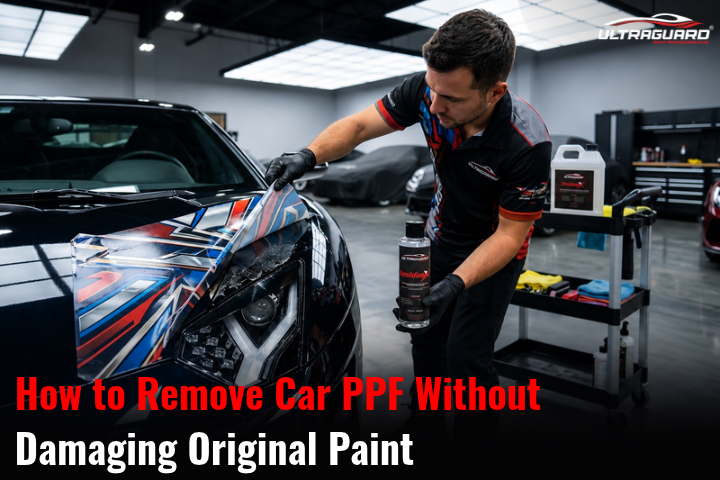
A safe paint protection film removal workflow looks like this: Inspect Paint and Film ● Experts confirm OEM vs repainted panels ● They check for clear‑coat failure, cracks, or heavy UV damage Surface Preparation A clean surface shows what to work on. PPF removal technicians follow these: ● Wash the vehicle thoroughly ● Film is tucked or wrapped, so identify edge seams ● Panels should be cool so they work indoors Heat the Film ● Steam is applied to a starting corner for 30-60 seconds ● Tool distance: 15-20 cm (if using a heat gun) ● Keep panels warm to the touch but never hot enough to burn. ● Heat in small sections Edge Lifting ● Experts get under the PPF with their nails or a scraper ● Avoid metal blades, as they can harm the OEM paint Peeling at Low Angle ● Once experts get the edge, they pull back at 15-45° ● The safest guidance is a shallow, controlled angle ● The applied tension is continuous and gentle ● Never pull straight (90-degree angle), which pulls paint ● On the separation line, heat is constantly applied ● If the film tears, re‑heat and restart from the new edge Expert Insight Experienced PPF removal experts use a trick to release the adhesive easily. They stretch the film forward because it spreads the adhesive, lowering its overall strength. Then the removal process becomes easier. Glue Residue Dissolution ● Apply a clear‑coat‑safe adhesive remover ● It is left as it is for 1-2 minutes. The chemical liquefies the glue. ● Wipe with a microfiber cloth in one direction Final Decontamination and Inspection ● The panel is treated with the isopropyl alcohol solution ● It strips away oils and chemical residues ● Experts now inspect the clear coat under high-intensity lighting ● Wash with mild shampoo Expert Insight: PPF Removal Is Physically Demanding People often assume PPF removal is simple. You gotta just find an edge and pull. In reality, it’s demanding — physically. Many PPF removal experts sometimes report finger and hand soreness. It’s often after jobs involving old or strongly bonded film. They spend hours gripping, pulling, and maintaining tension on PPF.Tools Needed for Car Protection Film Removal
PPF removal tools are essential for minimizing paint risk. It makes the process faster and cleaner.| Category | Tool | Purpose |
| Heat | Heat gun | Softens adhesive fast; needs careful control |
| Garment/handheld steamer | PPF removal steamer gives gentler heat, ideal for older or sun-baked film | |
| Hair dryer | Budget option for small areas or newer film | |
| Lifting and Peeling | Plastic razor blades | Lift edges without scratching paint |
| Plastic squeegee/scraper | Even pressure while peeling | |
| Nylon/dental picks | Tight edges, trim, and badges | |
| Residue Removal | Adhesive remover (citrus-based, IPA cleaner) | Dissolves leftover glue |
| Isopropyl alcohol (70%) | Light residue and final wipe-down | |
| Mild automotive soap and water | Final clean before polishing | |
| Cleaning and Protection | Microfiber towels | Wipe solvents and dry panels |
| Spray bottle | PPF removal spray keeps surface lubricated while peeling | |
| Masking tape and plastic sheeting | Protects trim and seals from heat/solvent | |
| Nitrile gloves | Hand protection from adhesive and chemicals | |
| Post-Removal Refinement | Dual-action polisher + foam pads | Removes marring or adhesive haze |
| Finishing polish | Restores gloss after film removal | |
| Paint thickness gauge | Checks clear-coat health (optional) |
What’s Included in a PPF Removal Kit?
● Heat gun or steamer ● Plastic razor blades ● Plastic squeegee / soft scraper ● Automotive adhesive remover ● Isopropyl alcohol ● Multiple microfiber towels ● Spray bottle ● Nitrile gloves ● Masking tape ● Polisher + finishing polish Avoid: Metal blades, cold pulling, harsh solvents (acetone, brake cleaner), and excessive heat.DIY vs Professional PPF Removal: Which Is Better?
Professional PPF removal is a safer option compared to DIY one. Removal is done when the film is old, brittle and has completed its lifespan. PPF is already near its end. Removing it at home can harm your paint. In worst cases, your clear coat can also strip off. If the PPF is new, a DIY can be successful. But the margin of error is very low. The cost of making a mistake is very high. Why professionals do better PPF coating removal: ● Steamers and tuned heat guns soften adhesive evenly — no hot spots, no torn film ● They know the right peel angle and speed to keep stress off your clear coat ● They spot repainted panels or weak paint before they become a problem ● They use proper adhesive removers, not whatever's under the kitchen sink When DIY removal of PPF on car might work: If your car has 100% original factory paint, the PPF is under 3-5 years old and good-quality TPU, and you've got a steamer, plastic tools, and patience — you can attempt it. Emphasis on can. You should choose professionals when: ● Repainted panels or paint history is unknown ● Film that's old, yellowed, cracked, or cheap ● Exotic cars ● You have zero experience with heat guns and peel technique Bottom Line One wrong pull can turn a free DIY job into an expensive respray. In India, film ages faster and adhesive bonds harder. Professional removal isn't just safer; it's the smarter math.PPF Removal Cost
Paint protection film removal cost is around 8,000 to 25,000. It is a labor intensive job and completely done by hand. The actual cost can vary based on car size, film quality and the condition of OEM paint.| Removal Coverage | Estimated Cost (₹) | Time Required |
| Single Panel (Bonnet or Bumper) | 2,000 - 5,000 | 1-3 Hours |
| Partial Front (Bumper, Mirror Caps, Half Hood) | 5,000 - 10,000 | 3-5 Hours |
| Full Car (Standard Sedan /Compact SUV) | 10,000 - 20,000 | 6-10 Hours |
| Full Car (Large Luxury SUV /Complex Labour) | 15,000 - 25,000 | 10-14+ Hours |
Essential Steps After PPF Removal
Once paint protection film is removed, your paint becomes bare and vulnerable to damage. The right post-removal steps are important to protect it again. Here are the expert-curated steps to consider after removing PPF coating from a car:| Step | What to Do | Why It Matters |
| Deep Decontamination Wash | Strip wash with high-pH shampoo +clay bar treatment | Adhesive trails, chemical residue, embedded glue dots removal |
| Critical Surface Inspection | Check under bright lights for adhesive shadows, paint lift, marring | Catches ghosting lines, lifted clear coat, or scratches |
| Paint Correction (Polishing) | Machine polish with DA polisher, cutting pad | Gloss, removes ghosting lines |
| Apply Fresh Protection | New PPF / Ceramic Coating | Bare clear coat needs a barrier from UV, scratches, oxidation |