In a country where summer temperatures can blister paint above 45°C, monsoon grit strips clear coats like sandpaper, and highway construction zones shower vehicles in road debris — protecting your fleet’s paint isn’t optional. It’s the smartest financial decision a fleet manager can make in 2026.
What Is PPF And Why Does Every Fleet Manager Need to Know?
Paint Protection Film, commonly known as PPF or ‘clear bra,’ is a thermoplastic urethane film applied directly to the exterior painted surfaces of vehicles. Originally developed by the U.S. military in the Vietnam War era to protect helicopter rotor blades from shrapnel, PPF has evolved into one of the most sophisticated automotive surface protection technologies available today.
At its core, PPF is a multi-layer film — typically 6 to 9 mils (thousandths of an inch) thick — comprising a polyurethane top coat, a clear urethane film body, an adhesive layer, and a protective liner. The magic lies in the self-healing top coat: when a minor scratch occurs, the film’s molecular memory literally causes the scratch to disappear when exposed to heat from sunlight or warm water.
For fleet operators managing anywhere from 10 to 5,000 vehicles across India, PPF isn’t a luxury — it’s a calculated investment that directly impacts the Total Cost of Ownership (TCO) of every vehicle in the fleet.
| Type | Tier |
| Reduction in paint repair costs over 3 years | 40% |
| Average PPF cost per car (partial coverage) | Rs. 30-45K |
| Lifespan under Indian conditions | 7-10 yrs |
| Higher resale value vs unprotected vehicles | 15-20% |
The Indian Road Reality
Before diving into PPF specifics, let’s be honest about what Indian roads do to vehicle paint. This is something every fleet manager who has signed a maintenance contract knows intimately — and what every car enthusiast quietly dreads on every morning commute.
UV Radiation & Extreme Heat
India receives 250–300 sunny days per year. UV intensity in cities like Rajasthan, Gujarat, and Tamil Nadu accelerates paint oxidation and fading up to 3x faster than temperate climates. Fleet vehicles parked outdoors are especially vulnerable.
Monsoon Acid Rain & Contaminants
Industrial pollution in metros like Mumbai, Delhi, and Pune means monsoon water is laced with sulphur dioxide and nitrogen oxides — forming mild acid solutions that etch clear coats and cause micro-pitting that no polish can fully reverse.
Under-Construction Highway Debris
India’s infrastructure boom means 80% of National Highways have active construction zones. Flying pebbles, tar spray, cement dust, and construction aggregate strike fleet vehicles daily at 80–100 km/h, causing stone chips and deep scratches.
Urban Parking Hazards
Tight urban parking, two-wheelers brushing past in traffic, poorly maintained car wash equipment, and overcrowded parking lots mean fleet cars in metro cities accumulate swirl marks and door dings at an alarming rate.
Bird Droppings & Tree Sap
Fleet vehicles parked under trees — especially gulmohar and neem trees common in Indian city streets — face a constant assault of acidic bird droppings and tree sap that can permanently etch unprotected paint within 48 hours in summer heat.
Abrasive Car Washes
Automated and manual car washes at petrol stations — used daily by fleets — frequently use gritty cloths and harsh detergents that create micro-scratches. Over a year, these multiply into a haze of swirl marks across every panel.
NOTE: A fleet of 50 mid-segment sedans without PPF in Delhi NCR will typically require Rs. 8–12 lakhs in paint touch-up and panel respray work per year. The same fleet protected with partial PPF brings that cost down to under Rs. 60K – 1.5L+ lakhs — a saving that pays for the film investment within the first 18 months.
Types of PPF Available for Fleet Vehicles in India
Not all PPF is created equal, and for fleet applications, the type you choose must balance durability, budget, and practical maintenance requirements. Here’s a clear breakdown of what’s available in the Indian market:
| Type | Tier | Description | Thickness | Price Range (per vehicle) |
| Standard Clear PPF | Entry Fleet | Basic scratch/chip resistance. No self-healing. Good UV protection. 6 mil. | 6 mil | Rs. 8,000 – 14,000 |
| Self-Healing PPF | Premium Fleet | Elastomeric top coat heals light scratches with heat. Hydrophobic. Optically clear. | 8-9 mil | Rs. 18,000 – 45,000 |
| Matte PPF | Luxury Fleet | Creates factory matte finish. Self-healing. Ideal for luxury executive and premium brand fleets. | 8-9 mil | Rs. 35,000 – 75,000 |
| Coloured / Tinted PPF | Brand / Wrap | Protection + colour change. Eliminates need for respray. Fully removable. | 8-10 mil | Rs. 40,000 – 90,000 |
Fleet Manager’s Pro Tip: For most Indian corporate fleets, the partial self-healing PPF package — covering the front bumper, hood, front fenders, side mirrors, and door edges — provides 85% of the protection at 35–40% of the cost of a full-body PPF package. This ‘high-impact zone’ coverage hits every panel that takes daily punishment on Indian roads.
PPF Coverage Options: Partial vs Full-Body for Fleets
One of the most strategic decisions for fleet deployment of PPF is choosing between partial and full-body coverage. This is less about aesthetics and more about risk analysis — mapping coverage to the actual damage patterns of your specific fleet operation.
| Coverage | What’s Covered | Best For | Cost Per Vehicle | Protection Level |
| Track Pack / Minimal | Front bumper + leading hood edge only | Budget fleets, city cabs | Rs. 6,000 – 10,000 | Moderate |
| Partial / High-Impact | Bumper, hood, fenders, mirrors, door edges | Corporate sedans, MUVs, HR vehicles | Rs. 15,000 – 35,000 | High |
| Three-Quarter | Above + rocker panels, pillars, full doors | Long-distance fleet, executive cars | Rs. 30,000 – 55,000 | Very High |
| Full Body | All painted surfaces incl. roof and trunk | Luxury fleet, OEM paint preservation | Rs. 55,000 – 1,20,000+ | Maximum |
The ROI Case: How PPF Pays for Itself in Indian Fleet Operations
Numbers speak louder than any sales pitch. Let’s model a realistic ROI scenario for an Indian corporate fleet — using conservative, real-world figures rather than optimistic projections.
Fleet ROI Model — 25 Corporate Sedans, 3-Year Horizon (Delhi NCR)
Without PPF: Average paint repair cost per vehicle per year = Rs. 14,000 | Total for 25 vehicles over 3 years = Rs. 10.5 lakhs
PPF Investment: Partial self-healing PPF per vehicle = Rs. 22,000 | Total for 25 vehicles = Rs. 5.5 lakhs
Maintenance cost with PPF: Rs. 2,500/vehicle/year | Total over 3 years = Rs. 1.87 lakhs
Total with PPF (install + maintenance): 7.37 lakhs vs Rs. 10.5 lakhs without = Saving: Rs. 3.13 lakhs
Resale benefit: PPF-protected vehicles command 12–18% higher resale. On a Rs. 12 lakh sedan, that’s Rs. 1.44–2.16 lakh per vehicle = additional Rs. 36–54 lakhs across 25 vehicles at disposal.
Net 3-year benefit of PPF: Conservatively Rs. 39+ lakhs for a 25-vehicle fleet.
Beyond pure financials, PPF protected fleets carry a powerful secondary benefit: brand image consistency. A fleet of gleaming, scratch-free vehicles arriving at client sites communicates professionalism and attention to detail. For client-facing industries — consulting firms, luxury hospitality, pharmaceutical MRs — this is a tangible competitive asset.
The PPF Installation Process: What Fleet Operators Must Know
The quality of PPF installation is as critical as the quality of the film itself. A premium film applied poorly will peel, lift at edges, trap contaminants, and look terrible within months. For fleet deployment, understanding the installation process helps you evaluate vendors and set proper expectations.
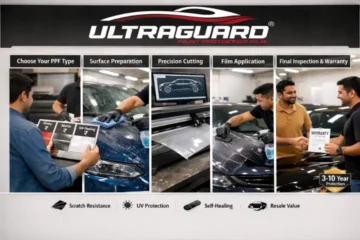
Step 1: Pre-Installation Inspection & Paint Correction
Every vehicle must undergo a thorough inspection under LED lighting. Existing scratches, swirl marks, water spots, and contamination must be removed via clay bar treatment and paint correction polishing before PPF application. PPF locks in whatever is under it — permanently.
Step 2: Pattern Cutting (Computer-Aided)
Premium installers use digital pattern libraries (like those from Xpel, STEK, or Llumar) that provide precise computer-cut templates for each specific vehicle make and model. This eliminates bulk-film hand-cutting errors, reduces waste, and ensures clean edges that don’t trap water or lift over time.
Step 3: Surface Decontamination
Panels are wiped down with isopropyl alcohol (IPA) solution to remove all oils, waxes, and polishing compounds. This step is critical for adhesion — any contamination will cause the film to lift prematurely, which is a particular risk in India’s dusty workshop environments.
Step 4: Film Application with Slip Solution
The film is applied wet using a slip solution, then squeegeed down to remove air bubbles and excess fluid. Experienced installers use heat guns to stretch the film around curves and complex body lines — this is where skill really matters for Indian car models like SUVs with pronounced shoulder lines.
Step 5: Curing & Quality Check
After application, vehicles are ideally kept in a dust-free environment for 48–72 hours for the adhesive to fully cure. Final inspection checks for lifting edges, trapped debris, silver or cloudy patches, and edge finishing quality. A professional fleet installer will conduct a walkthrough before handover.
NOTE: Warning for Fleet Managers: Beware of vendors offering suspiciously low rates (under Rs. 6,000 for full-front coverage) who skip paint correction, use bulk-cut film, or install in open dusty workshops. The visible result within 3–6 months will be peeling edges, trapped bubbles, and silver-grey patches — and you’ll end up paying twice.
PPF Maintenance for Fleet Vehicles: The Indian Context
PPF is not a ‘fit and forget’ solution — though it’s far lower maintenance than unprotected paint. For Indian fleet operations, here are the maintenance protocols that extend film life and preserve appearance:
Weekly wash: Always use the two-bucket method or a gentle touchless wash. Never use rotary brush car washes — they create micro-scratches on the film’s top coat.
Avoid high-pressure on edges: When pressure washing, keep the nozzle at least 30 cm from film edges. Direct high-pressure at edges is the primary cause of premature lifting in Indian conditions.
Seasonal decontamination: At least twice yearly (pre-monsoon and post-monsoon), perform an IPA wipe-down to remove iron particles, industrial fallout, and embedded contaminants.
PPF-safe sealants: Apply a ceramic or fluoropolymer-based spray sealant every 3–4 months. This enhances the hydrophobic effect and adds a UV-blocking layer on top of the film.
Bird dropping emergency protocol: Train drivers to blot (never rub) fresh bird droppings with a damp microfiber and warm water within 30 minutes. Even self-healing film doesn’t prevent chemical etching from droppings that sit in Indian summer heat for hours.
Annual inspection: Have a professional inspect all film edges, high-wear areas, and any zones showing yellowing or cloudiness annually. Early intervention is exponentially cheaper than reactive replacement.
PPF vs. Ceramic Coating vs. Traditional Polish: The Fleet Manager’s Honest Comparison
One of the most common questions from Indian fleet managers entering the paint protection space is: ‘Should I do PPF, or is ceramic coating enough?’ The short answer is they serve different purposes — but here’s the full picture:
| Protection Factor | PPF (Self-Healing) | Ceramic Coating | Traditional Polish |
| Stone chips & rock strikes | Excellent | None | None |
| Scratch resistance | Excellent (self-heals) | Light scratches only | None |
| UV & oxidation protection | Excellent | Very Good | Moderate (temporary) |
| Chemical resistance | Excellent | Good | Poor |
| Hydrophobic / self-cleaning | Good | Excellent | Temporary only |
| Cost per vehicle (full) | Rs. 50K – 1.2 Lakh | Rs. 12K – 35K | Rs. 2K – 5K |
| Longevity | 7-10 years | 2-5 years | 3-6 months |
| Fleet recommendation | High-impact zones | Over PPF or body panels | Not recommended |
NOTE: The Best of Both Worlds: The elite fleet protection strategy is to apply PPF on high-impact zones first, then coat the entire vehicle (including over the PPF) with a ceramic coating. The PPF blocks physical damage; the ceramic adds chemical resistance and the easy-clean hydrophobic effect on top. Together, they form an almost invincible defence system.
Choosing the Right PPF Vendor for Your Fleet in India
The Indian PPF market has exploded in the last five years, with hundreds of small shops claiming expertise. For fleet operators deploying PPF across dozens or hundreds of vehicles, vendor selection is a high-stakes decision. Here’s your evaluation checklist:
Certified film dealership: Authorised installers for recognised brands (The Detailing Mafia and Ultraguard). Certification ensures access to quality film, pattern software, and brand warranties.
Dedicated fleet programme: Fleet-specific pricing, SLAs (vehicle turnaround times), and the capacity to handle multiple vehicles simultaneously without compromising quality.
Climate-controlled install bay: PPF installation requires a dust-free, temperature-stable environment. Excessive heat in the bay causes the adhesive to activate too quickly, leading to poor positioning and trapped bubbles.
Portfolio of comparable fleet work: Ask to see documented fleet PPF case studies — not just consumer cars. Corporate fleet paint patterns and higher daily mileage create different challenges.
Warranty policy: Premium PPF on fleets should carry a minimum 5-year manufacturer warranty. Clarify what’s covered (yellowing, cracking, bubbling, delamination) and the claims process for fleet accounts.
Post-installation support: Will they provide maintenance training for fleet drivers or wash staff? A brief 30-minute session on PPF care can triple the film’s effective lifespan.
PPF for Specific Fleet Types in India
Not every fleet is the same, and PPF strategy should be calibrated to operational reality. Here are tailored approaches for the major fleet categories in India:
Corporate / Executive Fleets (Sedans, SUVs)
These vehicles are brand ambassadors. Recommended: Full-front partial PPF + full ceramic coating. Matte PPF on premium brands like BMW, Mercedes, and Audi to preserve OEM paint perfection. Monthly professional detailing included in SLA.
Cab Aggregator / Ride-Hailing Fleets (Dzire, Ertiga, Etios)
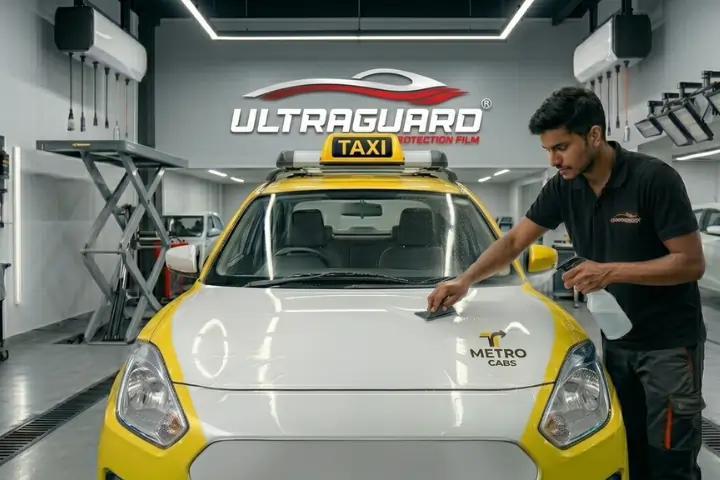
High mileage, urban operation, multiple drivers daily, and frequent manual washes create extreme wear. Recommended: High-impact zone PPF only (bumpers, hood, mirror caps, door edge guards), focusing on the highest-collision panels with the highest individual repair cost.
Last-Mile Logistics Fleets (Vans, Bolero Pickups)
Loading/unloading scratches and warehouse proximity make side panels especially vulnerable. Recommended: Door panels, rocker panels, and full bumpers. Standard (non-self-healing) PPF is appropriate — the cost savings are meaningful at scale.
Car Rental Fleets
Unknown drivers, unpredictable use, and daily turnarounds make rental fleets perhaps the single biggest beneficiary of PPF. Recommended: Three-quarter coverage minimum. Include door edge guards and boot lip protection. Self-healing film is worth the premium here.
Pharma / FMCG Field Sales Fleets
These vehicles clock 60,000+ km/year in mixed terrain. Recommended: Partial PPF with special attention to underbody side sills, rocker panels, and a full-front wrap to handle constant exposure to construction debris.
Conclusion
In a demanding and cost-sensitive market like India, maintaining the appearance and value of fleet vehicles is not just about aesthetics—it’s a strategic business decision. Daily exposure to harsh sunlight, road debris, pollution, and constant usage can quickly deteriorate a vehicle’s paint, leading to increased maintenance costs and reduced resale value.
With Ultraguard PPF, your fleet doesn’t just stay protected—it stays ahead.
FAQ’s
Q1. Is PPF worth it for fleet vehicles in India?
Yes, PPF is worth it for fleets as it protects vehicles from heavy daily wear and maintains resale value. It also keeps branding and appearance consistent across all vehicles.
Q2. How much does PPF cost for fleet vehicles in India?
PPF costs vary based on vehicle type and coverage, but are often discounted for bulk fleet installations. Businesses usually opt for partial protection to balance cost and durability.
Q3. What are the benefits of PPF for commercial fleet vehicles?
PPF protects against scratches, stone chips, and environmental damage from daily usage. It helps maintain a clean, professional look for business branding.
Q4. Can PPF reduce maintenance costs for fleet vehicles?
Yes, PPF reduces the need for repainting and frequent repairs caused by surface damage. This helps lower long-term maintenance and downtime costs.
Q5. Which areas of fleet vehicles should be covered with PPF?
High-impact areas like bumpers, hoods, side mirrors, and door edges should be prioritized. These parts face the most damage during regular operations.




0 Comments