India’s automobile sector is far more than the vehicles seen on roads every day. It is a complex ecosystem involving manufacturers, component suppliers, logistics providers, technology companies, dealerships, financial institutions, and aftermarket service providers. Over the last two decades, the country has evolved from primarily a consumer market to one of the world’s most important automotive manufacturing hubs.
India’s automobile sector contributes significantly to manufacturing output, employment generation, and tax revenues — and is rapidly becoming a key pillar of the country’s export economy.
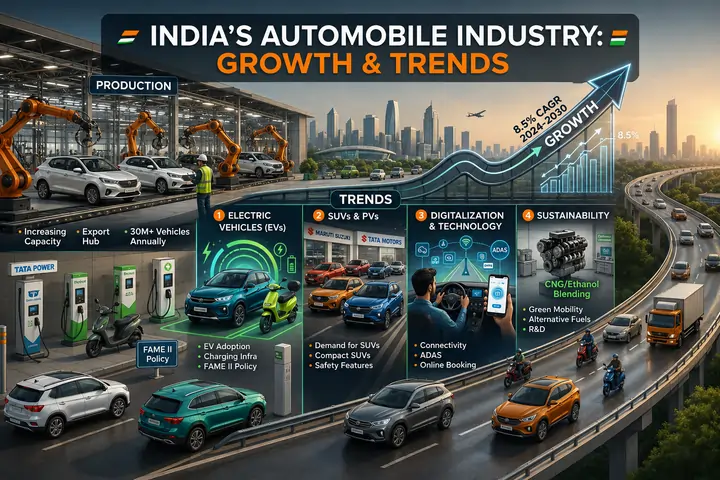
Major Industry Segments
| Segment | Description & Key Insight |
| Passenger Vehicles | Hatchbacks, Sedans, SUVs, and Luxury Cars — rising incomes are driving demand toward premium categories. |
| Two-Wheelers | Motorcycles and Scooters — the backbone of India’s mobility, especially in rural and semi-urban areas. |
| Commercial Vehicles | Trucks and Buses — support economic activity and the movement of goods across the country. |
| Electric Vehicles (EVs) | The fastest-growing segment — with the strongest adoption in two-wheelers and three-wheelers. |
What makes the Indian automotive sector uniquely powerful is its diversity. Few markets globally combine large-scale two-wheeler demand, growing passenger vehicle sales, active commercial transportation, and an emerging EV ecosystem — all within a single marketplace.
What is Driving Industry Growth?
Several powerful forces have worked together to create sustained momentum within India’s automotive sector. Growth is not the result of any single factor — it is driven by a combination of economic, demographic, policy, and technological forces reinforcing one another.
1. Rising Income Levels
The growth of India’s middle class is perhaps the most fundamental driver. As household incomes increase, vehicle ownership becomes more accessible. For many consumers, purchasing a vehicle represents not only a transportation solution but also an important financial milestone. This shift has moved demand beyond entry-level vehicles into premium categories — particularly SUVs and feature-rich models.
2. Urbanization & Changing Lifestyles
India’s cities continue to expand at a rapid pace. Growing urban populations require greater mobility, creating demand for both personal and commercial transportation. At the same time, lifestyle expectations have evolved significantly — modern buyers prioritize convenience, safety, technology integration, and fuel efficiency when choosing a vehicle.
■ Urban Growth: Compact cities drive stronger personal vehicle demand.
■ Lifestyle Shift: Young consumers increasingly prefer feature-rich, technology-enabled models.
■ New Categories: The e-commerce boom has created strong demand for last-mile delivery vehicles.
3. Infrastructure Development
Large-scale investments in highways, expressways, and logistics corridors have fundamentally strengthened the automotive ecosystem. Improved road networks encourage vehicle ownership while also supporting freight transportation, e-commerce growth, and commercial vehicle demand. Better connectivity between urban and rural areas has further expanded market opportunities for manufacturers.
4. Government Support & Policy Initiatives
Government initiatives have played a major role in shaping industry growth. Key programs have created a highly favorable environment for investment and expansion:
■ Production Push: Make in India initiative driving domestic manufacturing growth.
■ EV Policy: Financial incentives making electric vehicles attractive for both manufacturers and buyers.
■ Tech Investment: Advanced automotive technology development programs supporting R&D.
■ FDI Environment: Favorable regulatory framework welcoming global automotive investment.
5. Foreign Investment & Global Partnerships
The Indian market continues to attract global automotive companies seeking long-term growth opportunities. International investments bring capital, technology, research capabilities, and manufacturing expertise — helping the industry remain globally competitive and accelerating the adoption of advanced vehicle technologies.
6. Expanding Rural Markets
An increasingly important but often overlooked driver is the rise of rural consumers. As income levels improve and infrastructure expands, rural India has become a significant source of demand — particularly for two-wheelers and entry-level passenger vehicles. This diversification of the consumer base adds considerable resilience to overall industry growth.
Segment-Wise Growth Trends
While the overall industry continues to expand, growth patterns vary significantly across segments. Each category has its own unique dynamics, consumer drivers, and future trajectory.
Passenger Vehicles — The SUV Era
One of the most noticeable shifts in recent years has been the growing dominance of SUVs within the passenger vehicle segment. What was once considered a premium category has now become completely mainstream — compact and mid-sized SUVs now account for a substantial and growing share of total new vehicle sales.
The “premiumization” trend is reshaping the market: buyers are no longer focused solely on the most affordable option. Comfort, safety, technology, and road presence have all moved up the priority list — and consumers are willing to pay for them.
■ Safety Standards: Improved NCAP ratings and growing awareness are making safety a key purchase factor.
■ Value Proposition: Feature-rich variants available at increasingly competitive price points.
■ Aspiration: Young professionals are making aspirational vehicle purchases at earlier career stages.
■ Finance Access: Better financing options and EMI accessibility are expanding the buyer pool.
Two-Wheelers — The Backbone of Indian Mobility
Despite the strong growth of passenger vehicles, two-wheelers remain central to India’s transportation ecosystem. Motorcycles and scooters continue to serve millions of commuters — particularly in smaller cities and rural regions where public transport infrastructure may be limited. Their affordability, fuel efficiency, and ease of use ensure strong and durable long-term demand.
■ Urban EV Shift: Electric scooters are experiencing rapid adoption in urban markets.
■ Premium Segment: Demand for premium motorcycles is growing steadily in rural areas as incomes rise.
■ New Demographics: Scooters are gaining strong popularity among women riders in urban centers.
■ Gig Economy: The expansion of gig-economy delivery services has driven a surge in commercial bike demand.
Electric Vehicles — The Biggest Game Changer
No trend is transforming India’s automobile industry more rapidly than electric mobility. A few years ago, electric vehicles were largely viewed as a niche category. Today, they represent one of the most significant growth opportunities in the entire automotive sector — and arguably the defining story of the industry’s next decade.
| 2x+ | #1 | 2030 | Falling |
| Annual EV Sales Growth | 2-Wheeler EV Adoption Rate | Mass EV Adoption Target | Battery Cost Trajectory |
Three Forces Driving the EV Transition
■ Environmental Imperative: Both governments and consumers are actively moving toward cleaner transportation alternatives.
■ Technology Progress: Battery performance is improving while ownership costs are steadily declining.
■ Policy & Incentives: Government subsidies and tax benefits are making EVs financially attractive for manufacturers and buyers alike.
Where Is Adoption Happening Fastest?
The strongest EV adoption has occurred in two-wheelers and three-wheelers. These categories are more cost-sensitive, which makes the economic benefits of electrification easier to realize and more immediately visible to buyers. The passenger EV segment is also growing, but at a somewhat slower pace, given the higher upfront costs and the current state of charging infrastructure.
Over the next decade, EVs are expected to become a major contributor to overall industry growth. Companies investing in the EV ecosystem today are positioning themselves to be the market leaders of tomorrow.
Technology is Redefining the Modern Automobile
The modern automobile is no longer simply a mechanical machine — it has become a sophisticated technology platform on wheels. Software, connectivity, artificial intelligence, and data analytics have become integral to the vehicle experience. This shift is fundamentally reshaping competitive dynamics across the entire industry.
Connected Car Features
■ Navigation: Real-time navigation and live traffic updates delivered directly through the vehicle’s interface.
■ Remote Access: Vehicle diagnostics, lock/unlock, and climate control accessible via smartphone.
■ OTA Updates: Over-the-air software updates that continuously improve vehicle performance and features.
■ AI Integration: Voice commands and AI-powered in-car assistants for a seamless driving experience.
Advanced Driver Assistance Systems (ADAS)
ADAS features are rapidly expanding from premium vehicles into mainstream models, significantly improving road safety outcomes and the overall driving experience:
■ Lane Safety: Lane departure warning systems alert drivers when unintentional lane changes occur.
■ Adaptive Cruise: Adaptive cruise control automatically adjusts speed to maintain safe following distance.
■ Collision Prevention: Automatic emergency braking and forward collision alerts reduce accident risk.
■ Blind Spot: Blind spot detection systems monitor areas outside the driver’s direct line of sight.
Smart Manufacturing — Industry 4.0
Alongside in-vehicle technology, manufacturing processes are undergoing their own transformation. Automation, robotics, and Industry 4.0 technologies are enabling companies to improve productivity, reduce production costs, and maintain consistent quality at scale.
In the future, competition in the automotive sector will be defined as much by digital innovation capability as by traditional engineering expertise. Software-driven companies are already beginning to challenge established hardware-focused players.
Key Challenges Facing the Industry
Despite its strong growth trajectory, India’s automobile industry faces several significant challenges that must be successfully navigated. Companies that manage these headwinds effectively will be best positioned to emerge as long-term winners in an increasingly competitive landscape.
| Challenge | Impact & Implications |
| Supply Chain Disruption | Recent global events exposed the risks of over-dependence on international component networks — manufacturers are now working to diversify and localize supply chains. |
| Raw Material Cost Volatility | Fluctuating prices for steel, aluminum, semiconductors, and battery materials create ongoing pressure on production costs and profit margins. |
| EV Infrastructure Gap | Widespread EV adoption requires massive investment in charging infrastructure, battery localization, and a secure domestic battery supply chain. |
| Tightening Regulations | Environmental emission standards and vehicle safety norms are becoming progressively stricter, increasing compliance costs for manufacturers. |
| Intensifying Competition | Both established global players and new EV-focused entrants are competing aggressively — particularly in the electric vehicle space. |
Future Outlook
The future of India’s automobile industry appears exceptionally promising. The sector is moving beyond simple volume growth toward a more sophisticated phase defined by innovation, sustainability, and value creation.
Over the coming decade, the following trends are expected to shape the industry’s trajectory:
■ EV Acceleration: Electric vehicle adoption will continue to accelerate across two-wheelers, three-wheelers, and passenger segments.
■ Manufacturing Localization: Domestic production of components, batteries, and technology will deepen under the Make in India push.
■ Digital Integration: Connected cars, ADAS safety features, and AI-driven manufacturing will become industry standards.
■ Global Export Hub: Competitive manufacturing costs and a large domestic supplier ecosystem will strengthen India’s export position.
■ Sustainability Focus: The industry’s focus is shifting decisively from pure volume growth toward innovation, sustainability, and long-term value creation.
Conclusion
India’s automobile industry is undergoing one of the most significant transformations in its history. Traditional growth drivers — rising incomes, rapid urbanization, and infrastructure investment — continue to provide a strong foundation, while new forces are simultaneously reshaping the sector from within.
Electric mobility, digital technologies, connected vehicles, and advanced manufacturing are creating opportunities that barely existed a decade ago. Challenges around infrastructure development, supply chain resilience, and regulatory compliance remain real and substantial — but the overall direction of the industry is unmistakably clear.
FAQ’s – Indian Automobile Industry 2026
Q1. What is driving India’s automobile industry growth in 2026?
India’s automobile industry is growing due to rising vehicle demand, government support, and increased investments in manufacturing. The rapid adoption of EVs and smart mobility solutions is also fueling expansion.
Q2. How are electric vehicles impacting the industry?
Electric vehicles are accelerating innovation and supporting India’s transition to sustainable transportation. Government incentives and expanding charging infrastructure are further boosting EV adoption.
Q3. Why are SUVs popular in India?
SUVs are preferred for their spacious interiors, higher ground clearance, and enhanced safety features. Their versatility makes them suitable for both city roads and long-distance travel.
Q4. What technologies are shaping the automotive sector?
Technologies such as connected cars, ADAS, AI, and digital platforms are transforming the industry. These innovations improve safety, convenience, and the overall driving experience.
Q5. What is the future of India’s automobile industry?
The industry is expected to grow steadily through EV adoption, exports, and sustainable mobility initiatives. Continued innovation and infrastructure development will support long-term growth.




0 Comments