Probably the most costly thing that you have is your car. It might be the high-performance sports car, or the off-road sports utility vehicle, or the luxury sedan, but in any case, the environmental factors are in an unending fight against your paint. Even before the first scratch appears, be it stone chips and road debris, bird droppings, or UV radiation, the new car smell is long gone.
This is where PPF Coating comes in. It is generally considered to be the ultimate automotive surface armor. But with the boom in the use of Car PPF coating, so too have the horror stories of people who ended up with peeling edges, yellowing film, or broken-down paint.
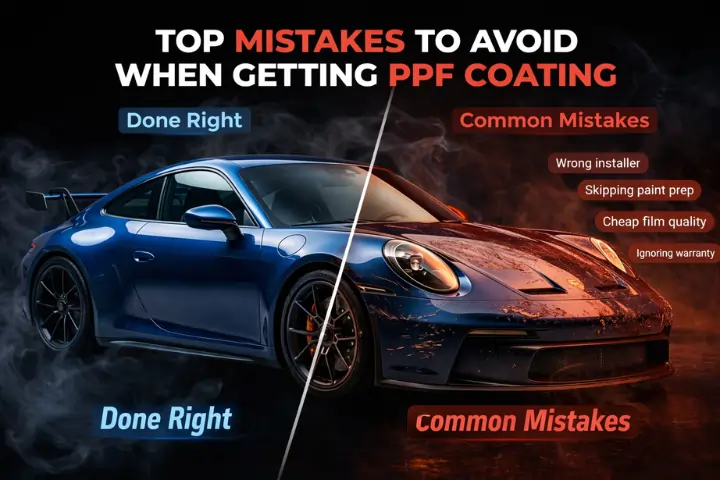
We are the experts in Ultraguard PPF, having assessed thousands of installations. Installing a Paint Protection Film coating is costly, and, like any investment, due diligence must be done. In order to make this process easy, we have prepared a comprehensive list of the most common pitfalls that you should avoid in order to keep your car safe and clean.
Choosing the Lowest PPF Coating Price
When it comes to automotive detailing, nearly everything is what you pay for. The most common error made by car owners is that of buying the cheapest PPF. Although it is a clever idea to be cost-effective, cheap PPF can be a very costly illusion.
Low-Grade Materials Trap
Not all films are made equal. Thermoplastic Polyurethane (TPU) is used to manufacture High-end Paint Protection Film. This is a flexible, durable material that is optically transparent. PVC (Polyvinyl Chloride) or low-grade TPH is often used by installers on a budget tier.
What will happen when you select a low-budget film?
(1) Yellowing: PVC films do not have UV stabilizers. The film starts to assume a sickly yellow color in 6-12 months of exposure to the sun, destroying the appearance of your car, particularly when it is white or silver.
(2) Cracking and Brittleness: Low-grade films lose plasticizers rapidly. They are brittle and can be broken like an eggshell; they are very hard to take off without using harsh chemicals that may cause damage to your clear coat.
(3) Orange peel texture: This is a texture in films of low quality, which has an appearance of an orange skin, making the original paint on your car less deep and clear.
The Invisible Cost of Low-Paying Labour
A low price of PPF coating normally means that the shop is skimming labor. Installing a vehicle is very time-consuming, usually taking 3 to 5 days to complete an entire vehicle. When a shop claims to complete a complete car in just a few hours at less than half the market price, probably, they are not following several important procedures, such as edge wrapping or deep decontamination.
Have you Overlooked the Critical Significance of Surface Preparation?
Think about how the fingerprint and piece of lint would look through a high-end smartphone screen protector. Just think of doing so on a much bigger scale on the entire hood of your car.
What occurs prior to the film coming into contact with the paint is all that determines the success of a PPF Coating for Car.
The Need for Paint Correction
Even some fresh vehicles that have just left the showroom floor usually have swirl marks, shallow scratches, or transportation damage installed by the dealer. By placing the Paint Protection Film over these defects, you are basically locking these defects inside. PPF Coating can conceal extremely small scratches, but requires a magnifying glass to see bigger ones.
Decontamination is Non-Negotiable
It should be installed by a professional installer in several steps:
(1) Iron Decontamination: This involves a chemical process of decontaminating embedded metal particles on the brakes and rail dust.
(2) Clay Bar Treatment: Removing bonded contaminants, such as tree sap or road tar, can not be just removed by a regular wash.
(3) Isopropyl Alcohol (IPA) Wipe: Removing all the residual waxes or oils so that the PPF adhesive can be attached to the clear coat.
Failure to go through these steps results in either silvering (bubbles due to entrapment of air/dirt) or early lifting of the film edges.
Think and Drive: Is your car really safe?
To do a poor job with PPF Coating is a worse thing than having no protection. It may seal moisture and contaminants on your paint, which will be harmful in the long run.
Why Do You Not Want to Hire Unqualified or Untrained Installers?
(1) PPF Coating has been referred to as origami in plastic. It involves superhuman patience, hand-eye coordination, and technical understanding of the behavior of film under tension.
(2) Films can be fitted in two methods: Plotter-cut (Pre-cut PPF Kits) and Bulk-loading (Hand-cutting).
(3) Hand-cutting: The installers may want to cover a large sheet of film and cut it directly on a car using a razor blade. This is very hazardous. A slip of the hand and the blade will cut through the film and deep into your paint.
The Ultraguard Approach: We use the state-of-the-art software to pre-cut the Paint Protection Film to the precise size of the panels on your vehicle, so that as little of the blade as possible is used in contact with your vehicle paint.
Unseemly Stretching and “Fingers”
When film is pulled too far to accommodate an intricate curve (such as a bumper), it may become overstretched and lose some thickness and protection in the region. On the other hand, when not nailed in place, one will get “fingers” (air/water channels) around the edges. A professional installer may attempt to conceal them using heat, which may lead to the adhesive failing prematurely.
Are You Aware of the Differences in Gloss, Matte, and Color PPF?
When walking into a shop, many owners request PPF Coating without knowing that there are other aesthetic options. Making an incorrect kind of choice may result in an appearance that you did not bargain for.
Gloss vs. Matte (Satin)
Gloss PPF: It is transparent. It increases the richness of your factory paint.
Matte/Satin PPF: This is the one that gives a shiny car a smooth, high-quality finish. In case you have a car with factory matte paint, you need to apply matte PPF coating so as to retain the appearance. Application of gloss film on a matte car will appear blotchy and uneven.
Rise of Color PPF
New technology has made it possible to have a combination of the protective properties of TPU and aesthetic transformation, like a vinyl wrap, and therefore it is now referred to as Color PPF. But Color PPF Coating is much more cumbersome and difficult to lay down than clear film. Another main mistake made by the stores that do not deal with Car PPF coating is that they mistakenly treat it as an ordinary vinyl, which is thinner and not as strong.
Do you Neglect After-Sales Service and Maintenance?
The “Top Mistakes” list doesn’t end when you drive out of the detailing studio. The duration of your PPF Coating will be determined by what you do in the first week and how you wash the car afterwards.
The “Curing” Period
PPF is applied with the help of the so-called slip solution (usually a combination of water and a special lubricant). Microscopic traces of moisture are left even after the squeegee process of the film.
The Error: Washing the car or putting it in freezing temperatures right after picking it up.
The Rule: You have to wait at least 48-72 hours before the first wash to give time to the film to flake out and the adhesive to adhere.
The Friend or Foe of High-Pressure Washers?
A pressure washer can be used on a car that has Paint Protection Film, but it should be done with care.
The Error: Aiming the nozzle at the side of a film panel. The edge can be caught by the high-pressure water and lifted up by the film or water pushed under the film.
The Solution: Maintain a minimum distance of 12-18 inches between the nozzle and never spray at a sharp angle towards the edges.
Incorrect Chemicals
Shun waxes that have dyes or petroleum-based cleaners. These have the ability to wear the self-healing top coating of the Paint Protection Film coating. Use pH-neutral soaps and special PPF sealants.
Are all Self-Healing Technologies the Same?
One of the “coolest” features of a modern PPF Coating for a car is its ability to heal itself. In case the film is swirled due to incorrect washing, the heat of the sun, or warm water, can re-solidify the upper coating, and the scratches will vanish.
Misconception: Assuming all films have this feature
Earlier, PPF came in a low budget and lacked a real automotive-grade top coat. And therefore the film used to get scratched as paint, and in a year will appear to be dull and hazy. When requesting the price of a PPF coating, be sure that the film contains a heat-activated self-healing top coating.
Check Warranty?
A good Paint protection film company has a brand name for its product.
Error: To accept an oral warranty given by an installer.
The Standard: Ultraguard and other quality brands have a warranty (usually 5, 7, or 10 years) by the manufacturer against yellowing, bubbles, and cracking.
Always request a physical or electronic guarantee card. In case a store is not able to offer it, it is an indication that it is using white-label or unbranded film, which has no guarantee of quality in the long-run.
Why the Partial Front Protection May Be a Trap
To save money, many owners choose a “Partial Front” kit (just the front half of the hood).
The Problem: With time, a noticeable mark will be formed over the center of your hood where the film runs out. The dirt accumulates in this section, making it unattractive. In addition, the exposed part of the hood will still be exposed to stone chips and UV decay.
The Better Move: It is sometimes preferable to have the Full Front (Full hood, full fenders, bumper, and mirrors) rather than a partial kit, particularly when money is an issue.
This guarantees the non-existence of visible lines and total protection of the most vulnerable parts.
Do you have an Environmentally Controlled Shop?
You may consider a garage, but in the case of PPF Coating, everything is an environment.
Error: Installing PPF Coating in an open-air bay or workshop with lots of dust.
The Consequence: Dust particles are flying all around. After being applied to the surface of the adhesive section of the film, they remain permanently as miniature-sized zits or bubbles.
The Professional Standard: Seek a studio that is closed, well-lit, and preferably has an air filtration system. This is what makes the difference between a good and a concourse-level finish.
Not Making Realistic Expectations
And lastly, the greatest mistake is that PPF makes your car indestructible.
PPF is not armor plating: It can withstand stone chips, but may not withstand a large, sharp rock at 100 mph.
PPF will not clean permanently: You must wash your car. Indeed, PPF should be cleaned off immediately after the bird droppings and bug splatter because the acids may eventually etch the film when left in the warm sun over a period of weeks.
Ultraguard Checklist to Success
To ensure that you do not fall victim to such pitfalls, you can use the following checklist to determine when choosing to have a Paint Protection Film coating:
| Feature | What to Look For | Why It Matters |
| Material | TPU (Thermoplastic Polyurethane) | Prevents yellowing and allows self-healing. |
| Installation | Custom Paint Protection Film Kits | Prevents razor cuts on your car’s paint. |
| Prep Work | Full Decontamination & Paint Correction | Ensures the film looks invisible and stays bonded. |
| Warranty | 5-10 Year Manufacturer Warranty | Protects your investment against product failure. |
| Environment | Clean, Dust-Free, Indoor Studio | Prevents unsightly dirt bubbles under the film. |
Conclusion
The best thing you can do to increase your vehicle’s lifespan is to get a PPF Coating. It retains the factory paint, facilitates the cleaning process, and enhances resale value tremendously. But compromising on the price of PPF coating, selecting the incorrect installer, or failing to provide aftercare can make a great idea a nightmare.
Ultraguard boasts of being more than mere installers; we are hobbyists, and we will treat the car like it is our own. Our Paint Protection Film is made of the finest quality. We cut it with precision technology and use an industry-leading process to install it in order to keep your car looking brand new for many years.
Don’t wait for the first scratch to ruin your ride
FAQ’s – Top PPF Installation Mistakes to Avoid
Q1. Does a low PPF coating price sound an alarm?
Yes. Low prices normally imply low quality of PVC or TPH. PPF Coating of high quality utilizes TPU that is UV resistant, self-healing, and has a 5-10 year warranty.
Q2. Does the paint need to be repaired before PPFs?
Absolutely. Paint Protection Film enhances the available scratches and swirls. The surface is polished by the professionals to make sure that the surface is clean before the finish is locked into the surface.
Q3. Does car PPF paint render my car scratch-resistant?
It is not bulletproof, but it withstands scratches. This means that even though it automatically mends light swirls and stone chips, it is still possible that the film can be damaged.
Q4. When can I wash my car after getting PPF coating?
Wait 48-72 hours. This will allow the moisture to dry up and the adhesive to be firmly bonded. The first week wash should be without high-pressure water along the edges.
Q5. What can I do to keep my Paint Protection Film as it is?
Wash with pH-neutral soaps and avoid petroleum-based cleaners or abrasive waxes. Then the self-healing of the top coat is regularly maintained.
Q6. Which is the best hand-cut or pre-cut PPF?
Templates that are pre-cut are more accurate and safer. Hand-cutting consists of cutting with blades along the body of your car, and this may permanently damage the factory paint.


0 Comments