Your car looks new and flawless when you first bought it home, but while driving, you see the stone chip marks on the bumper and swirl marks over the door handle within a month. But how is this even possible, and how can you protect your car from this? This is exactly why paint protection film has become the first thing serious car owners ask about before their vehicle even leaves the showroom. But here’s what most sellers won’t tell you upfront: not every roll of paint protection film is built the same way. One version can guard your paint for a decade. Another can turn yellow and lift within a single monsoon.
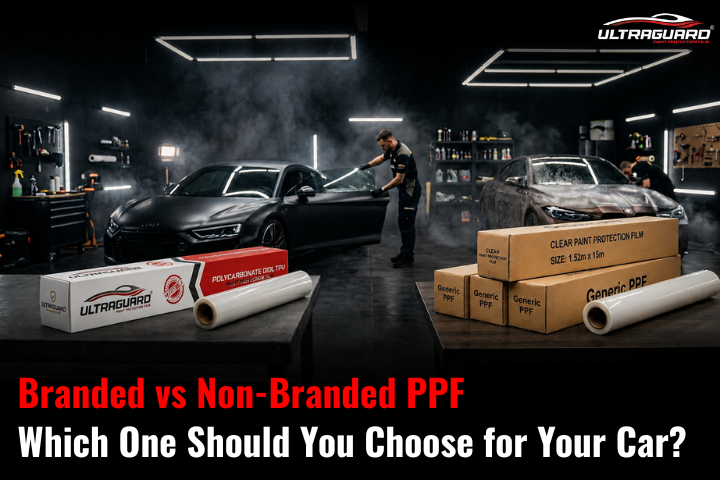
Why This Decision Matters More on Indian Roads
India isn’t a gentle place for car paint. Gravel, dust, peak summer days, harmful UV rays, and moisture during the monsoon all these can affect your car’s paint very easily. In that case, a layer of paint protection film is applied that acts like a shield and protects your car’s painted surface from all these conditions, but how can you choose the best one for your car? If you go to the market, there is branded PPF and non- branded PPF; how would you know the difference between both of them? Rather than spending your money on any film, choose the one that actually protects your car from these environments.
What Is Branded PPF?
Branded paint protection film always comes from a trusted manufacturer that shows their clear production process, products, warranty, and everything that is all clear in front of your eyes. Good quality is made up of TPU Thermoplastic Polyurethane), which is designed especially to give clarity, flexibility, and self-healing performance. Brands like Ultraguard and UltrashieldX build every roll under consistent quality checks, so the film installed on a hatchback performs the same way it would on a luxury sedan. That consistency, backed by real accountability, is exactly what you’re paying for with branded PPF.
What Is Non-Branded PPF?
Non-branded film usually has no traceable manufacturer, no batch record, and no warranty support. It’s often TPH or PVC dressed up to look like genuine TPU paint protection film, sold at a fraction of the price. It can look identical on installation day, but the gap shows up fast, yellowing within a year, edges lifting in the heat, and self-healing that simply stops working. And if something went wrong with the PPF, they clearly don’t take responsibility.
Branded PPF vs Non-Branded PPF
| Factor | Branded PPF | Non-Branded PPF |
| Material | Genuiene TPU | TPH or PVC |
| Self-Healing | Works when it gets in contact with heat | Very low or none |
| Anti-Yellowing Property | 5- 10 years | 1-2 years |
| Warranty | Given by the manufacturer based on the film that you have chosen | None |
| Batch Tracking | Yes | No |
| Performance in India | Stable | Usually fails |
| Cost | Moderate to high | Low to High |
The upfront price gap between the two can look tempting. But spread across the real lifespan of each film, branded paint protection film almost always turns out to be the more affordable choice per year of protection.
Which one is the correct choice for you?
If you are choosing between the two PPFs, it also comes with a few questions that you should first ask yourself, and according to your personal needs, you can choose the right one for your car:
● Do you want to keep your car for a long time? If your answer is yes, then a branded paint protection film can be a better option; it can easily protect your car for years. It’s built to last the distance, so you’re not paying for a reinstall halfway through ownership.
● Do you want to resell your car in the future? If you are planning to sell your car in the future, it is very important to know that a good and well-maintained paint have higher value so you can sell it easily.
● Do you drive often? If you are driving your car daily, then a branded paint protection film that is sold by a trusted manufacturer only can be very helpful for you to protect your car from external damage and all.
● Does this film also come with a warranty? If we talk about the warranty period, only branded films such as Ultraguard and UltrashieldX give a warranty period for the film.
● Thinking of going non-branded to save money? It’s worth remembering that the savings rarely last. Once the non-branded paint protection film starts peeling or yellowing within a year or two, you end up paying for a fresh installation, and sometimes paint correction on top of it.
Want to have a complete guide to choosing the correct PPF? Read this blog to know more: Car PPF Buying Guide
Conclusion
You can choose between both of them: branded vs non-branded PPF, but at the end of the day it’s not about which one looks better and gives more shine to your car after installation. The right one is the one that actually protects your car from external damage, environmental conditions, and all. Between the two of them, the right one is going to protect your car’s original paint. Non-branded film may save money upfront, but that saving rarely survives the first year. If your car and its resale value matter to you, trusted paint protection film is always worth the investment.
FAQs – Best PPF for Car
Q1. Is branded paint protection film worth the extra cost?
Yes. Good-quality branded PPF can last for years without yellowing and usually comes with proper warranty support. This can save you money compared with replacing cheaper film again and again.
Q2. Can I tell branded and non-branded PPF apart just by looking at it?
Not always. Both films can look similar and have the same clear and glossy effect when it is freshly installed. You can clearly see the difference as time passes; you can see visible scratches, yellowing, and reduced self-healing properties.
Q3. Does non-branded PPF damage my car’s paint?
This is not necessary, but if the PPF is of poor quality or they have used a weak adhesive, it can cause damage to the original paint of the car, along with problems such as moisture beneath the film, peeling, and residue.
Q4. How do I know the PPF is correct?
Before installing and choosing the PPF for your car, always ask your installer that what’s the film batch number is, what the warranty of the film is, what the raw materials brands are that they have used for the film, and whether there is any proof. If the installer is giving all the answers and has valid proof for your answers, then the film is a correct choice.
Q5. How long does it take to install paint protection film?
A full-body PPF installation can usually take around 2–4 days, depending on the vehicle and the number of panels being covered. Good installation takes time, so be careful with shops promising a full installation in just a few hours.


0 Comments