Ceramic, graphene, and borophene coatings are the evolution of nano-ceramic automotive paint protection. Earlier, car owners had difficult-to-apply silica-based treatments to guard the OEM paint. But those times are bygones. The formulation and usability have changed, and so have the qualities of each ceramic coating liquid for cars and its benefits.
Car ceramic coating is made of silicon dioxide (SiO₂) and provides hydrophobic quality to the surface and UV resistance. Graphene coating mixes a ceramic matrix with graphene-related components (like graphene oxide). Its anti-static dust repulsion leaves a high-gloss finish and reduces water spotting. Borophene Coating uses boron-infused, borosilicate, or boron-doped ceramic hybrid formulas. Borophene car coating has chemical and pH resistance, flexibility, and extreme water-shedding.
In this blog, we decode Ceramic, graphene, and borophene coatings, their benefits, prices, and which one to choose for your car.
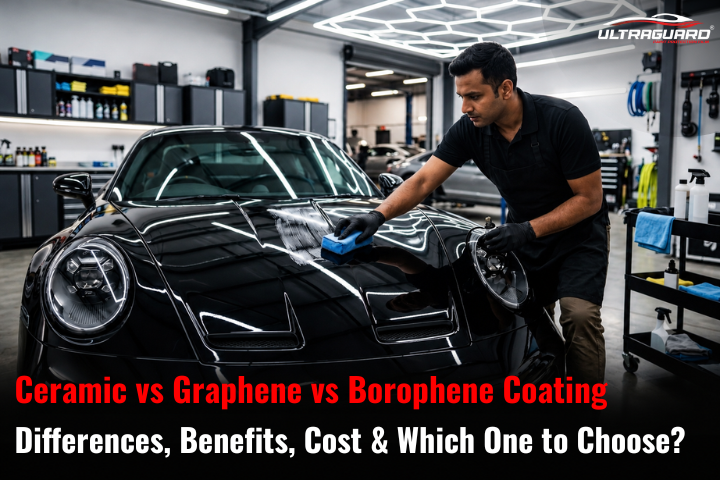
What Are Ceramic, Graphene, and Borophene Coatings?
Ceramic car coating is an established Silica technology, while graphene coating is a ceramic-style coating with a carbon-based additive. Borophene car coating is not yet a demonstrated mainstream application. Let’s understand each one.
What Is Car Ceramic Coating?
Ceramic coatings are liquid formulations that form a hard and ultra-thin layer on the clear coat of the paint. It is based on silica-related chemistry like silanes or siloxanes. They make paint easier to maintain while adding gloss and water repellency and chemical resistance.
What Is Graphene Coating for Cars?
Graphene is a one-atom-thick form of carbon. It’s also referred to as a hybrid coating. It mixes ceramic-style resin with graphene oxide or carbon additive. This coating offers superior water repellency.
What Is Borophene Coating?
This is a boron-based nanotechnology in a standard silica (SiO₂) liquid matrix. This is one of the latest innovations in paint protection with extreme hardness, low water-spot etching and stronger hydrophobic capacity. Boron-based compounds or boron nitride nanotechnology make up the primary component of Borophene Coating for cars.
Ceramic vs Graphene vs Borophene Coating: Major Differences
They are all types of automotive paint protection methods using ceramic technologies, but the difference lies in chemistry and marketing maturity. The core differences between Borophene vs Graphene Coating vs Ceramic Coating are listed here:
| Aspect | Ceramic Coating | Graphene Coating | Borophene Coating |
| Base chemistry | silica-based (SiO₂) | ceramic-based with graphene-derived additives | Composition and authenticity vary |
| Main benefits | Gloss, water repellency, and easier cleaning | Similar benefits, with potential improvements depending on formulation | Enhanced slickness and durability; tests are limited |
| Durability | 2-5 years, depends on product and maintenance | Varies by formulation; longer claims need verification | Product-specific durability is not well established |
| Scratch resistance | Resists certain surface contaminants but is not scratch-proof | Not scratch-proof; performance depends on the formula | Claimed superior hardness |
| Water behaviour | Strong water beading; water spots can still form | May improve slickness and water behaviour | Marketed for high water repellency; results vary |
| Cost | Moderate to premium | Higher than ceramic options | Premium pricing |
| Availability and evidence | Established, widely available technology | Available commercially but quality varies | Less standardized; verify composition and test results |
Expert Insight:
Our experts explain a common confusion among customers. They often confuse “9H” or “10H+” hardness with scratch resistance. But mind you, hardness ratings such as “9H” or “10H+” are based on pencil-hardness testing. They do not mean that a coating can prevent scratches. Ceramic coatings are very thin and do not resist scratches.
Which is better, ceramic or graphene coating?
Ceramic coating and graphene coating – both are advanced versions of auto paint protection. However, ceramic coating is more widely accepted and an established technology, while graphene coating is still limited to premium markets. Graphene coating has superior hydrophobic quality compared to acr ceramic coating, but performance depends on the composition. In warranty terms, the lifespan of modern ceramic coating is longer than that of graphene coating for cars. So, expert advice is to choose ceramic coating.
Ceramic Coating Benefits vs Graphene and Borophene Claims
Real-world durability, heat management, and base chemistry vary between these coatings for cars.
Ceramic Coating: Time-Tested Protection
- High-Gloss Finish: Gives your car a deep, wet look and reflective, glass-like shine
- Hydrophobic Effect: Water cannot stay on the surface for long, which attracts less dust and contamination; also reduces water spotting
- UV and Chemical Shield: Strong resistance to UV rays and chemicals, meaning the bonds do not break down in high UV radiation and when contacted with chemicals
Graphene Coating: Heat and Spot Resistance
- Reduced Water Spotting: Heat gets dissipated on the surface. Due to low heat, water minerals do not bake into the surface
- Enhanced Flexibility: Thermal cycles have less impact on the coating, which means reduced cracking and shrinking
- Anti-static: Makes it dust repellent so that loose and dry dust does not cling to the panels
Borophene Coating: Extreme Durability Claims
- Ultra-High Hardness: Highest scratch and abrasion resistance.
- Advanced Slickness: Smooth tactile feel. Water beading is superior to other counterparts.
- Self-Healing Trait: It can fade micro-marring and swirls on its own
What is Borophene?
Borophene is a two-dimensional and atomically thin crystalline sheet of boron atoms. Automotive borophene coating applications are not pure lab-grade 2D sheets. They are boron-ceramic hybrid formulas because pure 2D borophene is unstable and is hard to apply to a vehicle. The chemical exhibits:
- metallic conductivity
- anisotropic mechanical behavior
- high carrier mobility
- thermal/optical properties
Ceramic Coating Cost vs Graphene Coating Price and Borophene Coating Price in India
Ceramic coating price for cars, graphene coating price, and borophene coating price depend on brand, applicator, and the formulation of the product.
- ceramic coating cost: ₹15,000–₹45,000
- Graphene coating price: ₹20,000–₹55,000
- Borophene-positioned coating price in India: ₹32,000
| Coating type | Professional installed price | Life |
| Ceramic coating | ₹12,000–₹45,000 | 1–7 years |
| Graphene coating | ₹20,000–₹55,000 | 5–7 years |
| Borophene coating | ₹32,000- 40,000 | 3-5 years or more |
Borophene Coating vs PPF: Which Protects Car Paint Better?
Paint protection film protects cars better from scratches and stone chips because it is thicker than Borophene car coating and possesses self-healing properties. PPF is a sacrificial layer that runs around 190 to 200 microns thick, while coating is only around 5-8 mil. Borophene coating can offer more hydrophobic quality and chemical resistance, but it cannot stop scratches and stone chips. PPF wins in the Borophene coating vs PPF debate.
Which Is Better: Ceramic, Graphene or Borophene Coating?
The best coating for your car depends on your budget, coverage, and needs. Ceramic coating can offer durable protection, but graphene coating can be a winner in certain qualities. And Borophene coating should be a matter of scrutiny, as the proven performance is not yet clear.
| Your Priority | Which Option to Consider |
| Reliable paint protection | Ceramic coating from a reputable brand |
| Exploring graphene technology | Compare graphene and ceramic coatings using independent test results |
| Wanna try newer coating technology | Verify borophene coating composition, durability data, and warranty |
| Protection from stone chips and road debris | Paint Protection Film (PPF) |
| Best value for money | Compare installation costs, realistic lifespan and maintenance requirements |
Expert Insight:
Instead of choosing a car coating based only on brand name and chemistry, focus on installation, technician experience, and their previous work because even a premium product can fail if the surface preparation has not been top-notch.
How to Choose the Right Car Coating
1. Set your priority. Gloss? Scratch resistance? or easy washing? Pick one.
2. Check the ceramic coating benefits. Look for hydrophobic, UV protection, gloss.
3. Match the type to your car:
- Ceramic coating for car: balanced, great for daily drivers.
- Graphene coating for cars: handles heat and water spots well.
- Borophene Coating: extra hardness for a premium finish.
4. Weigh ceramic coating cost and lifespan.
5. Understand graphene coating price. It’s higher upfront.
6. Confirm paint prep. Wash, decontamination, and correction should be in the quote.
7. Vet the applicator. Trained team, indoor bay, past work
8. Get the warranty in writing. Claims can be confusing, so give them a good read.
Linchpin: Car Ceramic Coating
Ceramic, graphene, and borophene coating can be confusing because the benefits often overlap. However, if you are wanting to get superior and advanced paint protection, PPF for car can be a serious and highly durable option. It acts as a physical barrier against all kinds of contaminants and dust, shielding your paint from everyday damage. Ultraguard is one of the best Indian PPF brands, growing rapidly and gaining traction among detailers. Backed by 39 years of legacy, the brand offers PPF with up to 10 years of warranty, sourced from TPU pioneer Lubrizol. Ultraguard PPF is in-house tested and has self-healing and hydrophobic properties.
If you’re still confuse on which car coating to choose, talk to an Ultraguard expert. They will help you navigate the dilemma with curated options.
FAQ’s – Ceramic vs Graphene vs Borophene Coating
Q1. Is borophene coating better than ceramic coating?
Ceramic coating is a widely used car paint protection coating with hydrophobic qualities and stain resistance. Borophene coating is still a new phenomenon in the car detailing and protection industry. However, claims place it in a superior category compared to ceramic coating. You should compare each technical specification before you choose it.
Q2. Is borophene stronger than graphene?
Yes. Borophene is stronger than graphene because it has a unique “wrinkled” geometry, which makes it mechanically versatile. Graphene has a flat hexagonal carbon lattice, and borophene is made of a buckled, wavy lattice of boron atoms. But despite its high strength, borophene is not stable in the open air, while graphene stays stable.
Q3. How long does borophene coating last?
While the exact lifespan depends on the product contents and formulations, professionals say that borophene coating can last for 5 to 9 years. Maintenance is important when it comes to the lifespan of any car coating. Product brand and application quality also matter.
Q4. Is borophene the strongest material?
In laboratory and theoretical models, borophene is the strongest two-dimensional (2D) material yet discovered. It surpasses graphene in multiple physical metrics. Borophene’s ideal tensile strength is estimated at 170 Gigapascals (GPa), while graphene’s is 130 GPa. The bending strength and tunable flexibility outmatch those of others. But the catch here? Pure borophene cannot exist in the real world yet.
Q5. Is borophene coating real?
The literal presence of borophene in a car coating is just a marketing gimmick, not a true product. When you purchase a “borophene” kit or service, you are buying a boron-infused ceramic hybrid. These products can show real, high-quality outcomes, but they are not real borophene because pure borophene is completely unstable in the open air. It reacts almost instantly with oxygen and moisture. If a detailer were to apply it to the surface, the reaction would take place instantly, and it would disintegrate before they even wiped it.

0 Comments