What’s the difference between a parked car under the sun and an air fryer?
Your car can get window tinting. The air fryer cannot. So, what do you think about window tint films? Are they only about “VIP convoy” vibe? No. There is actual science happening on that glass. How does window tint work? Let’s understand.
Your car windows are bombarded with glare, ultraviolet (UV) rays, infrared heat and solar radiation. Car interiors can heat up by 20°F (11°C) in just 10 minutes under direct sunlight. Isn’t it brutal for you and your car? What’s the science behind window tinting? How does a thin tinted film on car windows suddenly make the cabin cooler and do so much more?
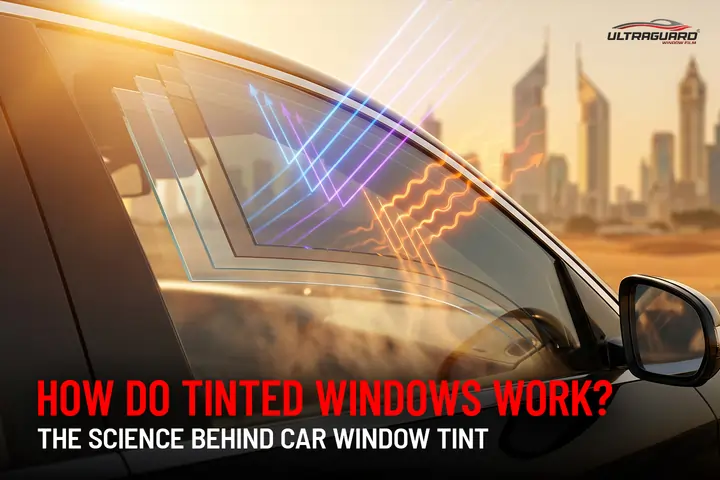
Apart from all these, you can still see outside clearly. Is it some automotive wizardry? In this guide, we will tell you that there is actually Physics and Chemistry both working behind your window tinting. We will also discuss the science behind different tint types. And why modern ceramic films perform better than traditional tints.
Science Behind Window Tinting
How do tinted windows work on a car? That is probably the most common question we get from our window tinting customers. Window tinting works by controlling the solar energy that passes through the glass. Window film for cars can block light, infrared heat, and ultraviolet rays in many ways. Window tinting can:
• Reflect
• Absorb
• Limit transmission of the light
The power comes from its construction. Let’s dive into window tint formation.
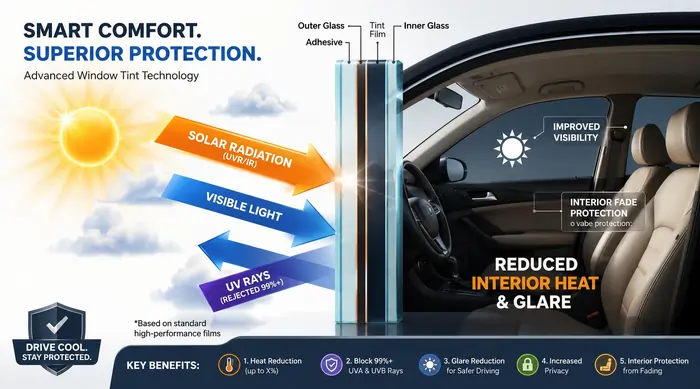
How Window Tints are Made
Window tint films are made with special layers of dyes or metals. They can manage how sunlight behaves when it hits the glass. Dyes, metals, or ceramic particles are embedded in thin polyester layers in tints. They can either absorb it or reflect. It does not pass straight through the car window. You get enough light to see but parts of the sunlight that make the cabin hot and uncomfortable are rejected.
Hard to grab?
Imagine window tints as a filter for sunlight.
Note: Ceramic window tints are different. They do not have any diy and are non-metallic.
How do Tinted Windows Work in Physics
Solar Heat Gain Coefficient (SHGC) measures how efficiently window tints work. By their capacity to block heat. It tells you how much solar heat enters through the glass.
Lower SHGC: less heat transmitted through the glass.
High-quality window tinting reduces SHGC value.
Controlling Natural Light with VLT
Window films can control how much visible light enters from the glass. We have Visible Light Transmission (VLT) to quantify it.
Lower VLT: darker tint and less sunlight entering the space
Consider Local Regulations: One of the most important aspects when you choose VLT in your window films.
Reflection Plays a Big Role
In the Physics of window tinting, the reflection is important. Window tint films can reflect the sun’s light. It can then stop some heat from entering car cabin. Reflective window tints act like mirrors for sunlight. It bounces heat and harsh rays away. You get better thermal comfort.
But the angle of the sun’s rays and the reflective properties of the film are vital here.
The Science of Nano Technology in Window Tinting
Window security film or car window tinting films nowadays have nanoparticles. They interact with the sun’s energy at a very small scale, thus blocking it. They are effective for infrared heat and ultraviolet rays.
Why Nanoscale Matters in Window Tinting
These particles are extremely small. They can be distributed via very thin layers of film. Then they target different parts of the solar spectrum. What do nanoparticles do? They absorb the light and release it as heat. This process is known as a photothermal conversion. That’s why nano-ceramic films can block a lot of IR and UV. Without making the glass darker. They also increase the longevity of tinted film on car windows.
Window Tint Work: Window Tint Glare Reduction
So what actually happens when the sunlight falls on a tinted window:
• Heat Blocking: The film helps stop excessive heat from entering. The cabin or room remains cooler.
• Reflection: A part of the sunlight is reflected away
• Absorption: The film absorbs the sun’s heat and harmful rays. Meaning? No glare and heat buildup.
• Controlled Visibility: Window tint allows some natural light to pass. You can control how dark or visible the glass looks.
Different Tint Technologies: How Different Window Film Works
There are various types of window tints available in the market. They all have different compositions, benefits, and prices. Below, we have explained how these window tintings work:
Dyed Tint
It absorbs the visible light through a dark dye layer. So it reduces the brightness and adds privacy. It can stop some heat but is weakest among its peers when it comes to heat rejection. It can also fade over time.
Metalized Tint
Its tiny metallic particles reflect sunlight away from the glass. A portion of it. It gives you a better heat rejection than dyed tints. But it can interfere with signals like GPS or mobile reception due to its metal particles.
Carbon Tint
Carbon tint has carbon particles. Not metal. It absorbs and rejects heat without disturbing your signal. Its dark and matte look is better than metalized window tinting.
Ceramic Tint
It is composed of ceramic nanoparticles. They block infrared heat and UV. Visible light can still pass. That’s the reason why ceramic window tints look light while keeping the cabin cool. It can target the heat and UV without being dark. It can:
• Block infrared heat
• Low UV exposure
• Still lets useful visible light through
So the cabin stays cooler. No turning the glass into a mirror. No more signal issues. Why ceramic window tinting films work best?
• Infrared rejection: Infrared is the part of sunlight that makes surfaces hot. Ceramic films can reduce it…strongly.
• UV blocking: Ceramic films can block most UVA/UVB rays. It protects skin and dashboards. And no upholstery fade.
• Non-metallic structure: It is not built with metal. It does not disturb your GPS, phone signal, or radio.
Nano/premium Window Films
Made up of very fine particles. It can block the sun’s energy spectrum. Light still comes in, but not more heat. They are the best option for window tinting work.
How Car Tint Works For Different Window Films
For quick comparison, take a look at this table:
| Window Tint Type | How It Works |
| Dyed Window Tint | Absorbs sunlight to reduce heat and glare
Affordable and common use for basic protection |
| Metallic Window Tint | Reflects solar heat with metallic particles
Offers strong heat rejection and glare control |
| Hybrid Window Tint | Combines dyed and metallic layers for balanced heat reduction
Less reflectivity |
| Ceramic Window Tint | Uses nano-ceramic particles for superior heat rejection
UV protection Clear visibility No signal interference |
| Carbon Window Tint | Blocks infrared heat
Premium matte finish Durable and fade-resistant |
How Tinted Windows Reduce Heat
Do you know tinted windows can reduce heat up to 84%? Impressive right? But how? So how can a car window tint reduce the heat?
Window tinting reduces heat because they block the thermal rays coming from the sun
However, the percentage differs based on the type of window tinting
• The tint film is multimple diffrent sheet sandwhiched together
• A dark colored film can block or absorb visible light
• A reflective film helps reflect visible/infrared light
• Both stop visible and infrared light from heating up the inside of the car
• They reflect away or disperse the heat generated by the light within the glass
• It reduces the AC load of your car because they cut down the amount of solar heat entering the cabin
• Privacy tints can reduce heat by up to 79%
• Security films improve privacy and add extra glass protection
How Do Tinted Windows Work to Block UV Rays?
UV rays are the silent troublemaker. Your car and your skin suffer from it. When you are stuck in traffic, UV fades your interior. Damages your skin. A quality window tint can block approx 99% of UV rays. And when UVs get blocked, you get:
• Better car interior protection
• Leather and plastic in your car last longer
• Your skin is saved too
Window Tinting Myths
Let’s bust some common myths around window tints and films.
Myth 01: Tint is only for looks.
Truth: It also blocks UV rays, heat, and IR.
Myth 02: Tint is illegal everywhere.
Truth: Depends on the local rules. Some window tinting level is allowed.
Myth 03: Tint makes driving unsafe.
Truth: High-quality window tints provide very good visibility. Without the glare.
Myth 04: Darker tints give better heat rejection.
No. Not always. Darkness is not the main factor in window tinting. It can help in heat rejection. What matters more than the color is the material of that tint and its infrared-blocking ability. For example, a ceramic tint can absorb more heat than the dyed one despite the fact that the latter is darker. So look for IR rejection or total solar energy rejection not just the color.
How Ultraguard is a One-stop Destination for you
Ultraguard has an advanced range of window tint solutions. Each window film is designed with superior heat rejection, UV protection, glare reduction, and enhanced driving comfort. Our carbon ceramic window films are made with advanced nano carbon black interlayer technology. It equips the optical clarity with minimal haze. Its carbon layers are dispersed in such a way that they ensure heat and UV rejection and cool cabin temperature.
We offer nano ceramic tint, sputter, chameleon (7 types of color-shifting films) and carbon window tinting films. Our window tint films comply with Indian visibility norms without compromising on durability and quality. Our NCT window tints come with 5%, 35%, 70% and 80% VLT. They offer hydrophobicity and IR rejection up to 94%.
Our Window Tint Solutions
You get heat rejection, UV protection, glare reduction, and enhanced comfort in window tinting.
Complete Range for Every Car Window Tint
From Nano Ceramic to Carbon and Sputter films, Ultraguard has high-performance window tint for cars for each type.
Performance at the Right Price
Ultraguard has competitive window tint price options with advanced technology.
Explore Our Window Film Range
| Film Type | Variants Available | Warranty | Best For |
| Chameleon Window Film | 7 Shades | 10 Years | Premium color-shift look
Heat rejection |
| Carbon Tint | 5 Variants | 3 Years | Affordable daily-use tint |
| Nano Ceramic Tint | 6 Variants | 8 Years | Maximum heat
UV protection |
Still confused about which window tint is right for your car?
FAQ’s – Car Tinting Work
Q1: Is 20% window tint darker than 35%?
If you want to know about the VLT, then yes. 20% VLT window tint is darker than the 35%. Let’s understand it practically. A 20% VLT means that only 20% of the total light can pass through your window, meaning the visibility will be only 20%. In 35%, the total light that will pass from the window will be 35%, meaning 35% visibility. So 35% will be brighter compared to 20%.
Q2: What is the disadvantage of window tint?
The disadvantage of window tint is its low visibility. Not all window tints are of low visibility. But if they are, your driving will be affected because you will not be able to see the outside. So it can also cause major accidents. And if you have darker window tinting, you can be subject to penalties due to the CMVR rules of visibility.
Q4: Can you see through tinted windows at night?
Yes, but it’s about how dark the tint is. What kind of light is outside? If the VLT of the window tint is 5%, the visibility will be very low. It’s hard to see through at night. Meanwhile, a lighter tint like 35% or 50% is more visible. So, if you choose a low VLT, you can not see through tinted windows at night. But if you go with two window tinting like 50% to 80%, the visibility will be good compared to the 5%.
Q5: How does one-way window tinting work?
One-way window tinting works by exploiting light balance. The brighter side of the glass becomes reflective. Like a mirror. So if you are outside, you will feel a mirror-like surface. But a person who is inside can still see outside. These kinds of window tints contain a thin layer of metal. Or it can be any other reflective coating as well. That layer sends more light back toward the brighter side. It creates the “one-way mirror” effect. It generally works in the daytime. How? The outside is much brighter than the inside in the sun. The exterior becomes more reflective. The window hides the inside view. It’s more like a daytime privacy film. It’s not 24-hour privacy.
Q6: How do tinted windows work on a car?
Car window tints work when they filter sunlight that is about to enter the car. The film is a thin layer. It is applied to the inside of the glass and:
• Reduces visible light
• Blocks UV rays
• Rejects some of the heat-carrying infrared energy
This window tint film can absorb and reflect the light. Meanwhile, it can also block infrared and UV. Different tints behave differently.
Q7: How do window tints block UV rays and heat in cars?
Window tint blocks UV rays. Reduces heat. They filter different parts of sunlight before they enter the cabin. The film can reflect, absorb and reject solar energy that results in UV rays and heat blockage in the car. Many films have UV inhibitors in the film layers or adhesive. It can stop all harmful rays. The heat comes from infrared radiation. The tints can reflect the sunlight which means low heat.
Q8: What types of window tints are best for Indian weather conditions?
Ceramic window tinting films work best for Indian weather conditions. It is composed of ceramic nanoparticles. They block infrared heat and UV. Visible light can still pass. Ceramic window tints look light while keeping the cabin cool. It can target the heat and UV without being dark. It can:
• Block infrared heat
• Low UV exposure
• Still lets useful visible light through
Ceramic films can block most UVA/UVB rays. It protects skin, dashboards. It is not built with metal. It does not disturb your GPS, phone signal, and radio.
Q9: Where can I find professional car window tinting services near me?
You can find professional car window tinting services near me by searching on Google. But keep a few points in mind: The window tinting installer should specify the type of film, warranty, and legal compliance. Also, make sure that you choose the right type because the market offers a wide range of tints depending on the VLT, UV rejection and heat rejection. You can also choose from the variety of window tintings offered by Ultraguard.
Q10: How much does professional window tinting usually cost in India?
Professional car window tints cost in India depend on the type of window films, their quality, the installer, and the location. But on a general basis, window tints in India cost around ₹5,000 to ₹25,000. Dyed window tints are the cheapest ones. Ceramic tints are the costlier ones. Brand and fitment also matter. Larger vehicles and big brands can push the price. So if you are planning a realistic budget for car window tint film, ₹5,000-₹15,000 is a mid-range option.

0 Comments