Electric car vs petrol car conundrum has one clear answer: An EV wins on running cost for most city and highway-commuting Indian buyers while upfront flexibility with refuelling ease is a straightforward perk of petrol car.
Reuters reported that alternative-fuel passenger vehicles outpaced petrol-powered cars in India in August 2026. CNG, hybrid and electric vehicles captured nearly 42% of passenger-vehicle sales. Petrol stood at 41% according to the Federation of Automobile Dealers Associations (FADA). Ultraguard experts with nearly 3 decades of industry experience credit E20 public backlash, Middle East war and raising petrol prices as the reasons for this pivotal shift.
Electric vs petrol car debate now goes beyond fuel costs, encompassing running costs, driving range, charging convenience, maintenance and impact on environment. So, EV vs petrol: which makes more sense for your needs? Read our guide before you decide: “Is EV better than petrol?”
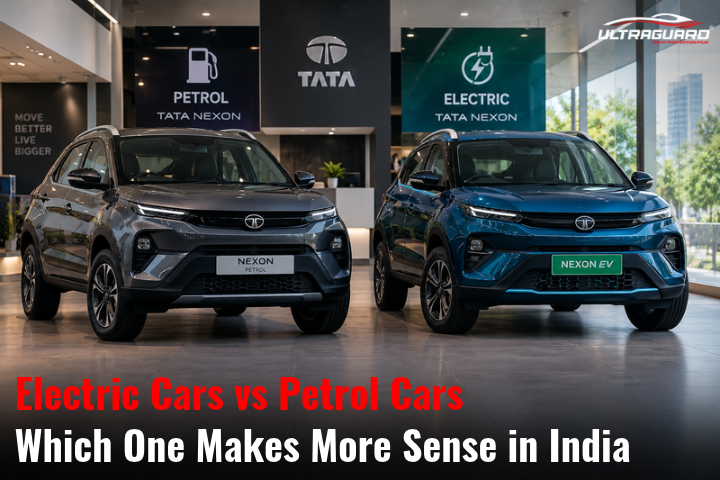
Electric Car versus Petrol Car: Which Is Better?
An electric car is better if you drive in cities frequently, charging is accessible and wanna save on long-term ownership. Petrol car is better for you if you are hunting for a vehicle on a tight initial budget, you cover long distances, or parking with a charger isn’t easy to get for you.
EV Is Better If You:
-
You drive 1,200 km or more per month
-
Home or office wall-box charger (dedicated parking spot with charging facility)
-
City commutes are a big chunk of your driving
Petrol Car Is Better If You:
-
Monthly running is under 800 km
-
You frequently take long inter-city road trips
-
Difficulty or restrictions on installing a personal charger in your apartment
Electric and Petrol Car Sales in India: The Market Just Flipped
-
Times of India reported that petrol car sales decreased by almost 5% from August 2025.
-
Total vehicle retail sales recorded 24,23,201 units in August 2026 (17.51% growth YoY). India recorded 2.98 lakh EV sales in August, up 52.9% compared to last year. EV penetration is about 12.3%, as per The Hindu.
-
Electric passenger car registrations rose 91.3% to 193,633 units in FY 2025-26.
-
Despite loosing the total vehicle sales number, the petrol segment still remains the single largest individual fuel.
Electric + Petrol Car India: August 2026 Sales Share
Source: Data released on ev vs petrol by the Federation of Automobile Dealers Association (FADA) in September 2026.
|
Fuel Type |
Share of PV Retail |
|
CNG |
25.28% |
|
Hybrid |
9.04% |
|
EV |
7.63% |
|
Alternative fuels combined |
41.95% |
|
Petrol/ethanol |
40.85% |
EV vs Petrol Car Price Difference: What You Pay at the Showroom
When comparing petrol car vs evs car price, electric vehicles (EVs) have an upfront premium (Green Premium) of ₹1.5 Lakh to ₹3.5 Lakh roughly. Petrol cars do not have such tags, meaning they are more affordable than their electric counterparts. But EV owners recover that extra amount with lower taxes and big savings on fuel.
Electric + Petrol Car India Price: Upfront Purchase Cost Breakdown
Let’s look at the structural price gap between ev and petrol car:
|
Price Component |
Petrol Variant (Nexon Creative Turbo) |
EV Variant (Nexon EV Creative Plus MR) |
Price Advantage |
|
Ex-Showroom Price |
~₹11.20 Lakh |
~₹12.49 Lakh |
Petrol is ₹1.29 Lakh cheaper |
|
GST |
28% GST + up to 22% Cess |
5% Flat GST |
EV Tax Advantage |
|
Road Tax & Registration |
~10% to 14% based on state) |
0% to 5% (Waived or subsidized) |
EV narrows the on-road gap |
|
Estimated On-Road Price |
~₹12.50 Lakh |
~₹13.70 Lakh |
Petrol is ~₹1.20 Lakh cheaper overall |
Source: Car Wale
Why GST Narrows the Petrol Car vs EVS Car Price Gap?
Goods and Services Tax (GST) is the biggest reason behind EV vs petrol car price difference. The pre-tax manufacturing cost of electric car’s battery pack is very high compared to an Internal Combustion Engine (ICE) equivalent. But government offers aggressive tax structures that reduces final on-road price delta – dramatically.
Electric Car vs Petrol Car GST Disparity: 5% vs. Up to 40%
government is penalizing carbon-emitting vehicles under streamlined indirect tax codes:
|
Vehicle Category |
Active GST Rate |
|
Electric Vehicles (EV) |
5% Flat GST |
|
Small Petrol Cars (≤1200cc, <4m) |
18% GST |
|
Mid-Size, Large & SUVs (>4m or >1500cc) |
40% GST |
Explained By Automotive Expert
Naveen, with 15 years of experience in Indian automotive market, explains the tax architecture on EV vs petrol simply. For example, imagine a petrol car and an EV have a similar baseline pre-tax manufacturing cost of ₹10,00,000.
-
Petrol vehicle incurs an 18% slab: ₹1,80,000 is taxes alone.
-
EV, taxed at 5%, adds: ₹50,000
-
Tax buffer: ₹1,30,000
Is It Better to Buy a Petrol or Electric Car on a Budget?
If you have strict upfront budget, petrol car can be a great pick. But electric car (EV) is the better choice for the lowest lifetime cost if you drive long distance.
Petrol vs EV Running Cost: Which Is Really Cheaper?
An EV is cheaper to run if you compare it with petrol car. As Autopunditz puts it, EV’s per-kilometer cost of running on home charging is around ₹1.00 to ₹1.30 per km. In a standard petrol car, this cost is around ₹6.50 to ₹7.50 per km.
EV vs Petrol Car Running Cost Calculation
Here, we have tabulated petrol vs ev running cost of Tata Nexon models on 150 km Mumbai–Pune run:
|
Points |
Petrol Nexon |
Nexon EV |
|
Energy price |
₹111.21/litre |
₹20.25/kWh (Subscribe & Save rate) |
|
Efficiency |
15 kmpl |
7 km/kWh |
|
Energy used |
10 litres |
21.42 kWh |
|
Trip cost |
₹1,112 |
₹434 |
|
Cost per km |
₹7.41 |
₹2.89 |
Source: Car Dekho
Petrol price is the Mumbai rate. EV rate is the Jio-BP Subscribe & Save fast-charging tariff.
Petrol Car Running Cost Per Km
-
Petrol Nexon gives 15 kmpl.
-
At ₹111.21 a litre
-
That works out to ₹7.41 per km.
-
It’s fuel only. Service, insurance and tyres are on top.
Electric Car Running Cost Per Km
-
The Nexon EV costs ₹2.89 per km
-
DC fast charging is the priciest way to charge. Home charging can widen the running cost gap even further.
-
EV costs less than half as much to run
EV vs Petrol Running Cost Calculator
By our calculation from CarDekho’s figures, the EV runs 61% cheaper per km.
Want to check your own numbers? Use this:
Running cost per km = energy price ÷ efficiency
- Petrol: price per litre ÷ km per litre
- EV: price per kWh ÷ km per kWh
Try it at 1,000 km a month. The gap of ₹4.52 per km adds up to about Rs 4,520 monthly. You can calculate it with your own mileage and local rates.
Electric Car vs Petrol Car: Which Is Faster and Which Weighs More?
Electric vehicle is both faster and heavier. Both answers trace back to the same part: the battery.
|
Specification |
Tata Nexon EV (45 kWh) |
Tata Nexon petrol (1.2L turbo) |
|
Powertrain |
1,198 cc turbo-petrol, 110 PS, 170 Nm |
|
|
0-100 km/h |
8.9 seconds |
NA |
|
Kerb weight |
NA |
1,237 kg |
|
Claimed range / fuel |
489 km MIDC certified |
44-litre petrol tank |
|
Dimensions |
3,995 × 1,802 × 1,625 mm; 2,498 mm wheelbase |
3,994 × 1,811 × 1,607 mm; 2,498 mm wheelbase |
Source: Tata Motors specifications
Electric Car vs Petrol Car: Which Is Faster Off the Line?
Nexon EV is the quicker car in acceleration. An electric motor delivers its torque the instant you press the pedal. No revs to build.
Why an Electric Car Weighs More Than a Petrol Car
Due to the heavy battery pack, EV weighs more while discussing electric car vs petrol car weight. Petrol cars are lighter because they do not carry a large battery pack.
Expert Insight:
Alok Pawar, Process Trainer at Ultraguard with 15 years of industry experience tells that the acceleration time gap rises if you move to a large SUV EV model. Mahindra’s official XEV 9e brochure lists the 79 kWh Pack Three version at 210 kW, 380 Nm, and 0-100 km/h in 6.8 seconds. Which means it is substantially quicker than its petrol rivals.
Maintenance and Reliability: Electric Cars vs Petrol Cars
Electric cars are easier to maintain and are more reliable in day-to-day operations but petrol cars offer higher predictability once the warranty nears its end. The difference is mechanical reliability, actually. EV vs petrol cars run on 1000 and 20 parts, respectively. EV has fewer parts working which means less wear.
Recently, The Guardian cited a study that gave insights:
Study of 47.4m MOT tests said, at 90,000-120,000 miles, EVs failed 16.5% of the time vs 22.1% for petrol. Electric cars are about 25% less likely to fail. But this data is UK-centric; Indian conditions can have different outcomes.
Electric vs Petrol: Maintenance Cost & Item Breakdown
|
Aspect |
Petrol Car (ICE) |
Electric Vehicle (EV) |
|
Routine Operations Required |
Engine oil changes, oil filters, air filters, fuel filters, spark plugs, timing belts |
Cabin filter replacement, brake fluid top-ups, basic electronic diagnostics, coolant checks |
|
Annual Service Cost (Avg.) |
₹7,500 to ₹12,000 per year |
₹3,500 to ₹5,000 per year |
|
Brake Wear & Tear |
High |
Very Low |
|
Tyre Replacement |
Normal wear cycles (50,000-60,000 km) |
10-20% Faster Wear (heavy battery packs, instant electric torque increase friction) |
|
Insurance Cost |
Base premium levels |
10-20% Higher Premium |
What Happens to an EV After 15 Years?
After 15 years, EV still runs but with less driving range. In this term, the battery can lose capacity and might need repairs to the suspension, seals, tyres, and electronics. Battery stays around 70–80% of original capacity. A car originally rated at 400 km may deliver roughly 280–320 km per charge. But it will still be mechanically sound.
High-Mileage Mechanical Reliability
After 15 years of standard driving, a traditional petrol car wears significantly on:
-
Engine
-
Transmission
-
catalytic converter
-
fuel systems
An EV bypasses these hurdles - entirely.
Battery Longevity and Degradation Reality
While the structure remains robust, battery degrades. Factory battery warranties end at the 8-year or 1,60,000 km mark. Replacement costs can be around ₹5 Lakh to ₹9 Lakh.
Expert Take:
Alok says, even after 15 years, your EV’s battery gets a secondary life market. At this point in time, it is still a good option for city commutes. If your vehicle’s frame is ultimately scrapped, the battery pack retains significant value. It is repurposed as grid energy storage. It can also be recycled for valuable raw materials like lithium, cobalt, and nickel in relevant facilities.
EV Charging in India: The Biggest Disadvantage of Electric Cars?
Biggest problem with EV in India is the uneven availability of EV charging points. According to Meta Materials Circular Market 2026 data, there were 27,737 public chargers by March 2026. India is heading to a target of 72,300. Initiatives like PM E-Drive and FAME-II legacy sanctions are fueling the surge. We still need 1.32 million public charging stations to reach the 30 percent EV penetration target by 2030. It is more than 40 times the current number (ORF Data).
To reach the 30 percent EV penetration target, we need an estimated 1.32 million charging stations, more than 40 times the current, per ORF projections. This can be considered the biggest disadvantage of electric cars. This is a big gap in electric and petrol car debate.
Electric Car vs Petrol Car Environmental Impact
Electric car vs petrol car have significant differences when it comes to environmental impact and emissions. A 4-wheeler EV emits approx 24.8 tonnes CO2e over a 1,60,000 km lifetime, versus 30.2 tonnes for a petrol car. It is roughly 5.4 tonnes less lifetime CO2e. About 18% lower. This data comes from The Energy and Resource Institute (TERI) and NITI Aayog.
India lifetime CO2: EV vs petrol
|
Vehicle |
Lifetime distance |
Lifetime GHG emissions |
Intensity |
|
Battery-electric 4-wheeler |
1,60,000 km |
24.8 tonnes CO2e |
0.15 kg CO2e/km |
|
Petrol ICE 4-wheeler |
1,60,000 km |
30.2 tonnes CO2e |
0.19 kg CO2e/km |
|
Diesel ICE 4-wheeler |
1,60,000 km |
27.2 tonnes CO2e |
0.17 kg CO2e/km |
The table is not just tailpipe emissions. It includes:
-
Manufacturing
-
battery production
-
electricity (fuel production)
-
Use
-
Maintenance
-
Recycling
-
disposal
Why EV Wins Here
EV starts with a disadvantage. Its battery and motor manufacturing create higher embodied emissions. TERI says: EV upstream emissions are 22,383.8 kg CO2e. It is largely from India’s electricity generation at 0.79 kg CO2 per kWh. But while using, EV’s higher efficiency offsets this. An IIT Roorkee–ICCT meta-analysis finds Indian passenger EVs emit up to 38% less CO2e per km than ICE vehicles .
Expert Insight on What E20 Changes in EV vs Petrol Cars
Naveen explains the nuance. With rising dissatisfaction among consumers over the reliability of a petrol car, EVs occupy stronger ground. But it also makes environmental impact more complex. PIB says E20 can reduce petrol mileage by about 3–5% in older E10-designed vehicles. For environmental impact, E20 modestly improves the petrol-car footprint. But it does not challenge the EV’s lifetime CO2 advantage in India.
Electric Cars vs Petrol Cars: Pros and Cons
Both have their own perks and downsides:
|
Factors |
Electric car |
Petrol car |
|
Running cost |
Rs 2.89/km |
Rs 7.41/km |
|
GST |
5% |
Up to 40% (large cars) |
|
Refuelling |
Charger network growing |
Pumps everywhere |
|
High-mileage reliability |
Fewer failures |
More failures |
|
Fuel-policy risk |
Insulated from E20 worries |
Exposed |
Is EV Better Than Petrol? Our Verdict for Indian Buyers
Electric car vs petrol car which makes more sense depends on what’s your budget, your preference and your driving conditions. EV is the better choice for buyers with reliable home charging. Running cost, city performance, maintenance and lifetime CO2 make an EV better than petrol car. Petrol is better if you do long drives and lack proper charging. Which is better ev or petrol:
-
City commute, home charger, 15,000+ km a year: EV
-
Under 8,000-12,000 km a year, no home charging: Petrol
-
Frequent long highway trips: Petrol
-
Lowest lifetime CO₂: EV
-
Lowest upfront price: Petrol
FAQ's - Electric Vehicle vs Petrol
Q1. What Is the 80% Rule for EV Charging?
Charge your EV to 80%, not 100%, for everyday use. Fast chargers slow down after 80%. If you charge less than 100%, it eases strain on the battery. Charge your electric vehicle to full only before a long trip.
Q2. Is an Electric Car Cheaper Than a Petrol Car to Run?
Yes. An electric car is cheaper than petrol car to run. EV costs 61% less to run compared to a petrol car. EVs are about 70–85% cheaper if you have home charging. With public fast charging, the cost rises to ₹2.50–₹3.60 per km.
Q3. Which is better ev or petrol?
EV is better if you can charge at home and drive daily. Petrol is more suitable if you lack charging or do frequent long highway trips. A practical choice for Indian car owners is EV if you have home charging. Otherwise petrol car is the safer choice.
Q4. What are the disadvantages of an electric car?
The biggest disadvantage of an electric car is the uneven distribution of charging. This can be considered the biggest disadvantage of electric cars. This is a big gap in electric vehicle vs petrol debate.
Q5. Is EV better than petrol for Indian road traffic?
EVs are better than petrol cars for Indian city traffic. Because regenerative braking recovers energy. Petrol cars waste it as heat and burn more fuel. EV advantage: smoother, quieter, instant torque, no gear shifts, and lower running cost in traffic.