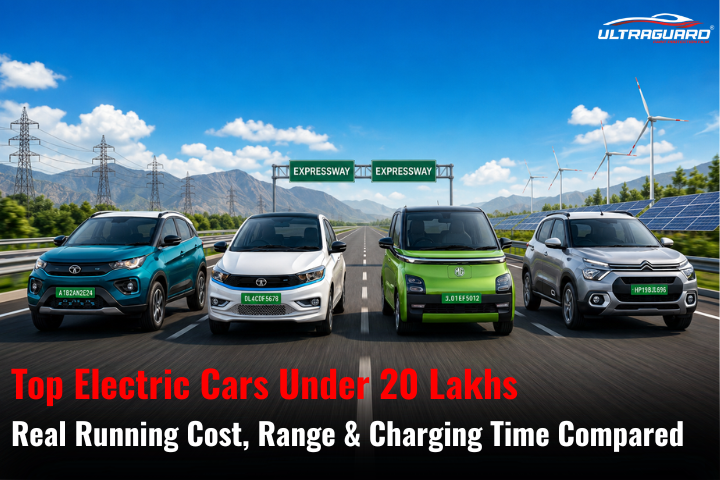
Under ₹20 lakhs, India’s strongest electric car options currently include the Tata Nexon EV, Tata Punch EV, Mahindra XUV400, MG Windsor EV, Citroen eC3, and Tata Tiago EV — offering real-world ranges between roughly 200–400 km, home AC charging times of 6–10 hours, DC fast charging of 40–60 minutes (10-80%), and running costs as low as ₹1–1.5 per km compared to ₹6–8 per km for an equivalent petrol hatchback or SUV.
If you’re choosing based on budget, range, or daily usability, here’s the full breakdown.
Why This Comparison Matters Right Now
Petrol prices have stayed high across most Indian cities, and the ₹15–20 lakh price band — once dominated only by petrol SUVs and sedans — now has genuine, capable electric options. The gap that used to exist (limited range, slow charging, few choices) has narrowed significantly. But not all EVs in this budget are equal, and the difference between “claimed range” and “real-world range” can be substantial. This post breaks down actual usable numbers so you’re not comparing brochure figures.
Comparison Table: EV Cars in India
| Car Model | Price Range (Ex-Showroom) | Claimed Range (ARAI) | Real-World Range (approx.) | Charging Time (AC, Home) | Charging Time (DC Fast) | Battery Warranty |
| Tata Tiago EV | ₹8 – ₹12 lakh | 250 – 315 km | 190 – 250 km | ~6-8 hrs (7.2 kW) | ~55 min (10-80%) | 8 yr / 1.6 lakh km |
| Tata Punch EV | ₹11 – ₹15 lakh | 315 – 421 km | 230 – 330 km | ~6-9 hrs (7.2 kW) | ~55 min (10-80%) | 8 yr / 1.6 lakh km |
| Citroen eC3 | ₹12 – ₹13.5 lakh | 320 km | 220 – 260 km | ~10-11 hrs (3.3 kW) | ~57 min (0-80%, optional fast charger) | 8 yr / 1.6 lakh km |
| Tata Nexon EV (Medium Range) | ₹12.5 – ₹17 lakh | 325 – 489 km | 250 – 350 km | ~6-8 hrs (7.2 kW) | ~40-56 min (10-80%) | 8 yr / 1.6 lakh km |
| Mahindra XUV400 | ₹16 – ₹19 lakh | 375 – 456 km | 280 – 350 km | ~6.5-9 hrs (7.2 kW/50 kW) | ~50 min (0-80%, DC) | 8 yr / 1.6 lakh km / 1.5 lakh km |
| MG Windsor EV | ₹13.5 – ₹19.5 lakh | 331 – 449 km | 250 – 340 km | ~9-10 hrs (7.4 kW) | ~50 min (10-80%) | 8 yr / 1.5 lakh km |
NOTE: Real-world range figures assume mixed city/highway driving with AC use. Highway-only or heavy-AC usage can bring range down further; gentle city driving can push it closer to claimed figures.
Which of the Best EV Cars in India Are Available Under 20 Lakhs Right Now?
• Tata Tiago EV — Entry-level hatchback EV, best for city-first buyers on a tight budget who still want a “real” EV rather than a quadricycle-style option.
• Tata Punch EV — Compact SUV body with EV powertrain; good balance of range, ground clearance, and price.
• Citroen eC3 — Budget-friendly hatchback EV, simple and functional, aimed at first-time EV buyers.
• Tata Nexon EV — The best-selling EV in India in this price band; offers Standard and Medium Range variants, more mature charging and service network than most rivals.
• Mahindra XUV400 — Larger SUV footprint, stronger performance figures, aimed at buyers wanting an SUV feel with EV running costs.
• MG Windsor EV — Positioned as a crossover/CUV, offers a spacious cabin and comes with unique ownership models (including battery-as-a-service in some markets) — worth checking current offer structure.
Which EV Cars in India Under 20 Lakhs Offer the Best Real-World Range?
On paper, the Tata Punch EV (long range variant) and Tata Nexon EV (Medium Range) claim the highest numbers (400+ km), but real-world range consistently comes in lower — usually 65-75% of the claimed ARAI figure once you factor in AC usage, city traffic, and highway speeds above 80 km/h.
Practically:
• City-only driving with moderate AC use: Expect 75-85% of claimed range across most models in this list.
• Highway driving at 100+ km/h: Range can drop to 55-65% of claimed figures, since aerodynamic drag and motor efficiency both fall at higher speeds — this affects EVs more noticeably than petrol cars.
• Mixed use (typical daily driver): Budget for roughly 250-320 km real-world range from the Nexon EV, XUV400, and Windsor EV; 190-250 km from the Tiago EV and eC3.
For most Indian city commuters (30-60 km/day), even the lower-range options in this list comfortably cover a full week on a single charge.
How Long Does It Actually Take to Charge These EVs?
Charging time depends heavily on what kind of charger you use, not just the car:
• Home AC (7.2 kW wall box): Most cars in this list go from roughly 10% to 100% in 6-9 hours — practical for overnight charging, similar to plugging in your phone before bed.
• Standard 15A home socket (no wall box): Significantly slower — often 10+ hours for a full charge — only recommended as backup, not primary charging.
• DC fast charging (public stations): 10% to 80% typically takes 40-60 minutes depending on the car’s charging capacity and the charger’s output. This is the “top-up on a road trip” scenario, not daily use.
• Real-world caveat: DC fast charger availability outside metro cities is still inconsistent as of 2026. Before buying, check charging infrastructure specifically on routes you drive often (not just your home city) — this matters more for range anxiety than the car’s spec sheet does.
What’s the Real Running Cost Per KM — EV vs Petrol?
Here’s the actual math, using average figures:
Electric car running cost:
• Average consumption: ~15-18 kWh per 100 km (varies by model, driving style)
• Average home electricity cost: ₹6-9 per unit (kWh), varies significantly by state
• Running cost: ₹0.90 – ₹1.60 per km (home charging)
If relying mostly on public DC fast charging (often ₹15-20/unit), cost rises to ₹2.50 – ₹3.50 per km
Petrol car running cost (comparable hatchback/SUV):
• Average mileage: 15-18 km/l
• Average petrol price: ₹100-105/litre (varies by state)
• Running cost: ₹5.80 – ₹7 per km
NOTE: Charging primarily at home, an EV in this segment costs roughly 4-6x less per km to run than a comparable petrol car. This gap shrinks significantly if you depend heavily on paid public fast charging, so your actual savings depend a lot on whether you can charge at home or society parking.
EV vs Petrol Under ₹20 Lakhs — Is It Actually Worth Switching?
The math depends on how much you drive.
Rough payback calculation: if an EV costs ₹2-3 lakh more upfront than a comparable petrol variant, and you save roughly ₹4-5 per km on fuel, you’d need to drive approximately 50,000-65,000 km to fully offset the price difference through running cost savings alone (excluding maintenance differences).
For context:
• High-mileage users (daily commute 40+ km, 15,000+ km/year): Break-even in roughly 3-4 years — strongly worth considering.
• Low-mileage users (under 8,000 km/year): Break-even could take 6-8+ years — the case is weaker unless other factors (no fuel price exposure, lower service costs, driving experience) matter more to you than pure cost.
Other real factors to weigh in:
• Maintenance: EVs generally cost less to service (no oil changes, fewer moving parts) — expect meaningfully lower service bills over ownership.
• Resale value: Still an evolving market in India; resale percentages for EVs are historically lower than petrol equivalents, though this is improving as EV adoption grows.
• Insurance: EV insurance premiums are often slightly higher due to battery replacement costs, partially offsetting fuel savings.
“EVs Are Cheaper to Run But Not Worth the Price” — Is This True?
This is a common myth, and the honest answer is: it depends entirely on your usage pattern, not a blanket yes or no.
• Myth 1: “EV batteries degrade fast and you’ll need an expensive replacement soon.”
• Reality: Most manufacturers in this list offer 8-year/1.5-1.6 lakh km battery warranties, and real-world degradation data from existing EV owners in India generally shows batteries retaining 85-90%+ capacity even after several years of use under normal conditions.
• Myth 2: “Charging takes too long for daily use.”
• Reality: For most owners, charging happens overnight at home — it’s not comparable to waiting at a petrol pump. Fast charging is only relevant for longer trips, not daily commuting.
• Myth 3: “EVs aren’t worth it unless you drive a lot.”
• Reality: Partially true — the cost-benefit genuinely does favor higher-mileage users. If you drive under 500 km/month, the savings take longer to materialize, and the decision may come down more to environmental preference or driving experience than pure economics.
What Should You Check Before Buying an EV in This Budget?
• Home/society charging access — Do you have a dedicated parking spot where you can install a wall charger? This affects your real running cost more than any other factor.
• Battery warranty terms — Check exact km/year caps and what’s covered (degradation below what % triggers replacement).
• Service network proximity — EV service centers are still less widespread than petrol car networks in smaller cities; check availability near you.
• Insurance cost difference — Get an actual quote comparison against the petrol variant before assuming savings.
• State subsidy eligibility — Many states offer additional EV subsidies/road tax exemptions beyond FAME — check current eligibility, as these change often and can meaningfully affect on-road price.
• Real-world range for your specific route — Ask a dealer for a test drive covering your actual daily commute, not just a showroom loop.
Looking for the Best Protection for Your Electric Car?
Give your EV long-lasting protection with high-quality Paint Protection Film. Discover the right solution to protect your investment from scratches, stone chips, and harsh weather conditions.
Conclusion
If range and highway usability matter most to you, the Tata Nexon EV (Medium Range) or Mahindra XUV400 are the strongest picks in this budget. If you want the lowest entry price with genuinely usable daily range, the Tata Punch EV offers a strong middle ground. And if you’re a first-time EV buyer just wanting to test the waters with minimal investment, the Tata Tiago EV remains the most accessible option.
Whichever you choose, the real deciding factor isn’t the spec sheet — it’s whether you can charge conveniently at home, and how many kilometers you actually drive each month. Run your own numbers using the running-cost formula above before deciding.
Electric Cars in India – FAQ’s
Q1. Which EV under 20 lakhs has the longest range?
Among current options, the Tata Punch EV and Tata Nexon EV (Medium Range variants) offer the highest claimed ranges (400+ km), though real-world figures typically run 65-75% of that depending on driving conditions.
Q2. Is home charging enough for daily use?
Yes, for most commuters. A full overnight charge on a 7.2 kW home charger comfortably covers a typical day’s driving (30-60 km) and then some, without needing public charging at all for regular use.
Q3. What is the on-road price after subsidy for these EVs?
This varies significantly by state — some states offer road tax exemption and additional subsidies on top of central incentives. Check your specific state’s current EV policy before finalizing budget, as this can change the effective price by ₹1-2 lakh in some states.
Q4. How much does EV insurance cost compared to petrol cars?
Typically 10-20% higher than a comparable petrol car, mainly due to battery replacement cost coverage — but this is often offset by lower running and maintenance costs over the ownership period.
Q5. Do these EVs qualify for FAME/state subsidies?
Central FAME-II subsidy structures have evolved over time, so confirm current status directly with the dealer at time of purchase — state-level subsidies (separate from FAME) are more commonly still active as of 2026, but eligibility varies.
Q6. What’s the resale value like for budget EVs in India?
Still developing, but improving. Early-generation EVs saw weaker resale percentages than petrol equivalents; however, models with strong sales volume (like the Nexon EV) are starting to establish more stable resale benchmarks as the used-EV market matures.





0 Comments