Paint protection film is one of the most advanced ways to protect your car’s paint. It’s a thermoplastic polyurethane sheet that shields the paint from everyday damage. Road debris, environmental wear, scratches and dirt do not stand a chance. But the caveat is- the automotive detailing industry can be confusing. Jargon, fluctuating prices, and material scams make choosing a PPF a difficult-to-navigate arena.
To overcome the situation, we have curated a car PPF buying guide with our most experienced PPF experts. This comprehensive blog breaks down everything you need to know to make a value-driven choice.
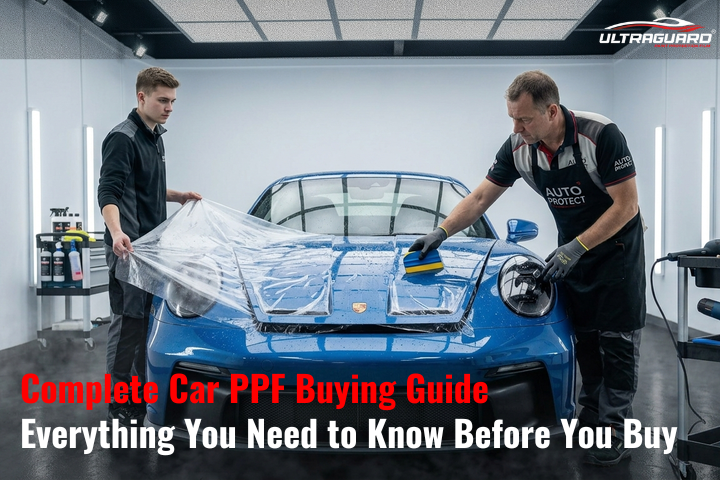
How to Choose the Best PPF for Car in 2026
Paint protection film selection boils down to a mix of a few points. Film technology, installer quality, coverage level, warranty, budget, and aesthetic goals. It sounds overwhelming. Right? But we are here to decode.
Material Chemistry: The Core Quality Filter
The chemical makeup is the most important part of a paint protection film. A cheap PPF can be made of low-quality plastic that can harm the paint if removed. You should not choose a PPF without understanding the base material.
PPF Material Comparison
| Film Type | Composition | Self-Healing | Lifespan | Verdict |
| TPU (Aliphatic) | Thermoplastic polyurethane | Yes, via heat | 5-10 years | Gold standard. No yellowing or brittleness |
| TPH | PVC base with plasticizers | No | 2-3 years | Mid-tier compromise, degrades fast |
| PVC | Rigid plastic, harsh adhesive | No | 12-18 months | Yellows, cracks, can strip your clear coat |
Why TPU Paint Protection Film Wins
This is the current premium standard of PPF coatings. Always look for a TPU-based PPF because they have segmented block copolymer structure. It is a unique mixture of hard segments for rigidity and soft segments for elasticity. Together, they make a durable PPF that can fight against scratches, chips, and other abrasions.
Choose Your Aesthetic Finish
Paint protection film is now not just limited to paint preservation. But it also gives you the creative freedom to completely transform its look. Our internal data shows that customers are increasingly choosing matte PPF coating for car to transform the original appearance. The result? The original paint remains safe while your car gets a makeover.
PPF Finish Types Compared
| Finish | Look | Cost |
| Ultra-Clear Gloss | Invisible, enhances factory shine | Standard rate |
| Matte PPF | Frosted satin texture, no respray needed | Add 15-25% |
| Color PPF | Full color change + TPU self-healing protection | Premium |
Budget and Your Car’s Size
The raw material makes up a big chunk of PPF cost in India. PPF pricing is calculated by the square footage. The vehicle type and its panels decide the actual cost.
PPF Pricing by Vehicle Segment
| Segment | Full Body PPF | Partial (Front-End) |
| Hatchback | ₹50,000-90,000 | ₹25,000-40,000 |
| Compact Sedan | ₹60,000-1,00,000 | ₹28,000-45,000 |
| Mid-Size Sedan | ₹80,000-1,30,000 | ₹35,000-55,000 |
| Compact SUV | ₹90,000-1,50,000 | ₹40,000-60,000 |
| Full-Size SUV | ₹1,20,000-2,00,000 | ₹50,000-80,000 |
| Luxury Car | ₹1,50,000-2,50,000 | ₹60,000-1,00,000 |
How Much PPF Coverage Do You Need?
PPF coverage depends on your driving conditions, ownership period, and budget. As a general trend, we have noticed that a lot of customers go for full front coverage (full hood, full fenders, bumper, mirrors, A‑pillars, and headlights). Meanwhile, a large segment also chooses full body coverage. The ultimate choice should be according to your needs.
| Coverage | Best For |
| Partial Front | City driving, low highway use, budget-conscious owners |
| Full Front | Daily drivers and regular highway use, best balance of protection and value |
| Full Front + Track Package | Long-distance travel, gravel roads, or high-impact driving |
| Full Body | Luxury/exotic cars, long-term ownership, maximum paint protection |
For long-term ownership or high-value vehicles, full-body PPF provides the right fit.
Installation Methods: Pre-Cut vs. Bulk Wrap
Installation is as important as the film itself. There are two options available:
● Software Pre-Cut Templates
● Custom Bulk Wrap
Precut vs Bulk Wrap Installation
| Method | Pros | Cons |
| Software Precut Templates | No blade near paint, precise cutouts for sensors | Tiny 1mm paint gap at edges can collect dirt |
| Custom Bulk Wrap | Seamless, invisible install with hidden edges | Needs elite installer, risk of clear coat damage in inexperienced hands |
Decode Paint Protection Film Warranties
Paint protection film is a serious investment. Therefore, you need to check the manufacturer’s warranty. Unregulated shops hand out beautifully printed pamphlets that tell you “backed by 7 years or 10 years of warranty”. But it often results in no coverage at all.
| Aspect | Details |
| Look For | Digital warranty registered to your VIN via the brand’s official portal |
| What’s Covered | Yellowing, bubbles, cracks, delamination |
| What’s Not Covered | Rock punctures, vandalism, accidents, chemical burns from bird droppings |
| Hidden Requirement | Maintenance check (60-90 days) |
Your Pre-Delivery Checklist
Before you hand over your vehicle to the studio and give your deposit, you need to confirm the following:
1. Dealer status: Certificate on display or listed on the manufacturer’s official locator
2. Paint correction: Check for 1-2 stage machine polish. PPF over swirls locks flaws underneath
3. Roof and pillar coverage: You must confirm these are included to cut costs
4. Application bay: Dust-free cleanroom
5. Curing time: TPU needs 48-72 hours
Top PPF Brands in India: What to Compare
Best paint protection film brands in India are divided into 2 segments, where the first is international premium and the second is domestic value brands. The price difference is stark, but apart from that, you also need to compare performance and warranties.
PPF Brands to Consider in India
| Brand | Origin | Key Strength |
| Ultraguard | India | Lubrizol TPU, competitive pricing, widest range of finishes, wide availability, backed by nearly four decades of legacy, hydrophobic self-healing top coat with warranties |
| UltrashieldX | India | Premium TPU, appealing warranty, authorised dealership distribution, multiple range of colored PPF |
| XPEL | USA | Self-healing TPU, optical clarity, strong warranty |
| 3M Scotchgard | USA | Established brand, availability, after-sales support |
| LLumar | USA | High clarity, hydrophobic options, global reputation |
| STEK | South Korea | Advanced topcoats, matte and colour options |
| Avery Dennison | USA | Excellent gloss, conformity and wrap expertise |
| Saint-Gobain | France | Durability and European engineering |
| Garware Hi-Tech Films | India | Indian-made TPU, price-performance balance |
| SUNMASK | India | Budget-friendly, growing distribution |
| SRF Limited | India | Polymer expertise, domestic manufacturing presence |
Expert Take:
Customers often get blinded by the brand name. But it alone cannot ensure high-quality protection of your vehicle’s paint. Always check warranty, installer experience and quality and type of film used.
Red Flags When Buying PPF
● No Technical Specs: Unknown TPU, thickness, or top coat.
● Unusually Low Price: Lower-quality materials.
● Verbal Warranty: Confusing coverage details and non-written warranty.
● Poor Clarity: Hazy and distorted finish
● Unclear Self-Healing: No details on healing technology or performance.
● No Film Sample: Seller avoids showing the actual film.
● Poor Installation: Bubbles, lifting edges, and contamination.
Why Ultraguard Should Be Your Final Choice
Ultraguard is a rising brand with the same TPU science as international brands, without the import price tag.
● Proven chemistry: Lubrizol Estane TPU, BASF; the same backbone premium imports use.
● Nearly 4 decades of legacy: We aren’t a new entrant in the PPF trend.
● Widest finish range: Gloss, matte, colour, carbon, carbon fibre – all under one brand.
● Self-heal PPF: Heat-activated top coat
● E-Warranty: Ranges from 5 years to 10 years.
● Dealer network: Presence in 27 states.
Conclusion
PPF on Car is a heavy and semi-permanent investment. One mistake and the finish can go south. Poor film quality, no surface prep or an inexperienced applicator can cause you more than you think. Meanwhile, you also need to look at the limitations of paint protection film. It’s not invincible and requires maintenance to remain at its best. Before buying the PPF, choose right film, right installer and last but not the least – right care. Best PPF protection starts with the right choice.
FAQ’s – Best PPF Brand in India
Q1: Is PPF worth it on a car?
Yes. PPF is totally worth it on a car because it protects your original paint and resale value of the vehicle. It guards against stone chips, scratches and other environmental contaminants.
Q2: Which brand is best for PPF?
Best brands for PPF are Ultraguard, UltrashieldX, XPEL, 3M and Llumar.
Q3: Is 200 micron PPF good?
Yes. 200 micron PPF is a standard in the automotive aftermarket. It is around 8 mil thick that provides significant protection from impacts and stone chips. The thickness is enough to take on minor road damage.
Q4: Which PPF is better, matte or glossy?
It depends on your aesthetic choice. Both glossy and matte PPF offer the same level of protection. But only the look is different. Choose glossy if you want that wet look. Go for matte PPF if you want aggressive, stealth look.
Q5: What is car PPF cost in India?
Car paint protection film cost in India is around ₹70,000 to ₹1,20,000 for a hatchback. For a full-size SUV, the cost can rise up to ₹ 3,00,000.
Q6: How much micron PPF is good for car?
190 to 200 micron PPF is good for a car because this is the standard thickness that is rigid enough to survive shocks and flexible enough to hug the curves.


0 Comments