PPF for monsoon acts as a barrier that repels water and blocks contaminants from reaching your car’s paint. PPF lowers the chances of watermarks, deposits, acid rain marks, and other scratches from debris. PPF coating is one of the most sought-after choices for monsoon car protection. Car protection during the rainy season requires PPF on high-impact areas. Like bumper, hood, mirrors, fenders, and door sills.
Muddy puddles and potholes that have turned into a swimming pool…your car’s exterior takes a beating every time. This is where Paint protection film for monsoon becomes “why didn’t I do it sooner?” Car paint protection in the monsoon acts as a raincoat. So before clouds roll in, let’s decode how PPF protects your car during monsoon season and monsoon car care tips.
Note: They always work, whether it’s rainy or not.
Why Monsoon Can Be Harmful for Your Car’s Paint
ScienceDirect, in its study, reported, “During recent years, a particular type of environmentally caused spotting occurred on late model cars. This spotting was due to the action of acid precipitates.”
In today’s polluted urban areas, monsoon conditions accelerate the visible paint damage. Like paint degradation and residue-related damage. Rainwater is not just water. It can carry:
• Pollutants
• Minerals
• Acidic contaminants like carbonic acid (H2CO3), nitric acid (HNO3), sulfuric acid (H2SO4), and nitrous acid (HNO2).
The Science Bit (Minus The Boring Part)
Acid rain has an evil trio: sulfuric, nitric, and nitrous acid. They aren’t gentle on your clear coat. Once the moisture evaporates, it leaves behind a concentrated acidic residue. Add a bit of sunlight. It breaks the polymer structure of the car’s clear coat. (a chemical reaction that hydrolyzes and breaks down the melamine crosslinkers). The result is dull-looking paint. You wouldn’t have realized the science could be this scary for your paint.
Now let’s look at why paint gets damaged without car paint protection in the monsoon:
• Acidic rain and pollution cause etching and fading in paint.
• The residues of the rain can bond permanently with the car’s paint.
• When you wipe these off when they’re dried out, they leave micro scratches.
• If your car has any damaged areas or seams, the moisture can cause corrosion and rust.
Expert Insight:
Our PPF experts often point out this when the detail a car that has been damaged in rainy season. Rain itself is not very harmful to your car’s paint. Rain what leaves behind is the damaging part. The residues and deposits. If you have outside parking or do not wash your car regularly, the degradation continues. Therefore, paint protection for cars in rain is vital.
What is Paint Protection Film (PPF)?
PPF is a car paint protection that is also known as a clear bra. It is a polycaprolactone-based thermoplastic polyurethane (TPU). It gives your car’s paint a heavy-duty physical barrier. PPF coating absorbs mechanical impact and aggressive chemical damage. The paint underneath remains safe.
Understanding PPF Technology: The Anatomy
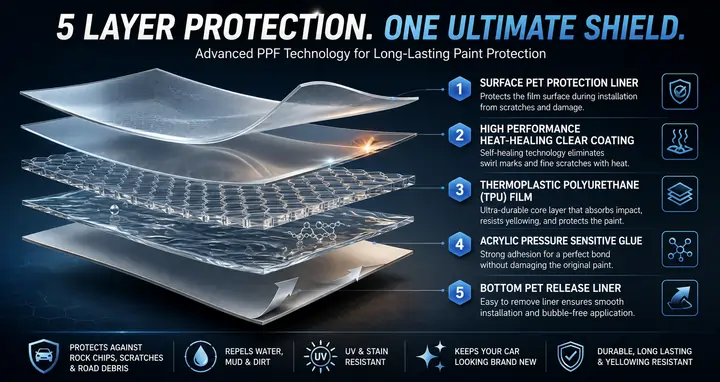
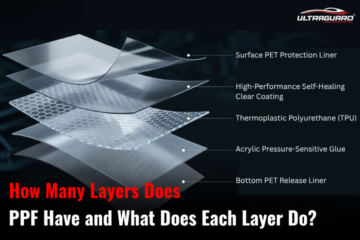
Modern paint protection films like Ultraguard or UltrashieldX are engineered with multilayer technology. The layers of car PPF:
• Release liner
• Acrylic adhesive
• TPU core material
• Clear top functional coat
How Modern PPF Works
Car PPF in monsoon is designed as a dynamic sacrificial barrier. The working of paint protection film:
• PPF uses polymer science
• It absorbs mechanical impact
• It chemically isolates environmental hazards
• The damages do not reach the clear coat
• The kinetic energy dispersion stops rock chips
Self-Healing Technology Explained
The elastomeric top coat has shape memory. When a scratch happens, the polymer chains are shoved out of alignment. When contacted with heat, the polymers go back to their original orientation. It repairs minor scratches and abrasions.
How PPF Protects Your Car During the Monsoon
PPF for cars in the monsoon gives an additional layer of protection. Through its benefits, it reduces the chance of water spots and acid rain etching.
⦿ Protection Against Rainwater Damage
Car PPF in monsoon shields the paint from rainwater damage as the water quickly slides off the surface. The chances of residues dip.
⦿ Defense Against Water Spots
Car paint protection film makes the cleaning part easier. The dust and deposits do not stick. The bonding reaction stops.
⦿ Protection from Mud and Road Debris
The abrasive contaminants do not reach the clear coat due to the PPF in the monsoon.
⦿ Stone Chip Resistance
The impact-absorbent nature takes the chips on itself, protecting the paint underneath.
⦿ Scratch Prevention During Frequent Washing
The functional top coat retains the original shape when micro scratches occur due to washing.
⦿ UV and Weather Protection
Advanced PPF for monsoon comes with UV inhibitors. They block or reflect the UV rays and reduce the yellowing effect.
Benefits of PPF During the Monsoon Season
Monsoon car protection is difficult if your car does not have any protection during monsoon season. Paint protection film in monsoon does two jobs to prevent rain damage car protection:
• reduces direct contamination
• reduces mechanical wear
The benefits of PPF as a paint protection for cars in rainy seasons:
• PPF repels rainwater and reduces water spots.
• Protects against acid rain, stains, and chemical etching.
• Shields protect from mud, grime, and road debris.
• Its self-healing topcoat minimizes light swirl marks and scratches.
• Washing becomes easier as dirt does not stick.
• Moisture-related damage reduces.
Which Parts of Your Car Need PPF During Monsoon?
Some high-impact areas like the front bumper, hood, mirrors, and fender need PPF for monsoon. These areas are highly exposed to damage:
| Car part | Why PPF matters in monsoon |
| Front bumper | First line of impact from rain spray, slush, grit, debris |
| Hood / leading edge | Gets direct rain impact and road contamination |
| Side mirrors | Hit by water, grime, and minor scrapes |
| Front fenders | Take heavy tire spray and debris from the road |
| Rocker panels | Sit low and collect dirty water, stones, and road grime |
| Door sills/door edges | Exposed to runoff, scuffs, repeated wet-dry cycles |
What Our PPF Experts Say
If your car is a daily driver in the monsoon, PPF advantages in the rainy season are your best monsoon car care. But we suggest that for these cars, a full coverage paint protection film is the most suitable. Full-body PPF gives the maximum paint protection for cars in the rain. But PPF coating cost is expensive. If you want a budget-friendly option, go for PPF on the lower and front-facing parts of the car because most of the monsoon damage is concentrated on these parts.
Case Study 1: Hyundai Creta- Beating the Daily Monsoon Grind
The Problem
Rohan drives his white Hyundai Creta every day in Ghaziabad. One monsoon in, water spots had already etched into the hood and bumper. Washing couldn’t fix the dullness.
The Fix
Ultraguard PPF went on the bumper, hood, fenders, mirrors, and rocker panels. It covered the spots his daily flooded-underpass commute hit hardest.
The Result
Rainwater beads off the hood now. Mud wipes clean in seconds. No more dreading the drive home with monsoon car care.
Case Study 2: Mahindra Thar- Surviving Highway Rain Runs
The Problem
Simran’s Thar takes weekend highway trips. Rain or not. Stone chips and acid rain residue had started etching the hood and fenders.
The Fix
She chose full front coverage TPU, built for stone chip resistance and chemical durability.
The Result
Stone chips bounce off instead of denting the paint. The self-healing topcoat handles minor swirl marks too. Simran’s drives are stress-free again.
PPF vs Ceramic Coating for Monsoon Protection
When it comes to monsoon car care, paint protection film is a better option than ceramic coating. Let’s compare both:
| Factor | PPF | Ceramic Coating |
| Water Repellency | Good | Excellent |
| Water Spots & Acid Rain | Very Good | Excellent |
| Mud & Road Grime | Excellent | Good |
| Stone Chips | Excellent | Poor |
| Scratch Resistance | Excellent | Limited |
| Ease of Cleaning | Good | Excellent |
| Paint Protection | Physical Barrier | Chemical Barrier |
| Best For | Daily Drivers, Highways, Monsoons | Easy Maintenance & Gloss |
What We Suggest for Monsoon Car Protection
With decades of experience in automotive detailing, we recommend that our clients choose both. The best PPF for rain protection in high-impact areas, then ceramic over the rest of the car.
Is PPF Worth Installing Before the Monsoon?
Yes, PPF is worth installing before the monsoon. If your aim is to protect the paint and avoid minor damage, you should choose PPF for monsoon. It gives a protective cover to your car even before the seasonal damage starts.
• The best PPF for rain protection creates a durable layer
• It eliminates the paint correction costs afterwards
• The wet-road grits cause abrasions that PPF in monsoon prevents
• Due to India/s mixed weather, PPF for car is more like an evergreen paint protection
When the Paint Protection Film in Monsoon is Most Worth It
• New cars
• Dark-colored cars, where water spots and swirl marks show more
• Daily-driven cars parked outdoors
• Cars used on highways or flood-prone roads
• Premium or luxury cars
How to Maintain Car Paint Protection Film in Monsoon
Our experienced detailers suggest maintaining PPF by washing it gently. Drying it fully. Avoiding harsh chemicals or abrasive tools. Your goal should be to remove the residues without lifting the edges.
Here are some monsoon car care tips for paint protection film:
⦿ Wash Immediately After Rain
Wash the car ASAP after the rain so that the acidic contaminant residues are washed off.
⦿ Use PPF-friendly Products
Do not use harsh detergents or degreasers on your paint. They can strip off the paint. Always use a pH-balanced shampoo.
⦿ Pre-wash
Rinse your car first so that the minor particles leave the surface. Otherwise, they will get rubbed off into the PPF.
⦿ Use Proper Washing Techniques
Always use a microfibre cloth to clean and buff the surface. The two-bucket method is the best for PPF-protected car care.
⦿ Inspect your PPF Timely
Check your PPF for lifting edges or corners. If left, they can allow the moisture to enter.
Tips to Protect Your Car During the Rainy Season
Our PPF experts have curated some monsoon car care tips for paint protection in rainy season.
• Wash mud immediately
• Dry the car after rain
• Use microfiber towels
• Inspect wheel arches regularly
• Combine PPF with ceramic coating
• Avoid parking under trees
• Periodic detailing is a must
Common Myths About PPF During Rainy Seasons
Once, a client asked us about our TPU Supre Shield PPF role (with 10 years of warranty period). He wondered whether it could survive Ghaziabad’s monsoon, where potholes basically become swimming pools. We assured him that this is our top-quality PPF made by Lubrizol, so it can and will survive the monsoon. Myths like this aren’t rare when it comes to the benefits of Paint Protection Film during the monsoon season.
Here we have debunked some with our PPF experts:
⦿ Myth: PPF makes a car fully rainproof.
Truth: PPF’s water repellency can remove the water beads and stop the dirt from building up. But it is not invincible of heavy rain.
⦿ Myth: You can expose PPF to rain soon after installation
Truth: One of the biggest PPF myths. PPF needs curing time. Exposing it soon to rainwater can affect the durability and performance.
⦿ Myth: You don’t need to wash the car after PPF application
Truth: PPF can make cleaning easier but it does not eliminate the need to wash the car. Monsoon contaminants still need cleaning after PPF.
⦿ Myth: Only luxury cars need PPF in monsoon.
Truth: Not true. Even a budget car can get PPF for rain paint protection. IF your car fights the battle of rain, daily driving, mud, and road debris…paint protection film for car is for you.
⦿ Myth: Rain can ruin a good-quality PPF.
Truth: A good-quality PPF is manufactured with advanced technologies. They are the most durable, even in the rain, if maintained correctly. But the challenge is the proper installation.
Signs Your Car Needs PPF Before the Monsoon
There are some frequent signs that suggest PPF for monsoon is necessary. Let’s take a look:
• You park outside most of the time: rain, humidity, and pollution hit the paint…without any filter
• You drive on highways or wet roads: high chances of stone chips, slush impact, and grit abrasion
• Your car has light scratches: this is gonna look bad when rain contaminants build up
• Your car has exposed areas: the rust can develop due to a wet environment
• You just wanna protect your car: PPF can reduce minor stone chips by 90%
Expert Take:
If your car ticks even two of these boxes, get paint protection film for monsoon.
How to Choose the Right PPF for Monsoon Conditions
Once you have made up your mind about getting monsoon paint protection, choose the best PPF for rain protection. PPF coating with strong hydrophobic behavior, anti-yellowing stability, self-healing top coat, and a warranty will be the best fit.
Monsoon-Ready PPF Checklist: Paint Protection for Cars in Rain
| Feature to Check | Why It Matters in Monsoon |
| Hydrophobic Top Coat | Helps water bead and slide off, reducing water spots |
| Self-Healing Layer | Minimizes light swirl marks from washing and wiping |
| Anti-Yellowing Protection | Prevents discoloration from UV exposure between rainy days |
| UV Resistance | Paint protection from sun damage |
| Strong Adhesion | Reduces the risk of edge lifting in humid conditions |
| Edge Stability | Helps film stay secure around corners and seams |
| Chemical Resistance | Defends against acid rain, pollutants, road grime |
| Stain Resistance | Limits staining from muddy water, contaminants |
| Long-Term Warranty | Provides coverage for performance, durability |
| Climate-Suitable Coverage | Warranty explicitly supports hot, humid, rainy conditions |
Do not forget the basics:
• TPU vs PVC Films: Go for TPU
• Self-Healing Features: Ask for a live demo
• Warranty Coverage: Choose as per your ownership period
• Thickness Considerations: For the monsoon season, consider a thicker TPU
• Professional Installation Importance: Always choose reputable studios and experienced installers
Why Choose Ultraguard PPF for Monsoon
Three decades of Manmachine Group’s trust drive Ultraguard paint protection film. We have maintained a pan-India customer base with our flagship-grade PPF coating.
You should choose Ultraguard PPF for car because:
• We utilize the world’s top TPU, Lubrizol, in our PPF
• We offer attractive warranties.
• Our dealers assist you at each step.
• We have an extensive range of car paint protection film. From gloss, clear, matte to color PPF, chrome, and textured PPF.
• We offer a standard thickness of 190 microns to 300 microns.
• Our PPF combines hydrophobic properties that cause water to roll off.
• Industry-proven self-healing technology.
• Our PPF range is excellently clear and gives maximum gloss.
Conclusion
Monsoon does not have to cause damage to your car. The best PPF for rain protection shields your car paint from a lot of issues. No matter how hard the rain pours. It isn’t just about the gloss. It saves your future repair costs. So if there’s one monsoon car care move worth making this year, it’s paint protection film. Rain or no rain, your car needs this.
Don’t Let the Monsoon Damage Your Car’s Paint
FAQ’s – Benefits of PPF During the Monsoon Season
Q1. Which is the best PPF for rain protection?
High-end PPF brands like Ultraguard and UltrashieldX are the best PPF for rain protection. Combined with warranties, they offer one of the thickest TPUs in the industry for maximum protection.
Q2. What are the advantages of PPF in rainy season?
PPF protects the most vulnerable areas of your car that are highly likely to get damaged due to rain’s acidic nature. It stops the contaminants from bonding with the paint and shields it from etching and corrosion.
Q3. Does PPF protect your car from rain?
Yes, PPF protects your car from rain thanks to its self-healing coat and hydrophobic nature. It safeguards the paint from micro marring, scratches and contaminants build-up.
Q4. How to protect a car in rainy season?
Always wash immediately if your car has been exposed to rainwater. Use a microfibre towel to dry it and cover the car if you are parking outside. Regularly check your car for possible issues.
Q5. Does a car PPF coating lift off in rain?
No, A high-quality PPF like Ultraguard will not lift from the edges. The range is designed to endure extreme conditions.


0 Comments