Choosing between Black Paint Protection Film (PPF) and ceramic coating depends on what you want from your car’s exterior: a new black finish, physical paint protection, enhanced gloss, or easier maintenance. Although both options help maintain your vehicle’s appearance, they work differently and offer different levels of protection.
Black PPF is a physical film that can change the appearance of your car while helping protect the underlying paint from certain forms of everyday damage. Ceramic coating creates a thin protective layer that improves gloss, water repellency, and cleaning performance but does not provide the same impact protection as PPF.
So, which is better for your car? In this guide, we compare Black PPF vs ceramic coating, including their benefits, limitations, maintenance requirements, cost factors, and suitability for different driving needs.
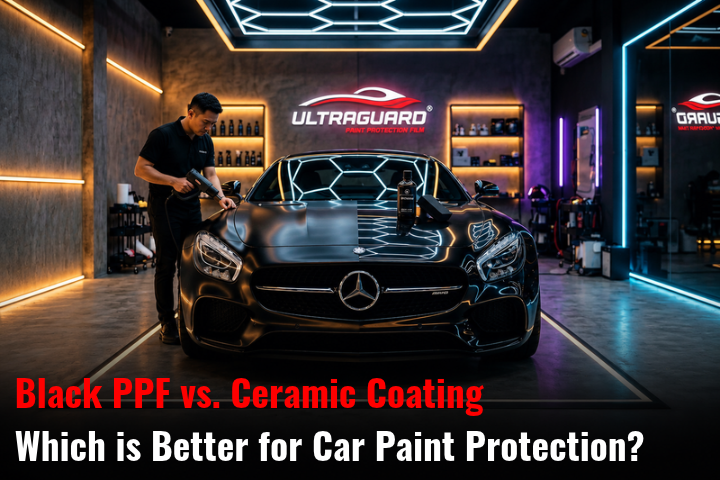
What Is Black PPF?
Black Paint Protection Film is a coloured protective film applied to a vehicle’s painted exterior panels. Depending on the product, it can give the car a glossy black, satin, or another specified black finish while providing a physical barrier over the original paint.
Unlike traditional clear PPF, which is designed to preserve the vehicle’s existing colour, Black PPF can also change its overall appearance.
High-quality films may offer features such as resistance to minor abrasions, protection against certain road debris impacts, UV resistance, and self-healing of minor surface marks. Performance depends on the film’s construction, specifications, and installation quality.
Benefits of Black PPF
1. Changes your car’s appearance
Black PPF can give a vehicle a deeper black appearance or a distinctive finish, depending on the film selected. It is an option for owners who want to change their car’s look without permanently repainting its panels.
2. Provides a physical protective layer
Unlike a liquid coating, PPF creates a physical film over the paint. It can help reduce damage from minor abrasions, small stones, and road debris, although no film can prevent every type of scratch, dent, or impact.
3. May offer self-healing properties
Some PPF products can reduce the appearance of minor surface scratches and swirl marks when exposed to suitable heat. Self-healing does not mean that deep scratches, cuts, or damaged paint will repair themselves.
4. Helps protect the underlying paint
Depending on its formulation and maintenance, Black PPF can help shield the paint from certain environmental contaminants and UV exposure.
5. Can reduce the need for paint correction
By helping preserve the underlying paint, a suitable film may reduce the need for some paint correction work. However, the film itself still needs proper washing and maintenance.
Limitations of Black PPF
Black PPF generally costs more upfront than ceramic coating because the material and installation process are more involved. Installation quality matters, especially around panel edges, curves, and complex bodywork.
The finish may also look different from the car’s original paint. Before choosing a film, confirm its finish, compatibility, maintenance requirements, and warranty terms.
What Is Ceramic Coating?
Ceramic coating is a liquid protective product applied to a vehicle’s paintwork or other compatible exterior surfaces. Once properly applied and cured, it forms a thin layer designed to improve surface properties.
Its main advantages include enhanced gloss, water repellency, and easier removal of certain dirt and contaminants during washing.
Ceramic coating is not a replacement for a physical protective film. It does not provide equivalent protection against stone chips, road debris impacts, or deeper scratches.
Benefits of Ceramic Coating
1. Enhances gloss and paint appearance
Ceramic coating can improve the visual depth and gloss of a well-prepared paint surface. The final appearance also depends on the condition of the paint before application.
2. Improves water repellency
Many ceramic coatings have hydrophobic properties that encourage water to bead or run off the surface. This can make routine cleaning easier, although water spots may still develop.
3. Makes routine washing easier
Dirt and some contaminants may be easier to remove from a properly maintained coated surface. Regular washing remains necessary.
4. Offers some chemical and environmental resistance
Depending on the formulation, ceramic coating can improve resistance to certain contaminants and environmental exposure. It does not make paint completely immune to bird droppings, acidic substances, or water spotting.
5. Can cost less initially
Ceramic coating generally has a lower initial cost than full-body PPF. The final price depends on the coating product, vehicle size, paint preparation, and installer.
Limitations of Ceramic Coating
Ceramic coating does not create the thick physical barrier provided by PPF. It cannot reliably prevent stone chips, deeper scratches, or impact damage.
Its performance also depends on preparation, application, curing, and maintenance. The coating may require periodic maintenance or reapplication according to the manufacturer’s instructions.
Black PPF vs Ceramic Coating: Key Differences
The most important difference is that Black PPF combines a coloured finish with physical film protection, while ceramic coating primarily improves the surface properties of the existing finish.
| Comparison factor | Black PPF | Ceramic coating |
|---|---|---|
| Primary purpose | Coloured finish and physical protection | Gloss, water repellency and easier maintenance |
| Changes vehicle appearance | Yes, depending on the film | Generally enhances the existing finish |
| Stone-chip protection | Helps absorb certain impacts | Does not provide equivalent impact protection |
| Scratch protection | Helps resist some minor physical damage | Limited resistance; not scratch-proof |
| Self-healing | Available with selected films | Not equivalent to self-healing PPF |
| Water repellency | Depends on the film’s topcoat | Usually a key feature |
| Cleaning | Can make maintenance easier, depending on the surface | Often makes routine washing easier |
| Initial investment | Generally higher for comparable full-body coverage | Generally lower |
| Repair or replacement | Damaged sections may need film replacement | Coating may need local correction or reapplication |
| Appearance | Can change the car to a specified black finish | Preserves and enhances the underlying finish |
Actual performance varies by product. Compare manufacturer specifications rather than assuming every Black PPF or ceramic coating offers the same benefits.
Black PPF vs Ceramic Coating Price in India
Price is an important factor when choosing between Black PPF and ceramic coating. However, the cheapest initial option is not necessarily the best value for every vehicle.
What determines the price of Black PPF?
The cost of Black PPF installation depends on:
- Vehicle size and body shape.
- Film quality, finish, and product specifications.
- Full-body or partial coverage.
- Complexity of installation and panel edges.
- Paint condition and preparation requirements.
- Warranty coverage and installer workmanship.
Full-body coverage generally requires more material and labour than protecting selected panels. Ask for a written quotation that specifies the film, coverage, warranty, and exclusions.
What determines the price of ceramic coating?
Ceramic coating costs depend on:
- The product and its intended durability.
- Vehicle size and paint condition.
- Paint correction or polishing requirements.
- Application quality and curing conditions.
- Maintenance services and warranty terms.
A coating applied after substantial paint correction may cost more than one applied to a vehicle that requires minimal preparation.
Which option offers better long-term value?
Black PPF may offer better value for owners who prioritise physical paint protection and want a blacked-out appearance. Ceramic coating may be more suitable for owners who mainly want gloss, water repellency, and easier cleaning at a lower initial cost.
For a fair comparison, calculate the total expected cost over your ownership period, including installation, maintenance, repairs, and possible replacement.
There is no single price that applies to every car. Obtain quotations for the same vehicle, coverage area, and product quality before making a decision.
Pros and Cons of Black PPF vs Ceramic Coating
Black PPF: Pros
- Provides a physical layer over the underlying paint.
- Helps protect against certain minor abrasions and stone impacts.
- Can change the car’s appearance to a black or specified finish.
- Selected films offer self-healing surface properties.
- May reduce the need for paint correction to the protected paint underneath.
Black PPF: Cons
- Higher upfront cost, particularly for full-body coverage.
- Requires skilled installation.
- The film’s finish and appearance may differ from factory paint.
- Damaged or deteriorated film may need replacement.
- Proper washing and product-specific maintenance are still necessary.
Ceramic Coating: Pros
- Enhances gloss and the appearance of well-prepared paint.
- Improves water repellency.
- Can make routine washing easier.
- Generally costs less initially than full-body PPF.
- Works on compatible painted surfaces without changing the vehicle’s colour.
Ceramic Coating: Cons
- Does not provide equivalent stone-chip or impact protection.
- Cannot prevent every scratch or chemical stain.
- Requires proper preparation and maintenance.
- Performance and longevity vary by product and application.
Which Is Better for Your Car?
The right option depends on your budget, driving habits, appearance preferences, and expectations.
1. If you want a black finish and physical protection
Black PPF is worth considering if you want to change your car’s appearance while adding a physical protective layer. Check whether the selected product is suitable for your vehicle and whether its finish matches your expectations.
2. If you mainly want gloss and easier cleaning
Ceramic coating may be a practical choice if you are happy with your car’s existing colour and want enhanced gloss, water repellency, and easier routine maintenance.
3. If you frequently drive on highways
Road debris and small stones can damage exposed paint. PPF is generally the more suitable option for protecting high-impact areas such as the front bumper, bonnet, and side mirrors. Black PPF may be appropriate if you also want a black finish; otherwise, clear PPF may be a better fit.
4. If you own a new car
Consider your priorities before choosing a treatment. If physical protection is important, evaluate PPF coverage. If you mainly want easier maintenance and enhanced gloss, ceramic coating may be sufficient for your needs.
5. If you want both physical protection and easier maintenance
You may be able to combine PPF and ceramic coating. The film provides the physical barrier, while a compatible ceramic coating can improve water repellency and cleaning performance.
The coating must be suitable for the particular PPF and applied according to the relevant manufacturers’ instructions.
Black PPF vs Clear PPF: What Is the Difference?
Black PPF and clear PPF serve related protective purposes but offer different appearance outcomes.
Clear PPF is designed to protect the paint while preserving the vehicle’s original colour as much as possible. Black PPF changes the appearance of the covered panels to the selected black finish.
Choose clear PPF if retaining the factory colour is your priority. Consider Black PPF if you want a black appearance and the associated physical protection.
Before installation, check the film’s finish, compatibility, removal guidance, and warranty. A professional installer can also advise whether the existing paint condition is suitable.
Can You Apply Ceramic Coating Over Black PPF?
Yes, ceramic coating can be applied over compatible Black PPF products. This combination may improve gloss, water repellency, and cleaning convenience.
However, not every ceramic coating is suitable for every film. Confirm compatibility with both manufacturers and follow the recommended preparation, application, and curing instructions.
The correct sequence is generally to install the PPF first, allow it to settle as instructed, and then apply a compatible coating if recommended. Applying ceramic coating over PPF does not make the combination immune to all damage.
How Long Does Black PPF and Ceramic Coating Last?
There is no universal lifespan for either product.
The service life of Black PPF depends on film quality, installation, climate, sunlight exposure, washing practices, and maintenance. Ceramic coating longevity depends on its formulation, surface preparation, application, driving conditions, and care.
When comparing products, look beyond a headline lifespan. Review the written warranty, covered defects, maintenance conditions, exclusions, and the manufacturer’s recommended care schedule.
A longer advertised lifespan does not automatically guarantee better performance under every condition.
How to Maintain Black PPF and Ceramic Coating
Regardless of the option you choose, proper maintenance helps preserve the finish.
For Black PPF:
- Follow the installer’s instructions for the initial curing period.
- Use suitable automotive shampoo and clean microfiber wash materials.
- Avoid abrasive compounds or aggressive polishing unless approved for the film.
- Remove bird droppings, tree sap, and other contaminants promptly.
- Inspect edges and damaged areas and seek professional advice when necessary.
For ceramic coating:
- Wash the car regularly with a suitable automotive shampoo.
- Avoid harsh cleaning chemicals unless approved for the coating.
- Dry the vehicle appropriately to minimise water spotting.
- Follow the manufacturer’s recommended maintenance schedule.
- Do not assume that water beading alone proves the coating is performing perfectly.
Always follow the specific care instructions for the product installed on your car.
FAQ’s – Black PPF vs Ceramic Coating
Q1. Is Black PPF better than ceramic coating?
Black PPF is generally better for physical paint protection and changing the car’s appearance to a black finish. Ceramic coating is better suited to enhancing gloss, water repellency, and cleaning convenience. The better option depends on your priorities.
Q2. Is Black PPF worth it?
Black PPF may be worth considering if you want a black finish and additional physical protection for the underlying paint. Compare the film’s quality, installation cost, warranty, and maintenance requirements before investing.
Q3. Does Black PPF protect against scratches?
Black PPF can help resist certain minor scratches and abrasions. Some products also offer self-healing properties for minor surface marks. Deep scratches, cuts, and major impacts can still damage the film.
Q4. Does ceramic coating prevent stone chips?
No. Ceramic coating does not provide the same physical impact protection as PPF. If stone chips are a major concern, consider PPF on the panels most exposed to road debris.
Q5. Can ceramic coating be applied over Black PPF?
Yes, if the coating is compatible with the film and both manufacturers’ instructions are followed. Professional application can help ensure suitable preparation and curing.
Q6. Is Black PPF more expensive than ceramic coating?
Black PPF generally has a higher upfront cost, especially for full-body installation. The actual price depends on vehicle size, film quality, coverage, and installation. Ceramic coating costs vary according to the product and paint preparation required.
Q7. Which is better for a black car?
For a car that already has black paint, ceramic coating may be suitable if you mainly want gloss and easier maintenance. Black PPF may be preferable if physical protection is a priority. Clear PPF is another option when you want to preserve the original paint colour.
Q8. Can Black PPF change the original colour of a car?
Yes. Black PPF changes the visible finish of the covered panels. Before installation, confirm the desired appearance, film compatibility, and any applicable vehicle or registration requirements.
Q9. Does Black PPF require special maintenance?
Black PPF requires proper washing and product-specific care. Avoid abrasive products unless the film manufacturer permits them, and follow the installer’s instructions for cleaning and maintenance.
Q10. Should I choose Black PPF, clear PPF, or ceramic coating?
Choose Black PPF if you want a black finish with physical protection. Choose clear PPF if you want to preserve the original colour while protecting the paint. Choose ceramic coating if your main goals are gloss, water repellency, and easier cleaning. You can also combine compatible PPF and ceramic coating products.
Conclusion
Black PPF and ceramic coating are designed for different priorities, so neither is automatically the best choice for every car owner.
If you want a black appearance combined with a physical layer of paint protection, Black PPF is worth considering. If you want to enhance the existing paint’s gloss and water repellency while making routine cleaning easier, ceramic coating may be a better fit.
If you want both physical protection and easier maintenance, consider a compatible combination of PPF and ceramic coating.
Before deciding, compare product specifications, coverage, installation quality, warranty conditions, and long-term maintenance costs.
Explore Paint Protection Solutions from Ultraguard
Ultraguard offers automotive paint protection solutions for car owners looking to preserve their vehicle’s appearance. Explore the available PPF options and consult an authorised installer to identify a suitable product for your car, finish preferences, and protection requirements.

0 Comments