Hybrid cars in India have stopped being a niche curiosity. They’re now the practical middle ground — better fuel efficiency, none of the range anxiety that comes with going fully electric. A hybrid pairs a petrol engine with an electric motor and battery, and the payoff shows up hardest in city driving, exactly where most Indian owners spend their time.
But here’s the catch nobody tells you at the showroom: not every car wearing the “hybrid” badge behaves the same way. Mild hybrids, strong hybrids, plug-in hybrids — three very different electric-assistance levels, three very different ownership experiences.
In 2026, Indian buyers have choice. Strong-hybrid SUVs, sedans, MPVs, even premium options. Maruti Suzuki Victoris, Toyota Urban Cruiser Hyryder, Maruti Suzuki Grand Vitara, Honda City e:HEV, Toyota Innova HyCross, and Maruti Suzuki Invicto are the mainstream picks.
This guide weighs them on price, claimed mileage, practicality, body type, powertrain, and real usage patterns, not just whoever tops the mileage chart.
One heads-up before we dive in. Prices and variants shift. The figures below are indicative ex-showroom numbers. And certified mileage is a lab number. Real-world mileage is affected by many factors: traffic, speed, driving, AC load, passenger count, and roads.
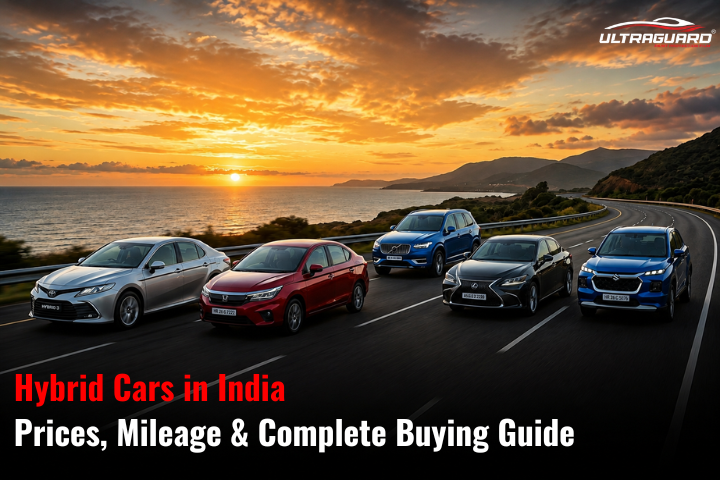
Hybrid Cars in India
| Hybrid Car | Type | Hybrid Type | Claimed Mileage | Approx. Hybrid Price* | Best For |
| Maruti Suzuki Victoris | SUV | Strong Hybrid | 28.65 km/l | ₹16.38–19.99 lakh | Overall mileage-focused SUV |
| Toyota Urban Cruiser Hyryder | SUV | Strong Hybrid | 27.97 km/l | ₹15.34–19.99 lakh | Efficient family SUV |
| Maruti Suzuki Grand Vitara | SUV | Strong Hybrid | 27.97 km/l | ₹16.63–19.73 lakh | Family and everyday use |
| Honda City e:HEV | Sedan | Strong Hybrid | Around 27 km/l | Around ₹20 lakh | Sedan buyers |
| Toyota Innova HyCross | MPV | Strong Hybrid | 23.24 km/l | Around ₹26–31 lakh | Large families |
| Maruti Suzuki Invicto | MPV | Strong Hybrid | 23.24 km/l | Around ₹25–29 lakh | Premium 7-seater buyers |
| Toyota Camry | Sedan | Strong Hybrid | 25.49 km/l | Around ₹48 lakh | Premium sedan buyers |
*Indicative ex-showroom pricing; variant availability and prices may change.
Expert Insight
The Victoris leads the pack here, 28.65 km/l certified; nothing else in this lineup touches it. The Hyryder and Grand Vitara sit tied at 27.97 km/l. Near enough that mileage alone won’t settle that debate. Innova HyCross and Invicto are in 2.0-litre territory, rated at 23.24 km/l. This is solid for vehicles hauling that much space.
Which hybrid car in India should you buy?
There’s no universal winner. Your driving pattern decides that, not a spec sheet.
● SUV Maruti Suzuki Victoris: Strong Hybrid Efficiency, modern features, SUV practicality (this one checks every box if those are your priorities).
● Toyota Urban Cruiser Hyryder: It has Toyota’s service ecosystem with strong-hybrid efficiency.
● Maruti Suzuki Grand Vitara: Strong Hybrid For buyers who’d rather stay inside Maruti’s orbit without giving up strong-hybrid numbers.
● Honda City e:HEV: Built for buyers who never wanted an SUV in the first place.
● Toyota Innova HyCross Hybrid: If space and family comfort outranks
● Maruti Suzuki Invicto: A premium 7-seater hybrid with a different feature set.
● Toyota Camry: For buyers who can spend considerably more for size and polish.
Hybrid Cars in India: What Are Your Options?
“Hybrid car” is an umbrella term covering several genuinely different powertrains.
In India, four categories show up regularly in Hybrid cars:
● Mild hybrid
● Strong hybrid
● Plug-in hybrid
● Premium and luxury hybrid systems
Charging infrastructure is still developing and most buyers prefer fuel savings. These two make them gravitate towards strong hybrids. It’s the most sought-after option in hybrid cars in India.
What Is a Hybrid Car?
A hybrid car draws power from more than one source, a petrol engine plus an electric motor. The motor pulls energy from a battery. The petrol engine steps in whenever more power is needed. Depending on the system and the driving conditions, the car might:
● Run on the electric motor alone
● Run on the petrol engine alone
● Run both together
● Recover energy under braking
● Store that recovered energy in the hybrid battery
Exactly how this plays out changes from manufacturer to manufacturer, and from one hybrid system to the next.
How Does a Strong Hybrid Car Work?
A strong hybrid relies on its electric motor more aggressively than a mid hybrid.
Here’s the cycle:
Starting Electric power: It can take over during low-load moments. No petrol burned at all.
Low-Speed Driving: The motor can propel the car solo when conditions cooperate.
Acceleration: Petrol engine and electric motor team up when the car needs real power, fast.
Cruising: System shifts both sources. It balances performance against efficiency.
Braking: The motor changes into generator mode; pulls kinetic energy back.
Battery Charging: That recovered energy is stored in hybrid battery. Now it’s ready for the next stop-start cycle.
This constant recovery loop is why strong hybrids shine in stop-and-go city traffic. It’s the kind every Indian commuter relates to.
Mild Hybrid vs Strong Hybrid vs Plug-in Hybrid
Get this distinction straight before you sign anything.
| Feature | Mild Hybrid | Strong Hybrid | Plug-in Hybrid |
| Petrol engine | Yes | Yes | Yes |
| Electric motor | Yes | Yes | Yes |
| Can drive using electric motor alone | Generally limited | Yes, under suitable conditions | Yes |
| External charging | No | No | Yes |
| Electric driving capability | Limited | Meaningful | Highest |
| Main advantage | Engine assistance | Fuel efficiency | Electric driving + petrol backup |
Mild Hybrid: A small electric system nudges the engine with trims fuel use. It can’t behave like a full EV.
Strong Hybrid: A meatier electric motor and battery combo. It can run on electric power alone in the right conditions, and regenerative braking keeps feeding that battery back up.
Plug-in Hybrid: Bigger battery, external charging port. It’ll cover more ground purely on electricity before the petrol engine has to wake up.
If charging cables aren’t part of your plan but you still want serious electric assistance, the strong hybrid is where you belong.
Strong Hybrid Cars in India
1. Maruti Suzuki Victoris Strong Hybrid
Maruti Suzuki Victoris Strong Hybrid is the most compelling new entrant for buyers who chase SUV fuel efficiency.
Its 1.5-litre strong-hybrid powertrain runs on an e-CVT automatic. Maruti Suzuki certifies it at 28.65 km/l for the Strong Hybrid variant.
Highlights
● 1.5-litre strong-hybrid powertrain
● e-CVT automatic
● 28.65 km/l certified efficiency
● EV mode
● SUV body style
● Multiple powertrain choices
● Advanced driver-assistance features on selected variants
● 360-degree camera on selected variants
Why consider the Victoris?
For efficiency. That’s the headline.
● 28.65 km/l puts it ahead of every other strong hybrid.
● Don’t bank on hitting that figure daily
● Lab numbers rarely survive real traffic untouched.
● It’s best for Buyers wanting a modern SUV that pairs strong-hybrid efficiency with a loaded features list.
2. Toyota Urban Cruiser Hyryder Hybrid
Toyota Urban Cruiser Hyryder Strong Hybrid has already earned a place in India’s strong-hybrid SUV segment.
A 1.5-litre petrol-electric powertrain. An e-CVT transmission. And a claimed rating up to 27.97 km/l.
Highlights
● 1.5-litre strong-hybrid system
● e-CVT automatic
● Up to 27.97 km/l claimed efficiency
● EV mode
● SUV body style
● Toyota service and ownership ecosystem
● Multiple powertrain options
Why consider the Hyryder?
● For buyers who want a compact-to-mid SUV without sacrificing fuel efficiency. Hyryder makes an easy case for itself.
● The real strength is SUV practicality riding on strong-hybrid tech. The price tag does not climb into premium territory.
● Best for Urban families who want efficiency and Toyota’s ownership network.
3. Maruti Suzuki Grand Vitara Strong Hybrid
Maruti Suzuki Grand Vitara Strong Hybrid shares its hybrid DNA with the Hyryder.
Its strong-hybrid variant is rated at up to 27.97 km/l.
Highlights
● 1.5-litre strong-hybrid powertrain
● e-CVT automatic
● Up to 27.97 km/l claimed efficiency
● EV mode
● SUV body style
● Multiple variants
● Family-friendly cabin
● Strong Maruti Suzuki service presence
Why consider the Grand Vitara?
● An easy pick for buyers with efficient family SUV in Maruti Suzuki.
● Don’t decide between this and the Hyryder on mileage alone.
● The hybrid tech underneath is nearly identical.
● Weigh variant pricing, features, service reach, warranty terms, styling, and plain old brand preference instead.
● Best for Family buyers who need efficient SUV by Maruti Suzuki’s ownership ecosystem.
Toyota Hyryder vs Maruti Grand Vitara: Which One Is Better?
These two sit close enough in engineering terms that a direct comparison is worth the ink.
| Factor | Hyryder | Grand Vitara |
| Hybrid technology | Strong Hybrid | Strong Hybrid |
| Claimed mileage | Up to 27.97 km/l | Up to 27.97 km/l |
| Transmission | e-CVT | e-CVT |
| Body style | SUV | SUV |
| Ownership ecosystem | Toyota | Maruti Suzuki |
| Best deciding factor | Brand/service preference | Brand/service preference |
Choose the Hyryder if:
● You prefer Toyota
● Toyota’s service network suits you better
● Its styling and variant package appeal to you
Choose the Grand Vitara if:
● You prefer Maruti Suzuki
● Maruti’s service ecosystem is more convenient
● Its feature and variant mix works better for you
Don’t let mileage break this tie. The numbers are essentially identical, so the real decision lives elsewhere.
4. Honda City e:HEV
The Honda City e:HEV fills a gap almost nobody else covers — a genuine strong-hybrid sedan.
Its hybrid system runs a petrol engine alongside electric motors and a lithium-ion battery, with Honda’s software managing the handoff between the two based on how you’re driving.
The City e:HEV lands around 27 km/l certified, give or take the exact specification you’re comparing against.
Highlights
● 1.5-litre petrol engine
● Two-motor hybrid system
● Electric driving capability
● e-CVT-type hybrid transmission
● Around 27 km/l certified efficiency
● Honda Sensing on the relevant variant
● Sedan body style
Why consider the City e:HEV?
Not an SUV person? This is your strong alternative.
● Sedan comfort meets hybrid efficiency, and it’s particularly well suited to anyone burning hours in urban traffic every week.
● Best for Sedan buyers wanting serious efficiency without stepping up to an SUV or over to an EV.
● Watch out: The prices are high. So weigh the fuel savings against upfront gap before committing.
5. Toyota Innova HyCross Hybrid
The Toyota Innova HyCross Hybrid is for a completely different buyer.
Forget compact dimensions and chart-topping mileage. This one blends hybrid efficiency with genuine large-family practicality.
Its 2.0-litre hybrid powertrain is rated around 23.24 km/l.
Highlights
● 2.0-litre strong-hybrid powertrain
● e-CVT
● 7-seater configuration
● Around 23.24 km/l certified efficiency
● Large cabin
● Long-distance comfort
● Premium features on higher variants
Why consider the Innova HyCross?
Mileage isn’t the headline act here.
You get space, comfort, hybrid efficiency, and genuine long-distance usability. All in one package. Pulling over 23 km/l out of a 7-seater this size is no small feat.
Best for: Large families and buyers regularly covering long distances.
6. Maruti Suzuki Invicto
Maruti Suzuki Invicto is another hybrid MPV. It is built on the same mechanical foundation as Innova HyCross. A 2.0-litre strong-hybrid system. Rated around 23.24 km/l.
Why consider the Invicto?
Worth a look if you want:
● A premium 7-seater
● Strong-hybrid efficiency
● A large family vehicle
● Maruti Suzuki ownership support
● A premium MPV experience
Best for: If you are looking for a premium hybrid MPV with Maruti Suzuki ecosystem.
7. Toyota Camry Hybrid
Toyota Camry plays in a different league. It is well above the mass-market hybrid SUVs on this list. It’s a premium sedan. It is made for buyers chasing comfort, refinement, and hybrid efficiency. The current Camry carries a claimed efficiency of around 25.49 km/l.
Best for
● Premium sedan buyers
● Buyers who prioritise refinement
● Highway users
● Buyers with a higher budget
Important consideration
Camry costs considerably more than Victoris, Hyryder, Grand Vitara, or City e:HEV. If you judge it purely on fuel savings, you miss the point. At this price every factor carry the same importance. Be it comfort, refinement, and the overall premium-car experience.
Hybrid Car Mileage: Claimed vs Real-World
Here’s the mistake buyers make more than any other — assuming the certified figure is exactly what they’ll see every single day.
Take a car rated at: 28.65 km/l
That number won’t show up identically in every situation. Real-world efficiency bends around:
● Traffic conditions
● Average speed
● Acceleration
● Braking pattern
● Air-conditioner usage
● Tyre pressure
● Passenger/load
● Road gradient
● Driving mode
● Highway vs city usage
Why hybrids are particularly good in city traffic
Hybrids are able to recover energy with each braking action and rely on electric assist at low speeds. That makes for more efficient traffic that is less of a fuel-guzzling headache than what it was before.
But on the highway, at a constant cruising speed, this is not the case, as less braking means less opportunities to recover energy.
Thus, don’t purchase a hybrid just on the basis of its ARAI number – it might sound fantastic on paper, but in reality, it isn’t. Consider carefully where and how you are driving.
Hybrid vs Petrol: Which Is Better?
| Factor | Strong Hybrid | Petrol |
| Initial price | Higher | Lower |
| Fuel efficiency | Usually higher | Usually lower |
| City traffic | Excellent | Moderate to good |
| Highway use | Good | Good |
| External charging | Not normally required | Not required |
| Electric assistance | Yes | No |
| Battery | Hybrid battery | Conventional 12V system plus vehicle-specific systems |
| Fuel cost | Potentially lower | Usually higher |
| Purchase cost | Higher | Lower |
A hybrid earns its keep financially if your annual kilometres are high enough to claw back that extra purchase cost through fuel savings.
Hybrid vs CNG vs EV vs Petrol
The right powertrain depends almost entirely on how you actually use your car.
| Factor | Petrol | Strong Hybrid | CNG | EV |
| Purchase cost | Lower | Higher | Varies | Usually higher |
| Fuel/running cost | Moderate | Lower than petrol in many use cases | Low | Very low per km in many cases |
| Refuelling | Easy | Easy | Requires CNG availability | Charging required |
| Long-distance convenience | Excellent | Excellent | Good where CNG is available | Depends on charging network |
| City efficiency | Moderate | Excellent | Excellent | Excellent |
| External charging | No | No | No | Yes |
| Tailpipe emissions | Higher | Lower than comparable petrol in use | Lower | Zero tailpipe emissions |
| Best for | General use | High-running users wanting petrol convenience | Cost-conscious city users | Buyers comfortable with charging |
Choose petrol if: Your annual running is moderate and the lowest initial cost matters most.
Choose CNG if: CNG stations sit conveniently along your routes and running cost tops your priority list.
Choose a strong hybrid if: You drive a lot, mostly in cities, and charging infrastructure isn’t something you want to depend on.
Choose an EV if: Charging’s convenient for you, and your driving can realistically be planned around it.
Is Buying a Hybrid Car Worth It in India?
This question deserves a real answer before you sign anything.
A hybrid isn’t automatically the cheaper option just because the mileage looks better on paper. The hybrid variant almost always costs more than its petrol equivalent. Which means you need to actually run the numbers on fuel savings, not just assume they’ll work out.
Simple Hybrid Payback Calculation
Suppose:
● Annual driving = 20,000 km
● Petrol car mileage = 15 km/l
● Hybrid mileage = 24 km/l
● Petrol price = ₹100/litre
Solution:
Petrol car: 20,000 ÷ 15 = 1,333 litres/year
Fuel cost: 1,333 × ₹100 = ₹1.33 lakh/year
Hybrid: 20,000 ÷ 24 = 833 litres/year
Fuel cost: 833 × ₹100 = ₹83,300/year
Approximate annual saving ₹1,33,300 − ₹83,300 = ₹50,000/year
If the hybrid costs ₹2 lakh more upfront than its petrol counterpart, the theoretical payback period works out to roughly:
₹2,00,000 ÷ ₹50,000 = 4 years
Note: Treat this purely as an illustration. Your actual payback depends on the specific car, current petrol prices, real-world mileage, how much you drive annually, and the exact price gap you’re facing.
So the pattern holds:
High annual running + substantial city driving = hybrid becomes genuinely attractive. Low annual running + a short ownership window = petrol likely still wins on the numbers.
Who Should Buy a Hybrid Car?
A hybrid fits you well if you:
● Drive frequently in city traffic
● Cover high annual kilometres
● Want better fuel efficiency
● Don’t want to depend on charging infrastructure
● Frequently take long road trips
● Want electric assistance without committing to a full EV
● Plan to keep the vehicle for several years
Who Should Not Buy a Hybrid?
A hybrid might not be your best move if:
● Your annual mileage is very low
● You mainly stick to open highways
● The hybrid premium feels steep for your budget
● You’re planning to sell the car quickly
● Home charging is convenient and you’d genuinely rather have an EV
● A cheaper petrol or CNG option already covers your needs
Hybrid Battery Life and Warranty: What Should You Check?
Battery replacement worries trail almost every hybrid buyer into the showroom.
Don’t assume every hybrid battery carries the same lifespan or warranty terms. Check the manufacturer’s current coverage for the exact model and variant you’re eyeing.
Before you buy, ask the dealer directly about:
● Hybrid battery warranty
● Hybrid-system warranty
● Battery warranty conditions
● Warranty extension options
● Authorized hybrid service availability
● Scheduled maintenance
● Battery replacement procedure
● Coverage after the standard warranty expires
A hybrid carries more electrical components than a conventional petrol car. Understanding the warranty isn’t optional homework. it’s part of buying responsibly.
Do Hybrid Cars Need Charging?
Most conventional strong hybrids covered in this guide skip external charging entirely.
Their batteries charge through the vehicle’s own hybrid system — regenerative braking, engine-driven generation, depending on how that particular system’s built.
That’s a different story from a plug-in hybrid, which carries a bigger battery designed specifically for external charging.
In simple terms:
● Strong Hybrid: Fill petrol and drive.
● Plug-in Hybrid: Charge externally + use petrol when required.
● EV: External charging is the primary energy source.
Are Hybrid Cars Good for Highway Driving?
Yes. Though the biggest efficiency gains show up where the electric system gets to assist the engine repeatedly and recover energy along the way.
On highways:
● Regenerative braking opportunities drop off
● Steady cruising trims the electric system’s relative advantage
● Hybrid systems still deliver smooth acceleration and efficient engine operation
So a hybrid isn’t automatically the most economical pick for someone living almost entirely on highways.
The case for a strong hybrid gets a lot stronger the moment congested city driving enters the picture.
Hybrid Cars in India Under 15 Lakhs
For a ₹20 lakh ex-showroom budget, these mainstream strong-hybrid options matter most:
● Maruti Suzuki Victoris: Best for buyers prioritising mileage and a modern SUV package.
● Toyota Urban Cruiser Hyryder: Best for buyers who prefer Toyota’s ownership ecosystem.
● Maruti Suzuki Grand Vitara: Best for families wanting a practical SUV with strong-hybrid efficiency.
● Honda City e:HEV: Best for buyers who’d rather have a sedan.
Which exact variant fits inside ₹20 lakh can shift with price revisions, so check current variant-level pricing before you book.
Hybrid SUV in India
Need seven seats specifically? The shortlist narrows fast.
● Toyota Innova HyCross Hybrid: Best for buyers prioritising space, comfort, and family travel.
● Maruti Suzuki Invicto: Best for buyers wanting a premium hybrid MPV with Maruti Suzuki ownership support.
For a large family, don’t stop at mileage. Weigh:
● Third-row space
● Boot space with all seats occupied
● Ride comfort
● Highway stability
● Safety features
● Service support
● Variant pricing
● Long-distance comfort
Important Things to Check Before Buying a Hybrid
Mileage alone shouldn’t make this decision for you.
Compare the hybrid premium: Work out the price gap between the petrol and hybrid versions.
Calculate annual running: More kilometres driven means more opportunity to recover that extra purchase cost.
Check real-world mileage: Certified mileage is a useful benchmark, not a daily guarantee.
Check battery warranty: Know exactly what’s covered, and for how long.
Check service availability: Confirm authorized hybrid service is genuinely accessible near you.
Compare variants: The cheapest hybrid trim might skip the features you actually want.
Check boot space: Hybrid batteries and related hardware can eat into packaging, depending on the vehicle.
Consider your driving pattern: Frequent urban driving is where a hybrid gets genuinely interesting.
Calculate the on-road price: Ex-showroom price is just one slice of what you’ll actually pay.
Consider how long you’ll keep the car: A longer ownership window makes that higher upfront hybrid cost far easier to justify.
How We Compare Hybrid Vehicles in India
A “best hybrid car” list shouldn’t rest on claimed mileage alone.
For this guide, the factors that actually matter are:
● Fuel efficiency
● Purchase price
● Powertrain technology
● City-driving suitability
● Practicality
● Space
● Features
● Ownership convenience
● Service availability
● Body style
● Expected usage
● Overall value
That’s exactly why the highest-mileage car on paper isn’t automatically the right car for every buyer.
Which Hybrid Car Should You Buy in 2026?
Choose the Maruti Suzuki Victoris Hybrid if:
● Mileage is a top priority
● You want an SUV
● You want newer features
● You drive extensively in cities
● You want a strong-hybrid automatic
Choose the Toyota Urban Cruiser Hyryder Hybrid if:
● You prefer Toyota
● You want an efficient SUV
● You want strong-hybrid technology
● Toyota’s ownership ecosystem suits you
Choose the Maruti Suzuki Grand Vitara Hybrid if:
● You want a family SUV
● Fuel efficiency matters
● You prefer Maruti Suzuki
● You want a balance between practicality and efficiency
Choose the Honda City e:HEV if:
● You prefer sedans
● You want strong-hybrid efficiency
● You value a refined driving experience
● You don’t need SUV ground clearance and packaging
Choose the Toyota Innova HyCross Hybrid if:
● You need seven seats
● You travel frequently with family
● Cabin space is important
● You want a large hybrid vehicle
Choose the Maruti Suzuki Invicto if:
● You want a premium MPV
● Seven seats are important
● You prefer Maruti Suzuki
● You want strong-hybrid technology in a larger vehicle
Choose the Toyota Camry if:
● You want a premium sedan
● You have a substantially higher budget
● Comfort and refinement matter more than entry-level value
Conclusion
Hybrid cars make the strongest case for buyers wanting real fuel efficiency without giving up the convenience of a petrol pump around every corner.
City-heavy driving is where strong hybrids genuinely earn their reputation — the electric motor pitches in at low speeds, and the system keeps clawing back energy every time you brake.
That said, a hybrid is never automatically the cheapest car to own. The higher purchase price means the hybrid premium, your annual kilometres, real-world fuel economy, and how long you’ll actually keep the car all deserve a proper look before you decide.
For most mainstream buyers, the Maruti Suzuki Victoris, Toyota Urban Cruiser Hyryder, and Maruti Suzuki Grand Vitara remain the key hybrid SUVs worth comparing. The Honda City e:HEV is the obvious pick for sedan buyers, while the Toyota Innova HyCross and Maruti Suzuki Invicto make far more sense for larger families.
The best hybrid car, then, isn’t necessarily the one boasting the highest mileage.
It’s the one whose fuel savings, practicality, price, and ownership experience actually line up with how you drive, day to day.
FAQs – Upcoming Hybrid Cars in India
1. Which is the best hybrid car in India?
No single hybrid wins for every buyer. The Maruti Suzuki Victoris is a strong pick for mileage-and-SUV-practicality buyers, while the Innova HyCross suits large families better.
2. Which hybrid car has the highest mileage in India?
Among the mainstream models in this guide, the Maruti Suzuki Victoris Strong Hybrid leads with a certified 28.65 km/l.
3. What is the difference between a mild hybrid and a strong hybrid?
A mild hybrid mostly assists the petrol engine electrically. A strong hybrid runs a more capable motor and battery, capable of electric-only driving under the right conditions.
4. Do hybrid cars need charging?
Conventional strong hybrids like the Victoris, Hyryder, Grand Vitara, and Innova HyCross don’t normally need external charging — the hybrid system handles battery replenishment on its own.
5. Is a hybrid car better than an EV?
Depends entirely on usage. An EV can offer lower running costs and zero tailpipe emissions, while a hybrid keeps the convenience of petrol refuelling — handy for frequent long-distance travel.
6. Does hybrid mileage remain the same throughout the car’s life?
Not necessarily. Efficiency shifts with driving conditions, tyre condition, maintenance, battery health, and driving habits. Certified mileage is a testing figure, not a lifetime guarantee.
7. Are hybrid cars good for city driving?
Yes. Strong hybrids thrive in city traffic. Electric assistance at low speeds, energy recovery under braking, exactly the conditions city driving creates constantly.



0 Comments