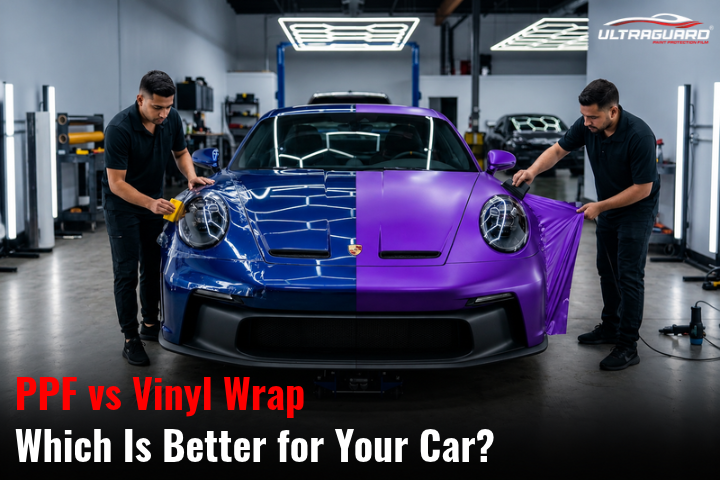
Vinyl Wrap vs PPF: Quick Comparison
| Feature | Paint Protection Film (PPF) | Vinyl Wrap |
| Main purpose | Protect the original paint | Change colour or appearance |
| Common material | TPU or other polyurethane-based constructions, depending on product | Commonly PVC-based vinyl |
| Stone-chip protection | Designed to resist certain impacts and reduce paint damage | Limited compared with dedicated PPF |
| Scratch resistance | Depends on film construction and thickness | Primarily offers light surface protection |
| Self-healing | Available on selected products | Not generally comparable to self-healing PPF |
| Colour selection | Clear and selected colour options | Extensive colours, finishes and graphics |
| Initial investment | Generally higher | Often lower |
| Maintenance | Requires appropriate film care | Requires care suited to the vinyl finish |
| Removal | Depends on film condition, adhesive and paint | Depends on vinyl condition, adhesive and paint |
| Best for | Long-term paint protection | Styling and colour customisation |
What Is Paint Protection Film (PPF)?
Paint Protection Film is a transparent or coloured film installed over a vehicle's painted surfaces to provide an additional protective layer. PPF paint protection is engineered to help reduce damage from common road hazards and environmental exposure. Depending on the product, PPF can help protect against stone chips, minor scratches, insect residue, bird droppings and other contaminants. Its actual performance depends on the film's construction, installation quality and maintenance. Premium PPF products may feature a self-healing top coat that helps minor surface marks diminish under suitable heat conditions. However, self-healing does not mean that deep scratches, cuts or severe impact damage will disappear.Key Benefits of PPF
- Paint protection: Helps reduce damage caused by small stones and road debris.
- Scratch resistance: Adds a protective layer against certain everyday surface marks.
- Self-healing technology: Available in selected products for minor surface scratches.
- Original paint preservation: Clear PPF allows the factory colour to remain visible.
- Different finishes: Depending on the product range, options may include gloss, matte and coloured films.
- Flexible coverage: You can protect selected panels or choose a full-body installation.
What Is a Vinyl Car Wrap?
A vinyl wrap is a thin, flexible film applied to a vehicle's exterior to change its colour, finish or design without repainting the entire car. Vinyl wrapping is popular among car enthusiasts who want a personalised appearance. Depending on the product, options may include gloss, matte, satin, metallic, colour-shift, textured and printed finishes. Traditionally car wrap vinyl is primarily a styling product. Although it may offer some protection against light surface abrasion and environmental exposure, it is not designed to provide the same level of impact protection as a dedicated automotive PPF.Key Benefits of Vinyl Wrap on Car
- Colour transformation: Change your car's appearance without a complete repaint.
- Wide finish selection: Explore different colours, textures and visual effects.
- Custom graphics: Create personalised designs for private or commercial vehicles.
- Lower initial cost in many cases: Vinyl wrap can be more affordable than premium full-body PPF.
- Reversible Styling: A suitable wrap can generally be removed professionally, subject to the condition of the film and underlying paint.
PPF vs Vinyl Wrap: 8 Key Differences
1. Paint Protection and Stone-Chip Resistance The biggest difference between PPF and vinyl wrap is the level of protection they are designed to provide. PPF is engineered to act as a sacrificial layer between the painted surface and external hazards. Its material properties help it absorb and distribute certain impacts, reducing the risk of paint damage from small stones and road debris. Vinyl wrap is primarily designed to change a vehicle's appearance. While it can protect against some light surface marks, it is generally less suitable for resisting stone-chip damage. For example, a car that regularly travels on highways may experience stone impacts on its front bumper, bonnet, and front fenders. Installing suitable PPF on these panels can help reduce the risk of paint damage. Which is better? PPF is generally the better option for impact protection. 2. Scratch Resistance and Self-Healing Both PPF and vinyl wrap can help protect the original paint from certain types of everyday wear, but their capabilities differ. Selected PPF products feature self-healing technology that helps minor surface scratches or swirl marks diminish under suitable conditions. The exact performance depends on the film's top coat and the type of damage. Traditionally, vinyl wrap generally does not offer the same self-healing property. If the vinyl is cut or deeply scratched, the affected section may require repair or replacement. It is important to distinguish between a scratch on the film and damage that penetrates through the film into the original paint. Which is better? A suitable self-healing PPF product is generally preferable when scratch resistance is a priority. 3. Material and Construction PPF and vinyl wrap use different material constructions to meet different requirements. Many premium automotive PPF products use thermoplastic polyurethane (TPU), a flexible material suited to impact protection. Other PPF products may use different constructions, so the material should always be confirmed for the specific product. Vinyl wraps are commonly made from PVC-based materials and are designed to conform to vehicle panels while delivering different colours and finishes. Material alone does not determine quality. Adhesive performance, film thickness, surface coating, flexibility, installation technique and product specifications all influence the final result. Before selecting a film, ask about its material, warranty, intended application and maintenance requirements. 4. PPF vs Vinyl Wrap Cost in India The cost of PPF vs vinyl wrap depends on several factors, including vehicle size, film quality, coverage, finish, and installation complexity. PPF generally requires a higher upfront investment because it is designed primarily for paint protection. Vinyl wrap can be a more economical choice when the main objective is cosmetic customisation.| Cost factor | PPF | Vinyl wrap |
| Initial investment | Generally higher | Often lower |
| Partial installation | Available for selected panels | Possible for selected panels or styling |
| Full-body installation | Depends on vehicle and film specification | Depends on vehicle and vinyl grade |
| Premium finishes | Available in selected ranges | Broad selection, depending on brand |
| Replacement cost | Depends on damaged area and product | Depends on wear, finish and replacement scope |
| Long-term value | Depends on protection needs and service life | Depends on styling preferences and replacement frequency |
- The manufacturer's recommended service life.
- The exact warranty terms and exclusions.
- Coverage for yellowing, peeling, cracking or staining, where applicable.
- The maintenance instructions for the chosen finish.
- The recommended removal procedure.
- Clear PPF: Preserve the original colour and add protection.
- Vinyl wrap: Prioritise colour customisation and styling.
- Colour PPF: Combine a colour change with paint protection.
- Avoid abrasive cleaning materials.
- Do not direct high-pressure water close to exposed film edges.
- Use cleaning products compatible with the film.
- Follow the installer's instructions during the initial curing period.
- Inspect edges periodically for lifting or damage.
PPF vs Vinyl Wrap for Indian Driving Conditions
Indian driving conditions can expose cars to strong sunlight, dust, highway gravel, construction debris, rain and outdoor parking. The right option depends on how and where you drive. If you frequently drive on highways PPF is generally more suitable for reducing stone-chip damage on vulnerable areas such as the front bumper, bonnet and front fenders. If you park outdoors Both films can help shield the paint from certain forms of exposure, but their resistance to UV damage, heat and staining varies by product. Check the manufacturer's specifications and maintenance recommendations. If you mostly drive in the city Consider partial PPF coverage for vulnerable panels if full-body installation is outside your budget. Vinyl wrap may be suitable if your main objective is a cosmetic transformation. If you want to change your car's colour Vinyl wrap offers a broad selection of colours and finishes. Colour PPF is another option if you want customisation along with the protective characteristics of PPF. The best choice is the one that matches your driving conditions, protection requirements and budget.Can You Apply PPF Over Vinyl Wrap?
Applying PPF over vinyl wrap is not a universally recommended combination. Adhesion, surface compatibility, film stability and warranty coverage depend on the specific products involved. Although certain combinations may be possible under defined conditions, you should not assume that every PPF product can be safely installed over every vinyl wrap. If you want a colour change along with paint protection, colour PPF may be worth considering as a single-film solution. Alternatively, consult the manufacturers or an experienced installer before layering products. Always confirm compatibility and warranty implications before installation.Which Should You Choose: PPF, Vinyl Wrap or Colour PPF?
The right option depends on what you want to achieve. Choose PPF if:- Protecting the original paint is your priority.
- You frequently drive on highways or roads with loose debris.
- You plan to keep your car for several years.
- You want a clear film or a product with suitable self-healing technology.
- You are willing to invest more upfront in paint protection.
- You want to change your car's colour or finish.
- You prefer a wide selection of styling options.
- Your priority is customisation rather than impact protection.
- You want a removable cosmetic transformation.
- You prefer a lower initial investment in many cases.
- You want a different colour and protective film in one product.
- You want to combine styling with paint protection.
- Your preferred colour and finish are available in a suitable PPF range.
- You are comfortable comparing its cost with conventional vinyl wrap.