PPF Coating on Bike is a thermoplastic polyurethane film applied on the painted parts of your bike, which shields it from road damage like stone chips, oxidation, and scratches. Bike PPF stands for paint protection film that has self-healing properties and UV and chemical resistance. Coverage for PPF for bikes is partial and full. The prices change based on your coverage and the quality of the PPF coating.
PPF coating for bike price (fuel tank, front mudguard, side panels, and headlight) is around ₹2,500 to ₹6,000. For full coverage of motorcycle paint protection film, you need to budget around ₹10,000 to ₹20,000.
In this blog, we discuss paint protection film for bikes, costs, PPF vs ceramic coating on bikes, benefits and whether it’s worth it or not.
One thing to remember: We often hear customers asking about PPF coating for bikes. PPF is a film, not coating. Many customers confuse it with ceramic coating.
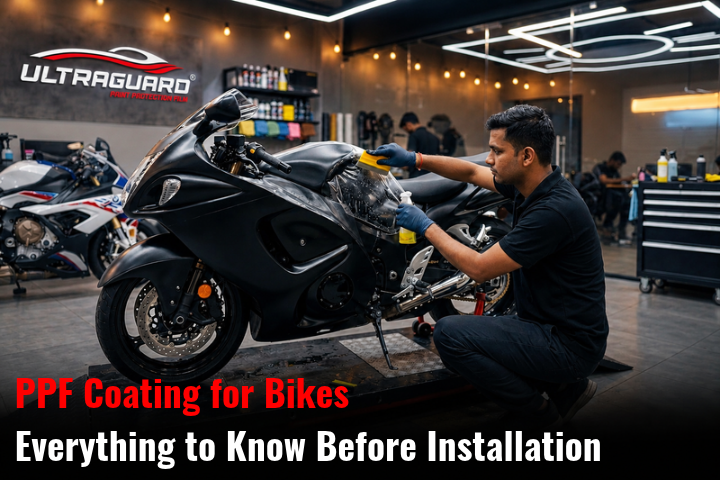
What Is PPF Coating on a Bike?
PPF coating on a motorcycle is a film, paint protection film, applied over a motorcycle or scooter’s body panels. Technically speaking, PPF is a film, not a coating. Bike Paint Protection has two popular methods: ceramic coating and TPU PPF bike. Bike Paint Protection Film is the most popular of the two. It gives high-level physical protection against stone chips, scratches, and keys. The film heals minor scratches when heat is applied. PPF on bike can last 3 to 7 years while premium brands like Ultraguard and UltrashieldX, 3M, Xpel and etc. offer up to 10 years of protection.
How Bike PPF Works?
It acts as a sacrificial and physical barrier against impacts and environmental damage. Paint protection film for bike absorbs impacts with its shock-absorbing quality and protects the factory paint. When it’s applied on the OEM paint, it takes the damage on itself, creating an invisible, tight-fitting armor.
The Science of PPF Bike Coating
How PPF layers protect your bikes or scooty:
| PPF Layer | Material | How It Works |
| Top Coat | Elastomeric Polymers | Minor scratches heal with heat and help resist stains |
| Core Layer | Thermoplastic Polyurethane (TPU) | Absorbs impact from stones and road debris to protect the paint underneath. |
| Adhesive Layer | Acrylic Copolymer | Keeps the film securely attached to the bike while allowing clean removal later. |
Lamination on Bike Options: PPF, Ceramic Coating, Wax and Vinyl
You get multiple bike paint protection options worth looking at. Let’s look at the comparison:
| Feature | Paint Protection Film (PPF) | Ceramic Coating | Carnauba/ Synthetic Wax | Vinyl Wrap |
| Purpose | Maximum physical protection from impacts | Enhanced gloss, slickness, and chemical defense | Short-term shine and basic environmental barrier | Color change, styling, light scratch defense |
| Material Type | TPU film | Liquid nano-ceramic silica (SiO₂) polymer | Natural wax or synthetic paste/liquid polymers | Polyvinyl Chloride (PVC) or polymeric film |
| Stone Chip Protection | Excellent (Dense TPU absorbs rock and gravel impacts) | None (Too thin to stop physical stone impacts) | None (Provides zero impact resistance) | Minor |
| Scratch Resistance | Excellent (self-healing properties) | Good (Resists micro-swirls, cannot self-heal) | Poor (Easily worn away; does not stop scratches) | Fair (Scratches stay permanently on the vinyl) |
| Aesthetic Effect | Invisible high-gloss or factory-matte finish | Deep, wet look with extreme mirror-like gloss | Deep organic warm glow; masks micro-swirls temporarily | Completely changes color, |
| Hydrophobic Properties | Good (Repels water and dirt effectively) | Excellent (Water beads up and rolls off effortlessly) | Moderate (Good initial water-beading for a few weeks) | Moderate (Standard plastic behavior; varies by brand) |
| Durability | 3 to 7 Years | 1 to 3 Years | 1 to 3 Months | 2 to 5 Years |
| Average Cost (India) | ₹10,000- ₹25,000 (Full bike) | ₹4,000-₹10,000 | ₹500-₹1,500 (Per application) | ₹5,000-₹15,000 (Full wrap) |
| Best Suited For | High-end bikes, daily commuters, and vulnerable tanks | Low-maintenance shine and ease of washing | DIY enthusiasts on a budget looking for shine | Customized aesthetics or a full color change |
PPF Vs Ceramic Coating For Bikes: Which Wins?
PPF vs ceramic coating on bike is a common debate among bike owners. The primary difference lies in the purpose of these two bike paint protection. Paint protection film for bike can safeguard against scratches and chips, while ceramic coating can offer hydrophobic shine and chemical resistance. Ceramic coating for bikes cannot protect against scratches. However, the water repellency makes the beads roll away which slows down dirt adhesion. You get easier maintenance. Choosing between these two depends on against what damages you wanna protect your two wheelers.
Is PPF Coating Good for a Bike
Absolutely. PPF coating for motorcycle is good and worth it if you compare it with the level of protection it offers. A bike has more exposed parts. On a bike, painted panels and road damage do not have any middle shield. Its front wheel, tank leading edge, fairing, fender, fork lowers, and headlight area receive direct hits. PPF, being a physical layer on the paint, takes these damages while your factory finish remains fresh and safe.
Is PPF Worth It for a Low-Mileage Weekend Bike?
Yes. PPF can be worth it for a low-mileage weekend bike in India. Especially if your bike is a premium one and you want to lock its OEM paint. But the choice of PPF on bike should be focused on your budget, bike’s value, and your daily commuter route rather than focusing on mileage alone.
Is PPF Worth It on a Cheap Commuter Bike?
It depends on your preference. A quality PPF installation can be expensive compared with the bike’s value. So many bike owners skip it. But many, on the other hand, apply paint protection film, no matter the costs. Choose PPF if you want to protect a new bike’s fuel tank, glossy panels, or special paint. Regular maintenance plays an important role here.
How Does PPF Protect Bike Paint from Stone Chips and Daily Wear?
PPF for bike features several layers, each layer with its own function, and these layers together provide a shock-absorbing layer on your factory paint. When a stone hits your paint, the panel takes that on itself and disperses the impact rather than letting it concentrate and cause a paint chip. Bike PPF also has a self-healing coat that can heal scratches when heat is applied.
Benefits of PPF Coating on a Bike
PPF for Bikes offers multiple advantages for your factory paint:
- A transparent shield against stone chips, gravel, and road debris.
- Fewer visible scratches and scuff marks on painted panels.
- The original factory finish stays protected for longer.
- Added resistance to UV exposure, stains, and contaminants.
- Minor surface scratches disappear with heat on self-healing films.
- Easier cleaning with less dirt sticking to the surface.
- Better long-term paint condition and overall appearance.
Types of PPF for Bikes: TPU, TPH and PVC
In Indian market, you’ll get many types of PPF for bikes which vary based on material used in the construction. Performance, durability, and cost depend entirely on the material type. Bike PPF installers offer three main types of paint protection film: TPU, TPH (Thermoplastic polyether) and PVC.
Technical Comparison of Bike PPF Materials
| Feature | TPU PPF for bike | TPH | PVC |
| Quality | Premium | Mid-range | Budget |
| Flexibility | Excellent | Moderate | Low |
| Self-Healing | Yes, in suitable films | Limited | No |
| Yellowing Resistance | High | Moderate | Low |
| Typical Lifespan | 5–7+ years | 2–3 years | 1–2 years |
| Removal | Generally clean | May leave residue | Higher risk of cracking or paint damage |
| Cost | High | Moderate | Low |
| Best For | Long-term paint protection | Budget-conscious protection | Short-term, low-cost coverage |
Most cited paint protection film types for bikes?
TPU Bike paint protection film is the most cited paint protection film types for bikes due to its advanced engineering and benefits.
Which PPF Thickness Suits High-Speed Touring Bikes?
Generally, a 190-micron-thick paint protection film is best for a bike. This thickness has enough rigidity to protect from chips and flexibility to conform to complex curves. Ultraguard’s TPU Pro Gloss PPF (5 years warranty) and TPU Pro Max PPF (7 year warranty) have 190 micron thick film.
Which PPF Kit or Coverage Suits Your Bike?
Motorcycle Paint Protection Film coverage depends on your budget and level of protection you want.
| Bike Type | Recommended PPF Coverage | Why? |
| Daily Commuter | Fuel tank and side panels | Protection from scratches from clothing, bags, and daily handling. |
| Sports Bike | Tank, front fender, fairings, and front panels | Helps prevent stone chips and scratches on exposed surfaces. |
| Adventure / Touring Bike | Tank, front panels, headlight area (if compatible), and side panels | Protects against gravel, road debris, and touring wear |
| Premium/ Superbikes | Full-body PPF | Broader protection for expensive paintwork and complex body panels |
| Weekend /Occasional Use | Tank and other high-contact areas | Targeted protection without the cost of full coverage |
How Much Does PPF Cost for Bikes?
PPF coating on bike costs depend on your coverage, type of bike (naked vs. fully faired) and film type. The partial coverage starts from ₹2,500 to ₹6,000. For full coverage, the cost of motorcycle paint protection film is around ₹10,000 to ₹20,000.
| Coverage Scope | Example | Gloss TPU Cost Range |
| Tank Only | KTM Duke, RE Classic, Yamaha R15 | ₹3,500- ₹10,000 |
| Full Bike (Naked / Standard) | RE Hunter, KTM Duke, Honda CB350 | ₹11,000- ₹15,000 |
| Full Bike with Fairing | Yamaha R15, Suzuki Gixxer SF, Ninja 300 | ₹20,000 |
| Superbikes / Premium Cruisers | Kawasaki Z900, Triumph Rocket, Harleys | ₹25,000 – ₹35,000 |
How Is PPF Applied to a Bike Tank? Step-by-Step Process
Applying PPF on bike is the most challenging part of a bike. Because bike tanks feature:
- aggressive contours
- deep knee recesses
- complex welds
PPF coating for bike installation demands wet application method via slip solution for better conformation. UltraGuard detailers follow this step-by-step procedure to ensure the film bonds correctly:
| Step | Process | What Happens |
| 1. Cleaning | Wash and decontaminate | Removes dirt, grease, and embedded contaminants from the bike’s paint. |
| 2. Preparation | Cut templates and prepare solutions | Film is cut and slip solution is mixed for easy positioning |
| 3. Film Placement | Wet application | PPF is positioned and aligned over the tank with slip solution |
| 4. Squeegeeing | Remove liquid and fit contours | Liquid is pushed out; film is carefully stretched around curves and recesses |
| 5. Edge Finishing | Trim and tuck edges | Excess film is trimmed, and edges are secured |
| 6. Final Inspection | Check and cure | recommended curing period, 24-48 hours |
Bike Paint Protection Film: DIY Kit or Professional Installation?
Professional installation is generally preferred when it comes to bike PPF application. Bikes feature complex parts that require experience and expertise for the intended finish. Stretching becomes the most critical part here. In a DIY setup, you might stretch the film so much that its self-healing coat can be broken. Apart from this, PPF installation demands a cleaner environment to prevent contamination. A home garage might not fulfill those criteria. So the best thing is to get a professional PPF installation on your bike.
What Are the Downsides of Bike PPF?
The downsides of bike PPF are its higher cost and its inability to protect against major collisions. Understanding the hidden drawbacks can prevent buyer’s remorse. For a mass-market commuter bike or scooter, a full wrap PPF cost is hard to justify. Bike PPF cost can be higher than repainting the entire vehicle. Poor installation can also be a con of two wheeler PPF. Relief cuts, stretch marks, wrinkles, and trapped air bubbles can compromise the finish if you choose an inexperienced installer.
A low-quality PPF can be your biggest mistake. TPH or PVC film lack the flexibility to stay on the panels longer. They can strip off the paint upon removal. But high-quality PPF films, like Ultraguard source TPU from Lubrizol, BASF, and Wanhua, can be paired with Ashland adhesive. This makes films safe for installation and removal.
Is It Legal to Wrap a Bike in India?
The legality of bike wrapping in India depends on what kind of wrap you are using and what modifications it causes. If you choose a clear paint protection film for a bike, it is considered legal. But if you are choosing a colored PPF that can change the original color of your bike, it’s considered illegal. Motor Vehicles Act, 1988 governs bike modifications in India. According to Section 52, you cannot change a bike in such a way that its original specifications provided by the manufacturer are also altered. Like:
- Engine
- Fuel system
- Capacity
- Body structure
- Chassis structure
- Colour without updating RC
- Exhaust system
If you are thinking of getting Ultraguard color paint protection film for bike then updating the new color in your registration certificate is mandatory. Apply for color change approval to the RTO. Failing to adhere to these rules can result in a fine.
What Do Industry Data and Experts Say About PPF on Motorcycles in 2026?
Indian riders are buying more bikes, which means there is more paint on the road unprotected.
- As per the Society of Indian Automobile Manufacturers (SIAM), India sold 1,30,64,789 motorcycles in FY26.
- The July–September 2026 quarter set a record for two-wheelers. Sales went up 15.2% to 64.33 lakh units. (Outlook Business).
With automotive aftermarket protection growing, PPF is gaining traction among these buyers. But experts also warn about counterfeit protection films that can harm the original paint and turn yellow in just 1-2 years.
What Ultraguard Experts See On The Road?
Our regional sales manager visits the field regularly. They give us insights that about one in four of our PPF jobs is a motorcycle. What Ultraguard PPF for bikes protected so far?
| Bike | Why riders protect it | Most-covered areas |
| TVS Apache RTR 160 4V / 200 | Daily use and weekend rides, so heavy exposure to road debris | Tank, fenders, headlight |
| Royal Enfield Classic 350 / Bullet 350 | Large painted tank, where scratches and fuel stains show first | Tank, side panels, fenders |
| Royal Enfield Hunter 350 | Urban riding, tight parking and stone chips | Tank, front fender |
| KTM Duke / RC series | Exposed panels, plus fairings on the RC | Tank, fairings, tail section |
| Triumph 400 platform | Premium finish and higher paint value | Full tank, fenders, headlight |
| Kawasaki Z900 / Ninja 650 | Costly paint, so repaint bills hurt | Full-body or partial-body kits |
Royal Enfield’s FY26 domestic sales have reached 11,07,343 units. It’s up by 23%. That’s a lot of new Classics, Bullets and Hunters rolling out with factory paint worth protecting.
PPF Coating on Bike Near Me: Ultraguard Paint Protection Film
If you are searching PPF for bike near me, your search stops here. With Ultraguard, you get a wide network of 100 dealers and 5000 detailers to protect your bike in nearly every Indian state and city. Ultraguard’s multilayer TPU-based PPF is available with 5 to 7 years of warranty coverage. Popular bike paint protection film includes:
| PPF | Warranty | Thickness |
| TPU Pro Gloss PPF | 5 years | 190 microns |
| TPU Pro Gloss Max PPF | 5 years | 190 microns |
| TPU Supreme Shield PPF | 10 years | 213 microns |
| TPU Instant Healing PPF | 5 years | 200 microns |
We also have matte PPF, color PPF and carbon fibre PPF for motorcycles. Contact the team for a quote.
Conclusion
Bikes take a beating. Stones, fuel spills, sun and parking-lot scrapes all go after your paint. Bike paint protection film fights back, and TPU film does it best. Whether you ride an Apache, a Classic 350 or a Z900 – early protection saves money later. Book your PPF coating on bike with Ultraguard today.
FAQ’s – Paint Protection Film for Bike
Q1. How much does PPF cost for bikes?
PPF coating for bike price (fuel tank, front mudguard, side panels, and headlight) is around ₹2,500 to ₹6,000. For full coverage of motorcycle paint protection film, you need to budget around ₹10,000 to ₹20,000.
Q2. Which one is the best PPF coating for a daily commuter bike?
A TPU bike PPF is best for a daily commuter bike because it is highly durable and flexible to protect against everyday wear and tear. Make sure you choose an aliphatic, 190 microns thick film and an experienced installer for best paint protection and finish.
Q3. How do I stop stone chips from damaging my bike paint?
Paint protection film is best to stop stone chips from damaging your bike paint because it acts as a physical layer that takes the damage on itself. The TPU core absorbs the shock of stones and disperses the force instead of letting it concentrate to one point. This prevents stone chips and keeps the paint safe.
Q4. How do I protect bike paint from commuting wear?
You can choose bike paint protection to protect bike paint from commuting wear. Popular options include ceramic coating and PPF coating. If you want easier maintenance, ceramic coating can be a good fit. For paint protection, choose PPF coating for bikes. Regular maintenance is important when it comes to protecting your daily commuter.
Q5. What’s the warranty for Ultraguard PPF coating for bike?
Ultraguard PPF for bike warranty ranges from 5 years to 10 years depending on the type of film you are choosing. A 190-micron-thick film gives you 5 years of paint protection while our other lineup with 200- micron thick can offer a warranty for 10 years.


0 Comments