When you roll out of the showroom floor on a new car, the clock begins to tick. The acidic properties, such as bird droppings, combined with the gravel on Indian highways, and the harsh UV radiation of our climate, are harming your car factory’s clear coat.
When in search of the Best Paint Protection Film, you must have come across three acronyms, namely TPU vs TPH vs PVC PPF. But what is it that they are really doing to the life of your car and its resale value? Being experts from Ultraguard, we have broken down the science behind these materials to make the right investment.
What is PVC PPF, and the reason why it is commonly referred to as Static Wrap?
Polyvinyl Chloride (PVC) is the original first generation of Car Paint Protection Film. It was created for heavy-duty industrial use and hence was adapted to cars, as the original design of the product was intended to be used in industrial machines.
- The Composition: PVC is a naturally stiff, hard plastic. Manufacturers incorporate plasticizers to achieve the use of this around the bumper of a car.
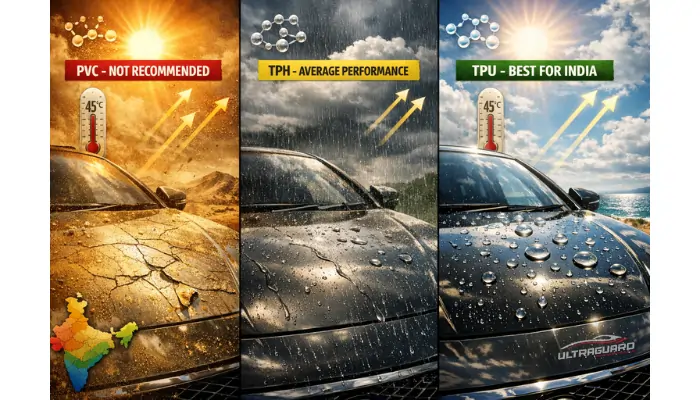
- The Failure Point: These plasticizers leak out or evaporate under the Indian sun. This causes the film to get brittle and shrink.
The Aesthetic Nightmare: PVC does not have UV stabilizers. It takes 6 to 12 months to acquire a dark yellow hue. It is also not flexible, so it has the same problem of being affected by oranges peel texture that spoils the smooth appearance of your paint.
Conclusion
PVC is an adhesive, not a shield. It is hardly regarded as the Best PPF Coating to be used with luxury or long-term ownership of a vehicle.
Is TPH PPF the cost-effective wonder as it claims to be?
TPH (Thermoplastic High-polymer) is commonly sold as a so-called hybrid film. It was developed to fill the huge price difference between low-cost PVC and high-quality TPU.
The way it is prepared: TPH involves using PVC as its center base, but replacing the conventional plasticizers with special high polymers. Others also have a microscopic coating of TPU attached to it.
Performance: It is far softer and easier to install than PVC. It has superior gloss and enhanced flexibility.
Conclusion
TPH itself is an improvement, but still, it is a disposable film. It normally takes 2 to 3 years before the edges begin to raise or the clarity starts to disappear. It offers a moderate level of protection, and it does not have the actual healing technology that the high-end brands have.
Why is TPU the Gold Standard of the Best Paint Protection Film?
Thermoplastic Polyurethane (TPU) is a complex linear block copolymer. TPU is inherently elastic as compared to the previous ones. It does not require any chemical additives to remain flexible, and that is the key to its unbelievable durability.
The Aliphatic Difference
The use of Aliphatic TPU is stressed at Ultraguard. Aromatic TPU is also used in many generic films, and it still yellows with time. Aliphatic TPU is chemically arranged to be “UV-invisible,” that is, it remains transparent to the eye even after decades of close exposure to extreme sunlight.
The “Magic” of Self-Healing
TPU has a shape memory top coating. The polymer chains are driven aside and not broken when a stone chip or a key scratch hits the surface. Once heated, i.e., by sunlight, warmed-up water, or the heat of an engine, the chains are once more pulled out of place, and the scratch will instantly vanish.
TPU vs TPH vs PVC PPF: The Technical Comparison
When a Paint Protection Film comparison of TPU, TPH, and PVC is done, it is evident when considering the “Total Cost of Ownership.”
| Feature | PVC (First Gen) | TPH (Mid-Tier) | TPU (UltraGuard Premium) |
| Chemical Base | Rigid Vinyl | Modified Polymer | Linear Polyurethane |
| Self-Healing | None | Very Limited | High (Instant/Heat-Activated) |
| UV Resistance | Poor (Yellows in months) | Moderate (2 years) | Excellent (Non-Yellowing) |
| Impact Absorption | Low (Tears easily) | Moderate | High (Elastic energy return) |
| Expected Life | 1 Year | 2–3 Years | 5–10 Years |
| Removal | Risky (Adhesive residue) | Moderate | Safe (Clean peel) |
What is the impact of the Indian climate on your TPU vs TPH vs PVC PPF selection?
Heat: PVC and TPH can bake onto the paint, and they are almost impossible to remove without the use of rough chemicals or heat guns, which may peel off the clear paint on your car.
Dust: The poor films are characterized by the fact that they contain dust. Whereas the TPU of Ultraguard is waterproof, sun-protected, and dustproof with a hydrophobic top coating, thus making it very easy to maintain.
Which is the Best PPF Brand that I should select for my Car?
Test the Raw Material: Is the brand made with high-quality TPU resins (such as Lubrizol)?
Warranty Check: Is the brand digitally tracking a warranty against cracking and yellowing?
Hydrophobic Properties: An excellent film must be water-repellent, like an excellent ceramic coating.
Advanced self-healing feature: Usually modernised paint protection film holds the ability of self-healing properties and even instant healing technology.
Does TPU justify the increased cost?
When it comes to taking care of your car, you are getting what you are paying for. A PVC or TPH film may save you some money now, but the expense of removing broken film or repainting a yellowed hood is much more than the savings you made.
TPU is the only option that would provide the car owner with true invisible protection, self-healing properties, and a 10-year showroom shine.
Ultraguard Protect Your Pride
Don’t leave the future of your car to a product if it is not good enough. Our product, the Best Paint Protection Film technology, is specially created to withstand the Indian road conditions with Ultraguard. So, experience the Best PPF Brand Ultraguard on your new SUV or a high gloss finish for your luxury sedan.
Why Choose Ultraguard?
It is not just the material that matters when it comes to the Best PPF Brand, but the added value of a guarantee, which is premium engineering. In our company, Ultraguard, we are dealing with high-performance TPU films that are directly tested on road debris and environmental pollutants. We do not merely give out a covering of plastic; we give out a shield of assurance.
You should not be satisfied with good enough in reference to the paint of your car. Protect your car with the best one ever. Today, we have all of our protection products on display at Ultraguard, or, to check out one of our certified installers, and see the full potential of the Best PPF Coating technology in action, just visit Ultraguard – https://www.ultraguardindia.com/ or call us at +91-93-10000-356.
Conclusion
When you compare the facts in the TPU vs TPH vs PVC PPF debate, it is obvious what you should choose: it depends on the long-term objectives of your vehicle.
PVC or TPH are potentially shortcuts worth considering in case the vehicle you are about to sell or wrap will be attractive within a year. Nevertheless, as numerous Indian car owners have discovered, such low-cost films may cause the problem of yellowing, cracking, and expensive labor charges to take them off. They are a short-term solution to a long-term investment.
TPU is the clear winner for people who consider their car as an investment, and they want to keep the showroom sheen on a car by day one. It is the sole material that provides the chemical stability to resist the strenuous Indian sun and the physical elasticity to heal itself of the daily wear and tear of the road. In the case of the Best Paint Protection Film, TPU is not a choice, but it is a standard in the industry.
Frequently Asked Questions (FAQ’s)
Ques: What is the most durable material?
Ans: TPU is an obvious winner, and it holds the warranty of 5-10 years. TPU vs TPH vs PVC PPF tends to fail in 1 year, and TPH tends to last between 2 and 3 years.
Ques: Does TPU PPF actually self-heal?
Ans: Yes. Quality Car Paint Protection Film is produced out of TPU that contains a memory layer. Swirls and light scratches actually disappear when they are exposed to heat (in the sun or in hot water).
Ques: Will the film turn yellow?
Ans: No, in case you select Best PPF Brand Ultraguard. We are working with Aliphatic TPU, which is UV-resistant. Lower price PVC and TPH films utilises Aromatic polymers that get yellow and brittle in several months.
Ques: Does PPF outweigh Ceramic Coating?
Ans: For impact protection, yes. Ceramic coating is only able to resist chemicals and light stains. The physical protection against stone chips and scratches is offered only by the Best PPF Coating (TPU).
Ques: Can PPF be removed easily?
Ans: Yes, as long as you use high-quality TPU. Less expensive PVC films contain aggressive adhesives that may remove your vehicle paint in the case of removal. Quality TPU comes off easily, leaving no residue.
Ques: Is it worth the higher price?
Ans: Absolutely. Although TPU is an expensive investment, it offers a high level of durability and paint saving, which makes it the Best Paint Protection Film in keeping your car with high resale value.



0 Comments