Types of Number Plates in India: Colours, Meanings & Rules Explained

  23 October 2026             Ultraguard Editorial Team
If you're like me, too, your car isn't always only a way from A to B; instead, it is a reliable companion, a weekend Warrior, and a considerable investment. But as soon as vivid, new types of number plates in India are used on the bumper, the car receives a professional identity that is notably enriched in detail. Even in the middle of the traffic or somewhere else, when you might have seen a different-coloured number plate, you would have questioned, "Why is that plate yellow? Is that even legal?" Vehicle registration plates of India are governed by a brilliant yet often misunderstood colour-coding system. It's not just about a random number; the colours instantly tell a story about the vehicle’s purpose, ownership, and even its fuel source! Let's take a deep dive into the blog, where we will see the most critical and different types of number plates in India, so you can confidently spot every transport type out there.

Types of Number Plates in India

Types of Number Plates in India

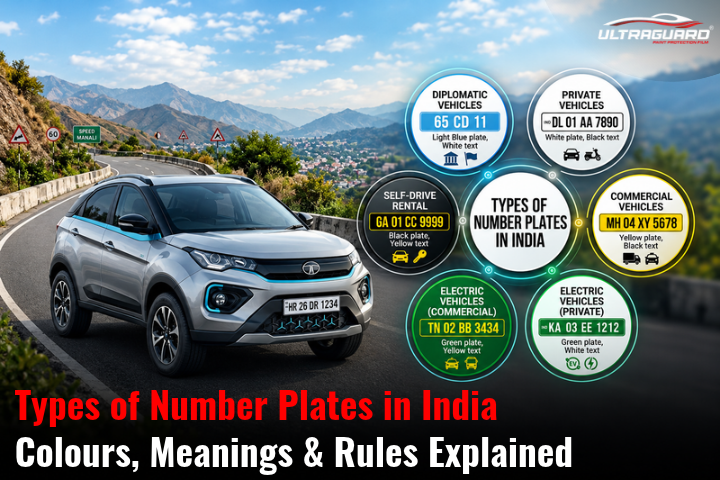
Here are the different kinds of number plates in India, and the meanings they hold as follows:

Number Plates for Private Vehicles

This is where most of us live, the world of private motoring.
Plate Type Background Colour Text/Numeral Colour The Real Story
The Private Standard White Black This is the common thing you will see on Indian roads, as well as in your personal travel vehicle. If you own a sedan, an SUV, or a two-wheeler for your family, errands, or daily commute, this is your plate. The most significant rule here? You absolutely cannot use this car to earn an income (like a taxi or courier vehicle).
The Rental Rider Black Yellow Self-drive rentals! These are registered commercially but are designed for you to drive. It’s perfect for that weekend getaway where you want a different set of wheels. The best part? Despite being a commercial vehicle, you don’t need a specialised commercial driver’s licence.
Understanding these types of number plates in India is fundamental. The white plate symbolises freedom and personal use, while the black plate represents flexible, temporary commercial access.

Commercial & Specialised Number Plates Explained

Look around a busy intersection, and you’ll notice that everything keeping the economy running, from buses to goods carriers, has a distinct identifier.

Yellow Plate

Simply put, the yellow plate (with black textual content) is uniform for all transport and heavy industrial vehicles. Taxi, car-rickshaws, city buses, and trucks are all coloured in this shade. This surely shows that its own tax and automobile are below the coverage structure, and the driver needs to have a commercial driving permit.

Green Plate

This is the plate of change! The Green Number Plate is reserved exclusively for Electric Vehicles (EVs) and is one of the most exciting and different types of vehicle number plates in India.
  • Green Background with White Text: This signifies a private EV or your personal, guilt-free electric daily driver.
  • Green Background with Yellow Text: This is for a commercial EV, such as an electric taxi fleet or an e-delivery vehicle.
It’s a simple, brilliant way to identify and encourage green mobility!

Unique & High-Security Number Plates Explained

Some plates carry serious weight, either due to protocol or new national security standards.
  • Blue quantity plate: This plate is reserved for vehicles used by overseas embassies and diplomatic missions. The registration number uses white text and frequently carries small phrases like CC (Cannons Corps) or CD (Diplomatic Corps). This indicates that the driving force represents an overseas government.
  • Red Plate (Temporary): Remember the paper number plate you had when you first bought your car? That temporary registration is often displayed on a Red plate (with white or yellow text) and is strictly valid for about 30 days while the RTO finalises your permanent registration. Don’t push your luck past that deadline!
  • Red Plate with the Emblem of India: This plate defines VVIP status. It is reserved for the country's highest offices, such as the President and State Governors. It swaps the standard number format for the prestigious Emblem of India.

HSRP vs BH Series: Key Differences

These are two modern additions to the types of number plates in India that directly benefit you, the owner. High Security Registration Plate (HSRP) HSRP is compulsory across the country, and for good reasons. It's not just about pure writing; it is a tamper-proof aluminium plate with a unique laser code, a mandatory IND inscription, and an Ashok Chakra hollow. This system is a significant leap for the safety of the vehicle, which is almost impossible, and helps law enforcement trace vehicles effectively. If you have an old car, make sure you get this upgrade! BH Series If your job requires you to move from Mumbai to Bengaluru or Delhi to Chennai, you know the pain of re-registering your car. The new BH (Bharat) Series plates (e.g., YY BH #### XX) eliminate this headache for central government, defence, and transferable private sector employees. It’s a national registration that saves you time, paperwork, and RTO fees.

Next-Level Car Care with PPF

So, your registration is perfect, legal, and current. That’s a giant checkmark! But as someone who appreciates their vehicle, I know your passion doesn't end at compliance. You want your car to look stunning year after year. Here’s the truth: no matter how compliant your plates are or what types of number plates are in India, they can't stop a stone chip or a key scratch from ruining your car's paint. To truly protect your mobile investment, you need something invisible yet incredibly resilient. This is where a quality PPF coating comes in. PPF is a high-grade, self-healing shield that deflects the daily abuse that would otherwise etch into your clear coat. This keeps your car's factory finish, maintains the 'new car gloss' look, and protects the resale value better than any wax or ceramic coating alone. Ultimately, a well - developed car, with its correct and shiny registration plates, is always the best effect.

Conclusion

It is clear that different number plates in India are much more than identifiers; they are an essential part of the country's transport code. Each colour has a meaning, from the white plate for your private car to a green plate that signifies a cleaner future. By knowing this code and taking some action steps to safeguard the vehicle's body with solutions such as paint protection film, you not only follow the rules but also drive your vehicle with peace of mind and pride.

FAQ's - Vehicle Registration Plates of India

Q1. What are the different number plate types in India?

The main number plate types in India include white, yellow, green, black, and red number plates, each indicating a vehicle's category or registration status.

Q2. What does each number plate colour in India mean?

The number plate colour in India indicates the vehicle's use. White plates are generally for private vehicles, yellow for commercial transport, and green for electric vehicles.

Q3. What is a commercial vehicle number plate?

A commercial vehicle number plate is generally yellow with black lettering and is used for eligible transport vehicles, such as taxis and goods carriers, according to applicable registration rules.

Q4. What is an All India number plate?

An All India number plate commonly refers to the BH (Bharat) series registration, which is available to eligible vehicle owners and allows vehicle registration to remain valid across states without requiring a new registration mark after relocation.

Q5. What are the new rules for vehicle number plates in India?

The new rules for vehicle number plates in India include requirements related to High-Security Registration Plates (HSRP), proper display, and prescribed formats. Vehicle owners should check the latest applicable government guidelines.

Q6. What are the important number plate rules in India?

The number plate rules in India require vehicles to display registration plates in the prescribed format, with legible characters and compliant plates. Applicable HSRP and colour requirements depend on the vehicle category and registration regulations.
Keep Reading

Related Articles

Anti-Fog Windshield Film vs Defogger: Which Is Better for Everyday Driving? Windshield PPF
Nov 2026 1 week ago

Anti-Fog Windshield Film vs Defogger: Which Is Better for Everyday Driving?

Reviewed By Ultraguard National Sales Manager (29 years' experience) Anti-Fog Windshie...

Read More
Car Wash After PPF: How to Wash PPF Cars - 7 Expert Tips for Paint Protection PPF Coating
Nov 2026 2 weeks ago

Car Wash After PPF: How to Wash PPF Cars - 7 Expert Tips for Paint Protection

Written By Ultraguard Editorial Team Reviewed By Ultraguard Regional Sales Manager (18...

Read More
Electric Car vs Petrol Car: Which One Makes More Sense in India Automotive
Oct 2026 3 weeks ago

Electric Car vs Petrol Car: Which One Makes More Sense in India

Electric car vs petrol car conundrum has one clear answer: An EV wins on running cost for most city...

Read More

See This Series on Your Car

Open the 3D Car Visualizer to preview every colour in this series, or talk to a dealer for samples and pricing.

WhatsApp