A foam wash uses a thick, soapy snow foam to loosen dirt before touching the car. In a normal wash, water and soap are applied directly with a sponge or cloth. Both are important methods of car washing. Keeping a car clean is an important part of vehicle maintenance. Regular exterior car cleaning removes dust, mud, road grime, bird droppings and contaminants. If left for longer, they can affect your car’s paint aesthetics.
Choosing the right car wash method is vital. Two common approaches are foam car wash and normal car wash. A foam wash sprays a layer of foam on the car and lets it sit to lift dirt. A hand wash means immediately washing the car with soapy water and scrubbing.
So, in this blog, we answer you question regarding car washing and cleaning:
● Is a foam wash actually better than a normal wash?
● Can foam washing a car reduce scratch risk?
● Do you need a pressure washer for a foam wash?
● And which method should you choose for your car?
Let’s compare both methods and understand when each one makes sense.
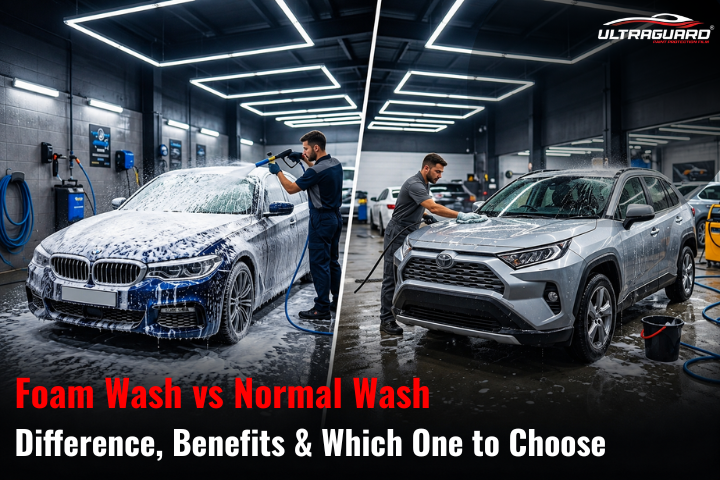
What Is a Foam Car Wash?
Car foam wash uses a thick foam layer to clean the vehicle. The method specifically utilizes a dedicated car foam shampoo which is diluted with water and sprayed over car’s exterior. To apply the foam, experts use foam cannon, foam lance, or suitable pressure washer attachment.
Once sprayed, it covers the vehicle entirely with a white, snowy foam that stays on the surface for a short period. This dwell time allows the car foam shampoo solution to loosen and encapsulate dirt, dust, and road grime. After the foam has had enough time to work, it is rinsed away. Then you can perform a normal car contact wash to remove that loose dirt with a clean wash mitt and car shampoo.
If you don’t remove that dirt and contamination and start directly with a normal car wash, the fine dust will scratch the paint and cause micro-marring. The foam wash for car isn’t just a routine. Its main purpose is to reduce the amount of loose contamination on the paint before you start physical car washing.
What Is a Normal Car Wash?
A normal car wash process first rinses the vehicle then starts cleaning with car shampoo. It involves agitating the surface with a wash mitt or sponge. Then it is rinsed again.
For example, a basic washing process may look like this:
● Rinse the vehicle with water.
● Apply car shampoo.
● Clean the exterior with a wash mitt or sponge.
● Rinse the shampoo and loosened dirt.
● Dry the vehicle using a suitable microfiber towel.
A properly performed normal wash can clean a vehicle. Many professional car detailing processes use a pre-wash or foam stage before the normal car wash to clean the car throughout.
What’s the Difference Between Foam Wash vs Normal Wash
The big difference in foam car wash and a normal contact wash is how dirt is removed before physical contact with the paint.
| Feature | Foam Car Wash | Normal Car Wash |
| Pre-wash cleaning | Yes | Limited |
| Washing foam | Used extensively | May not be used |
| Physical contact | Can be reduced during pre-wash | Usually starts earlier |
| Dirt loosening | Foam helps loosen contaminants | Shampoo + physical agitation |
| Pressure washer | Commonly used | Optional |
| Scratch-risk management | Can help reduce abrasive contact | Depends heavily on washing technique |
| Water usage | Depends on equipment and process | Depends on method |
| Detailing use | Common in professional car detailing | Common for routine washing |
| Best for heavy dirt | Generally useful | May require more physical cleaning |
| Maintenance wash | Excellent as a pre-wash | Suitable when performed correctly |
What Experts Say
Foam car wash and normal car washing may have similar outcomes, which is a clean vehicle but they both take a different approach. This doesn’t mean that foam wash replaces a contact wash. For many vehicles, foam wash + safe contact wash provides a comprehensive cleaning process.
How Does a Foam Car Wash Work?
A best car foam wash involves several detailed stages.
1. Initial Inspection
Before car washing kicks off, technicians check the entire panel. If there is heavy mud, bird droppings, tar, insects, or other contaminants, they curate their approach accordingly. This helps them determine how aggressive car cleaning process will be.
2. Pre-Rinse
Before you apply foam, splash some water to remove the surface dirt. Professional car washing shops use pressure washers to make this stage more effective because they offer strong water flow.
3. Apply Washing Foam
A suitable car shampoo is mixed with water and applied with a foam cannon or foam lance. The entire exterior is covered evenly:
● Doors
● Bonnet
● Roof
● Fenders
● Bumpers
● Side skirts
● Rear panels
4. Allow the Foam to Dwell
The foam sits on top for a couple of minutes. Always check car shampoo’s specification for dwelling time. The goal is to allow the cleaning solution to loosen contaminants without letting it dry on the surface.
5. Rinse Car Shampoo Foam
The foam and loosened contamination are rinsed away, preferably from the top of the vehicle downward.
6. Contact Wash
If the surface still does not feel smooth under your palm, go for normal car washing. Use a clean microfiber wash mitt and car shampoo. Use the two-bucket wash method:
● One bucket contains shampoo solution
● The other is used for rinsing the wash mitt
7. Dry the Vehicle
Professionals use car drying equipment to make the process quick. You can use a soft microfiber drying towel too. Do not let water dry naturally on the surface. Mineral deposits can leave water spots.
Does Foam Wash Prevent Car Scratches?
One of the most common questions about foam wash. A foam wash does not guarantee a scratch-free paint automatically. It can help reduce the cause of it. Scratches can happen if you drag dirt on the surface. But in car foam wash, that loose dirt is removed. Your surface then has no loose dirt and abrasive contamination present before contact washing.
What happens during a traditional contact car wash?
A dirty vehicle may contain:
● Sand particles
● Road dust
● Mud
● Grit
● Fine debris
● Industrial contamination
If these contaminants remain on the paint and you are using a wash mitt, you are accidentally causing scratches. That’s why foam pre-wash is used to dissolve this and give you a perfect surface to kick off next cleaning step.
Bottom line? The real benefit is not that foam itself protects the paint via some magic. The benefit comes from reduced potentially abrasive contamination before actual car washing. Technique still matters.
If you are going for car cleaning even after foam washing, make sure:
● You don’t use a dirty sponge or apply excessive pressure
● Do not wash in direct sunlight
● Using an unsuitable shampoo can directly harm the surface, causing permanent damage to factory paint
● Avoid contaminated microfiber towels
Is Foam Wash Better Than Normal Wash?
You cannot decide whether car foam wash is better than the normal wash because there is no single answer for every vehicle. A new car, rolled straight from the showroom, might not need a foam car wash, while a car parked under direct sunlight for a week might. Every vehicle demands a separate approach.
For example, some heavily contaminated cars need extra foam and contact wash. They need a whole process of alkaline, acidic, and neutral car shampoo washes to target each type of contamination.
A foam wash is particularly useful when you want to reduce physical agitation. For professional car detailing, a foam pre-wash is a part of a safe washing process.
Benefits of Foam Wash for Car
Car foam wash has multiple advantages for your vehicle:
1. Foam Wash Helps Loosen Road Grime
It has the ability to loosen dirt and road grime before contact wash. This can make the whole cleaning easier.
2. Car Foam Wash Reduces Initial Physical Contact
● Because foam is applied before the wash mitt
● Some loose contamination can be removed without touching the paint.
● Reduces unnecessary agitation
3. Best Car Foam Wash Is Useful for Heavily Dirty Cars
Vehicles exposed to highways, construction areas, monsoon conditions, or muddy roads can accumulate contamination. Gradually, it can bake into the clear coat. A foam washing can be very beneficial here.
4. Car Foam Wash Improves the Washing Process
The foam can prepare your vehicle for the next part of the process by giving a partially cleaner surface. Detailers can move to clay bar decontamination if needed.
5. Washing Foam Is Useful in Car Detailing
Professional detailers use pre-wash techniques as a pivotal part of car exterior care and detailing. Foam washing is incorporated into the bigger picture of exterior car care in car detailing.
6. Pressure Washer Can Make Washing More Efficient
When you combine suitable car shampoo with a pressure washer, the results appear in the result itself with lifted contamination.
What Is the Role of a Pressure Washer in Foam Car Wash?
A pressure washer is used with a foam cannon or foam lance. It provides the water pressure which is needed to generate foam; it also helps in distributing it evenly.
However, note that pressure alone does not determine cleaning performance. A good foam wash depends on several factors:
● Pressure washer performance
● Foam cannon or foam lance
● Car shampoo formulation
● Shampoo dilution
● Quality of water
● Foam coverage
● Dwell time
● Rinsing technique
Do not choose a pressure washer just because it has extremely high pressure
How to Choose the Best Car Foam Wash Shampoo?
Choosing the right product is more important than simply looking for the thickest foam.
A shampoo that creates huge amounts of foam is not necessarily the most effective cleaning product. When choosing a car foam wash product, consider:
| What to Check | What to Look For |
| pH Compatibility | Choose a shampoo suitable for automotive surfaces and your existing protection |
| Lubrication | Good lubrication helps the wash mitt move smoothly across the surface during contact washing |
| Cleaning Ability | Cleaning strength is important based on the type and level of contamination |
| Protection Compatibility | Check that the shampoo is suitable for wax, sealant, ceramic coating, or PPF if your car has one |
| Dilution Instructions | Manufacturer’s recommended dilution. More shampoo does not necessarily mean better cleaning |
Foam Wash for Cars With PPF
If your car has paint protection film on, you need to be a little careful while choosing foam car wash. PPF coating protects your vehicle from everyday damage like stone chips, scratches, stains, and environmental contamination. But it demands maintenance too. A foam wash can be used on PPF coated car but make sure that you tell your detailer about it. They should avoid extremely high pressure on the surface with a pressure washer. Because this can lift the edges of PPF.
For foam washing a PPF-protected vehicle:
1. Remove loose dirt with water.
2. Apply a PPF-compatible foam or car shampoo.
3. A suitable dwell time is needed.
4. Rinse it
5. You can go for a gentle contact wash if required.
6. Rinse again.
7. Dry with a clean microfiber towel
PPF features a top functional coat. If you don’t choose a suitable car shampoo, it can harm the functional coat and the self-healing process. Try to go with a pH-neutral shampoo for PPF.
Foam Wash vs Normal Wash for a New Car
Many new-car owners assume that a new vehicle does not require careful washing because the paint is fresh.
In reality, the condition of a new car’s paint can benefit from proper washing practices from the beginning.
A new car may still accumulate:
● Transportation dust
● Road grime
● Bird droppings
● Insects
● Industrial fallout
● Water spots
You can combine foam pre-wash followed by a contact wash. This approach helps maintain the exterior finish.
How Often Should You Foam Wash Your Car?
Vehicle maintenance on a periodic basis is important, especially if you are a daily commuter. You can either choose a foam wash weekly or twice or thrice in a month.
You may consider a foam pre-wash when:
● The car has visible road grime.
● The vehicle has been driven through muddy conditions.
● There is significant dust buildup.
● The car has been exposed to rain and road spray.
● The vehicle has accumulated insects or other surface contamination.
For routine maintenance, the focus should be on safe washing rather than washing as frequently as possible.
Common Foam Wash Mistakes to Avoid
Even the best car foam wash can be ineffective if the process is incorrect.
● Applying Foam to a Hot Surface: Avoid washing when the vehicle’s surface is excessively hot. Foam and shampoo should not be allowed to dry on the paint.
● Letting Foam Dry: The purpose of dwell time is to loosen contamination, not to let the product dry.
● Using Household Detergent: Household dishwashing liquids or detergents are not necessarily formulated for automotive paint and protective surfaces.
● Using a Dirty Wash Mitt: A contaminated wash mitt can carry abrasive particles back onto the paint.
● Using One Bucket: Separate wash and rinse buckets can help you manage contamination in contact washing.
● You Apply Excessive Pressure: More pressure does not mean better cleaning. Cleaning chemicals and water do the work.
● Dirty Drying Towels: Microfiber towels should be clean and suitable for automotive surfaces.
Is Foam Wash Necessary for Every Car Wash?
No. If your car is only lightly dusty, a simple and properly performed wash may be enough. However, if your vehicle has substantial road grime, a foam pre-wash can be a valuable additional step. The key is to understand the role of foam.
Foam is primarily a pre-wash cleaning step, not a replacement for every other stage of car washing. If you want a full exterior car cleaning routine, combine:
● Foam washing
● Rinsing
● Contact washing
● Proper drying
Foam Wash vs Normal Wash: Which Should You Choose?
The choice between foam wash and normal wash depends on the condition of your vehicle and your washing routine.
Choose a foam car wash when you:
● Deal with heavy road grime.
● Want a pre-wash stage before touching the paint.
● Regularly maintain a PPF-protected vehicle.
● Follow a professional car detailing process.
● Have access to a pressure washer and suitable foam equipment.
A normal car wash can be suitable when:
● The vehicle is only lightly contaminated.
● You use a proper car shampoo.
● You use clean microfiber equipment.
● You follow safe washing techniques.
● A foam pre-wash isn’t practical for your situation.
For many car owners, the most comprehensive approach isn’t choosing one over the other. It is using foam wash as a pre-wash followed by a safe contact wash when necessary.
Conclusion
The difference between foam wash vs normal wash is mainly the way contamination is handled before physical contact with the vehicle’s paint. A normal car washing can clean the car efficiently but the key is to perform the correct procedure. But a foam wash adds an important pre-cleaning stage. It helps loosen and remove surface contamination before contact washing.
For a daily driver, the best approach is to focus less on creating extremely thick foam and more on the right car shampoo, pressure washer, washing technique, microfiber equipment, and drying process.
FAQ’s – Foam Car Wash
Q1. Is foam wash better than normal car wash?
Foam wash can provide an additional pre-wash stage that helps loosen and remove dirt before contact washing. A properly performed normal wash can also clean a vehicle effectively. The better method depends on the vehicle’s condition and washing technique.
Q2. Does foam wash remove scratches?
No. Foam wash does not remove existing scratches from automotive paint. It can help reduce abrasive contact during washing by loosening and removing some dirt before the wash mitt touches the surface.
Q3. Can I use a foam wash without a pressure washer?
Some foam products can be used with alternative foam sprayers or pump-based equipment. However, a pressure washer with a suitable foam cannon or foam lance is commonly used to produce and distribute thick foam efficiently.
Q4. Is foam wash safe for PPF?
A suitable automotive foam or car shampoo can generally be used as part of PPF maintenance, but product compatibility should always be checked with the PPF manufacturer’s care instructions.
Q5. How often should I foam wash my car?
There is no fixed frequency. It depends on driving conditions, weather, road contamination, and how quickly the vehicle gets dirty. Foam pre-washing can be particularly useful when the car has significant road grime.
Q6. Does thicker foam mean better cleaning?
Not necessarily. Foam thickness alone does not determine cleaning performance. Shampoo formulation, dilution, dwell time, water pressure, and the overall washing technique also affect the result.
Q7. What is the best car foam wash?
The best option depends on the vehicle, level of contamination, existing paint protection, and washing equipment. Look for an automotive-specific product with suitable cleaning ability, lubrication, and compatibility with your vehicle’s protective coating or film.
Q8. Can foam wash prevent swirl marks?
It cannot guarantee that swirl marks will never occur. However, using foam as a pre-wash can help reduce loose contamination before contact washing, which may reduce unnecessary abrasive contact when combined with proper washing techniques.
Q9. Should I foam wash before or after using car shampoo?
Foam is commonly used as a pre-wash before the contact wash. After rinsing away the foam and loosened dirt, a suitable car shampoo can be used with a clean wash mitt if additional cleaning is required.
Q10. Is foam wash good for a dusty car?
Yes. Foam can be useful for loosening and removing dust and other surface contamination before contact washing. For very light dust, however, a full foam process may not always be necessary.

0 Comments