Windshield protection film, window tinting, and window film all claim to block heat. But only some of them actually stop the heat that overworks your car’s AC. With more than 39 years of experience in the automotive industry, we believe that when we say UV vs IR blocking on car glass sounds like one feature, but they both have two different agendas. And your car’s marketing brochure is banking on you never asking which one does what.
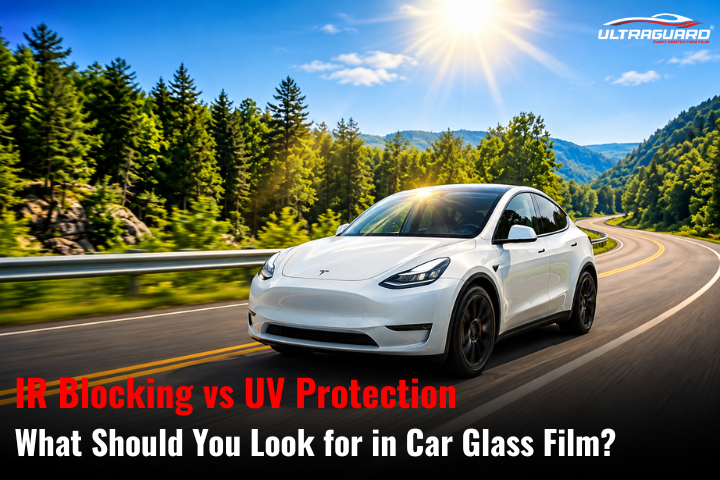
Step into a Maruti Suzuki showroom, ask about the Baleno’s Zeta or Alpha trim. The pitch says UV-cut glass that blocks harmful rays. And eases your AC compressor’s workload. But Uv is a different player, wrecking your skin and interiors. In contrast, infrared radiation causes heat. Block one, and the other struts in like nothing happened. That’s exactly where windshield protection film, window tinting, and window film earn their keep. In this blog, we decode both.
UV vs IR Blocking: What’s the Difference?
You must have heard the marketing claim of 99% UV or 99% IR rejection. We often mistake it for 99% heat rejection. But the truth? Not exactly that. Both UV and IR target different parts of the light spectrum.
• UV blocks ultraviolet light: about preventing fading, skin damage, and material degradation.
• IR blocks infrared light: reduces heat buildup and improves comfort.
| Performance Attribute | Ultraviolet (UV) Protection | Infrared (IR) Heat Rejection |
| Wavelength Range | Short, high-energy waves (100-400 nm) | Longer heat-carrying waves (780-2,500 nm) |
| Share of Solar Energy | Approximately 3% of total | Approximately 53% of total |
| Primary Impact | Protects skin and helps prevent fading, discoloration, and cracking of interior materials | Reduces cabin heat buildup, improving thermal comfort |
| Typical Technology | UV-absorbing coatings and chemical absorbers | Nano-ceramic, carbon, multi-layer heat-rejection technologies |
| Long-Term Benefit | Extends the life of dashboards, leather, plastics, upholstery | Reduces cooling load on the AC, enhances driving comfort and potentially improving energy efficiency |
Expert Take: If your goal is heat rejection and increased AC efficiency, you need to prioritize IR rejection more than UV rejection. A premium quality window film combines both.
Understanding Solar Heat: UV, IR and Visible Light
Let’s understand each:
What is UV Radiation?
Ultraviolet radiation (UV) is a high-energy electromagnetic radiation emitted by the sun. It has a wavelength range of 100-400 nm. It sits between visible light and X-rays on the electromagnetic spectrum. It is important for vitamin D production; meanwhile, it can also cause sunburn, premature aging and skin cancer. In an automobile, UV rays can fade the color, interior and upholstery. The leather and plastic in the interior can start cracking due to prolonged UV exposure.
What is Infrared (IR) Radiation?
IR is part of the electromagnetic spectrum. It is electromagnetic radiation just beyond visible red light. The wavelengths are shorter than microwaves but longer than visible light. It makes up around half of the sun’s total energy. When you stand in sunlight and feel warmth, part of that sensation comes from infrared radiation.
When sunlight hits your car’s glass, the visible light and UV rays penetrate the glass. Your dashboard, carpet and seats absorb that heat. MGA Research, in its article Why Sunlight is the Most Destructive in Automotive Materials, states that auto glass acts as a one-way trap. It re-radiates that energy, creating a powerful greenhouse effect. On a summer day, your cabin’s heat can reach up to 60°C due to IR rays. With this heat load, your AC has to work extra to cool the car down. This leads to increased fuel consumption in gas cars. EV cars experience reduced driving range.
What is Visible Light (VLT)?
Visible light is the electromagnetic radiation a human eye can see. It occupies a tiny fraction of the electromagnetic spectrum. Think of it as a sandwich spread between IR and UV rays. Visible light makes up roughly 44% of the sun’s solar energy reaching Earth. Visible light acts as a secondary catalyst for solar damage. Lowering VLT can decrease the cabin heat but reducing it too much can impact driving as visibility reduces too.
How IR, UV, and VLT Together Increase the Heat?
At sunlight level, the common breakdown is:
• 53% IR
• 43% visible light
• 4% UV
Does UV Blocking Make Your Car Cooler
Indirectly. UV blocking can protect the interiors from fading. But it is not the main reason a car feels cooler. It helps cut down harmful sun exposure. It can reduce the heat slightly because it only makes up around 4% of the sun’s energy. The real player is IR rejection.
Myth vs Fact: A film with 99% UV rejection can reduce cabin heat noticeably?
No, It’s a myth. 99% UV rejection does not mean significant heat control. However, it is very important in interior protection. It reduces fading and cracking of dashboards, seats, and trims.
Why IR Blocking Has a Bigger Impact on Car AC
IR blocking has a bigger impact on car AC and heat reduction because it carries most of the heat to the cabin. When less IR enters the cabin, the interiors are less warm. The AC achieves the target temperature quickly. This improves the overall comfort and reduces AC runtime. Window tinting solutions infuse technology to provide maximum IR rejection that increases fuel efficiency and reduces battery consumption.
What is TSER?
TSER stands for Total Solar Energy Rejection. It is the most accurate metric to measure how much heat a windshield protection film, window film or window tinting can block. Other numbers look at the fraction of the sun’s energy. Whereas TSER measures the percentage of all solar energy rejected across the solar spectrum. It combines IR, UV and VLT. A higher TSER means better heat rejection in aftermarket window films. So always look at the TSER percentage to know the actual cooling performance of your window tinting and windshield protection film.
What is a Good TSER Rating?
| TSER Rating | Performance |
| 60%-70% | Excellent |
| 50%-59% | Good |
| 35%-49% | Average |
| Below 35% | Poor |
How Window Films Reduce Cabin Temperature
Window films reduce cabin temperature by limiting the solar energy that enters the cabin through the glass and windshield. They reflect, absorb and filter incoming radiation. As a result, less heat reaches the cabin.
• Sunlight either passes through, bounces back, or gets absorbed by window film.
• Absorbed energy heats the glass, which re-radiates both outward and inward.
• Better window tinting pushes more heat back out.
• Slower cabin heating means less work for the AC.
• IR-blocking window film does the heaviest lifting.
• UV blocking in window tinting guards against fading.
• VLT controls light entry.
Types of Window Films Compared
| Window Film Type | Heat Rejection | UV Protection | Best For |
| Dyed Window Tints | Low to Moderate | Good | Budget-friendly privacy and styling |
| Metalized Window Films | Good | Very Good | Heat reduction where signal interference isn’t a concern |
| Carbon Window Tint | Good | Very Good | Balanced performance with no signal interference |
| Ceramic Window Film | Excellent | Excellent | Superior heat rejection, clarity, and overall performance |
| Security / Safety | Low | Varies | Glass protection and impact resistance |
| Decorative/ Frosted Window Films | Low | Varies | Privacy and aesthetic enhancement |
Windshield Protection Film vs Window Film: What’s the Difference?
Windshield protection films are for glass safety. It is designed to absorb or deflect impact from rocks, gravel, sandblasting, and small debris. Window films prioritize heat control. It’s used for privacy or styling. Window tinting and windshield PPF (protection films) serve different purposes. When combined, they can complement each other with significantly reduced cabin heat.
| Feature | Windshield Protection Film | Window Film |
| Primary Purpose | Protects the windshield from stone chips and cracks | Reduces heat, glare, and UV while enhancing comfort |
| Appearance | Virtually invisible | Available in clear or tinted options |
| Heat Rejection | Limited | High (depending on the film type) |
| UV Protection | High | High |
| Impact Resistance | Excellent | Minimal |
| Privacy | No | Yes (depends on tint level) |
| Best For | Windshield protection and durability | Cabin cooling, UV protection, improved driving comfort |
Is Window Tint Legal in India?
The legality of window tint in India is a grey area. Windshield glass can have tints up to 70% VLT, not less than that. Meanwhile, side windows are permitted to have 50% VLT. But the caveat lies in the VLT percentage and at what stage the tint is applied. In 2012, the Supreme Court of India banned solar control films, even though they comply with VLT criteria. But in the field, this reality is different. The VLT rules by RTO are to ensure visibility and safety. Modern window tints rely on advanced technology to block maximum TSER while staying in the legal limits.
How Much Difference Can Good Window Film Make?
A good window film can make your cabin 8°C (14°F) cooler. The AC does not have to fight the massive thermal load. The car will cool down 30% to 40% quicker. As a benefit, you get:
• Cooler steering wheel
• Cooler seats
• Less dashboard heating
• Reduced glare
• Improved passenger comfort
• Less reliance on maximum AC
How to Choose the Best Heat Rejection Window Tint
To choose the best heat rejection window tint, you need to look for film’s Total Solar Energy Rejection (TSER) rating. It is more important than the darkness of window tinting.
Here is the expert-curated guide:
Choose the Right Film Material
• Nano-ceramic: highest TSER, traps infrared, doesn’t block GPS/signal
• Carbon: solid infrared blocking, matte finish, doesn’t fade purple
• Multilayer optical: hundreds of ultra-thin layers, near-invisible, bounces heat
Compare Performance Metrics
| Metric | What it means | Target range |
| TSER | Total solar energy rejected | 55-70% |
| IRR | Infrared rejection | 85-99% |
| VLT | Visible light let through | Lower isn’t always better |
Darker isn’t better; a clear 70% VLT ceramic film can outperform a 5% “limo tint” on heat rejection.
Top-Tier Brand for Window Films
• Ultraguard: with 70% TSER, diverse range
• XPEL: max infrared rejection
• 3M Crystalline: barely-there tint, strong TSER
• LLumar FormulaOne Stratos: clarity, UV filtering
Verify Local VLT Regulations
• Windshields: 70% VLT
• Front sides: 50%
• Rear glass: 50%
Common Myths About UV and IR Blocking
In the automotive industry, window tints are the most contested subjects. Naturally, a lot of misconceptions exist among customers. That’s why we have decided to debunk them with expert inputs from one of the most experienced applicators, Navin.
• 99% UV Rejection Means 99% Heat Rejection
Not true. UV rays only account 4% of total solar energy. A 99% UV-rejecting window tinting can block only up to 4-5% of the total heat.
• Darker Tints Mean More Heat Control
Not always true. Modern technologies like ceramic window tints utilize nanoparticle methods to offer the best heat rejection while staying optically clear. So to get excellent heat rejection, you don’t have to go for a lower VLT film.
• Nano Ceramic Window Films Block Signals
No. Nano ceramic tints do not use metal particles in their construction; therefore, they do not mess up your signal or GPS.
Why Choose Ultraguard’s Range of Window Films and Windshield PPF
Ultraguard, backed by 39 years of heritage, offers a variety of windshield protection film and window films. With more than 73% TSER, 96% IR rejection and 99% UV rejection. Made with multi-layer construction nd are available in multiple VLTs.
Here are the advantages of Ultraguard window tinting:
| Specification | Ultraguard Window Films |
| Infrared Rejection (IRR) | Up to 95% |
| UV Rejection (UVR) | 99% |
| Warranty | 10 Years |
| Film Thickness | 2 mil |
| Scratch Resistance | >2H Hardness |
| Visible Light Transmission (VLT) Options | 5%, 35%, 55%, 75% |
Ultraguard Window Films’ TSER (Total Solar Energy Rejection)
| VLT (%) | TSER (%) |
| 5% | 75% |
| 35% | 61% |
| 55% | 52% |
| 75% | 42% |
Conclusion
UV protection guards your skin and stops your dashboard from turning into a faded relic. IR rejection is the one fighting cabin heat and keeping your drive bearable. So stop chasing “99% UV protection” as if it’s the whole story. It’s only half of it. Look instead at IR rejection, TSER, optical clarity, warranty, and legal compliance. That’s what actually tells you whether a film is built for Indian roads and Indian summers.
FAQ’s – UV vs IR Blocking on Car Glass
Q1. Is windshield protection film worth it?
Yes, Modern glasses come with advanced driving assistance systems. Windshield protection film acts as a physical barrier against road debris, stone chips and gravel. Thus, overall protection for the vehicle.
Q2. How much is RTO-approved car glass film?
For windshield, the RTO-approved car glass film is 70% while side windows are allowed to get 50% tinting.
Q3. What is car window tinting price in India?
Car window tinting price in India starts from ₹ 3,000 to ₹ 15,000 depending on the type of film you are choosing.
Q4. Is it worth putting film on windows?
Yes, putting film on windows is definitely worth it because it protects from damaging UV and heat-causing IR rays. It safeguards the vehicle’s interiors from premature damage.
Q5. What are the best options for heat rejection window tint?
Ultraguard and UltrashieldX are some of the best options for heat rejection window tints. Their range offers various types and VLT options with 96% IR rejection and high TSER rates.


0 Comments