Paint protection spray and paint protection film are the two most famous solutions for car paint protection. But we often get confused customers who ask, “What’s the best paint protection for cars? PPF vs PPS?”
Paint protection spray is a liquid polymer sprayed on car’s surface. It’s seamless and does not peel off the edges but it does not possess self-healing properties and the resistance is also very limited. Meanwhile, car paint protection film is a transparent TPU (thermoplastic polyurethane) film that gives a higher protection level with high-level resistance.
Let’s understand the difference between PPF vs PPS. And which is the best paint protection for cars?
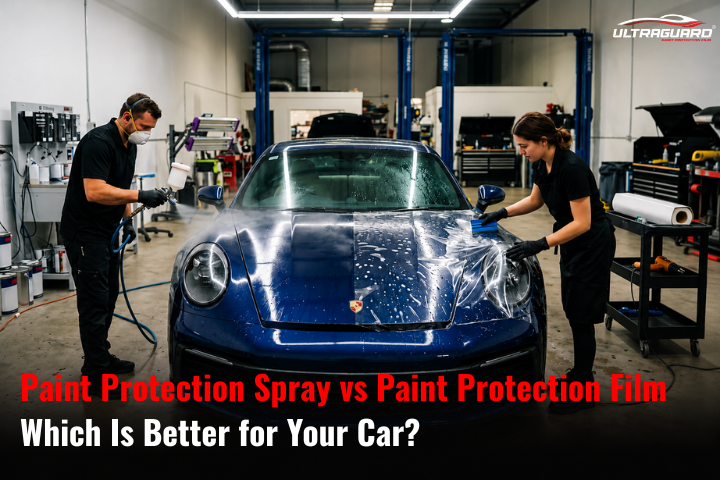
What is Paint Protection Film?
Made with a transparent Thermoplastic Polyurethane film, PPF for car is a protective layer pasted on the car’s paint. The PPF coating is installed by professional installers with adhesive and heat. It has a high tensile strength of 30- 60 MPa (polyester TPU >60 MPa), 2–3× stronger than natural rubber. It is highly resistant due to its elongation rate of 400-700%. It has heat asctivates self healing technology and warranty support.
To increase the PPF performance, manufacturers often add silicone or polydimethylsiloxane compounds, polyethylene glycol (PEG) with terminal alkoxy groups, nanoclay nanoparticles, graphene oxide, silane coupling agents, and optimized hard segment content.
Benefits of Paint Protection Film for Cars
PPF coating for car comprises multiple benefits to give you the best paint protection for cars:
● Protects from rock chips: stone chips from road debris at high speeds
● Scratches and swirl marks resistance: from brushes, parking mishaps, and minor abrasions
● Self-healing properties: light scratches disappear with heat exposure
● UV protection: No paint fading or discoloration over time
● Hydrophobic surface: water beads and rolls off
● Dirt and grime repellent: makes washing easier
● Protects against insect splatter: Also from bird droppings without paint stain
● Tree sap and acid rain contamination barrier: No buildup
● Anti-corrosion protection: Moisture and rust cannot stay
● Virtually invisible: maintains the original look of your vehicle
● High-gloss or satin finish: enhances natural shine and appearance
● Lasts 7-10 years: with proper maintenance
● Low maintenance: requires less upkeep than wax or ceramic coatings
● Increases resale value: original paint protection
● Cost-effective long-term: You save on paint repair and detailing
● Protects original paint: good for factory finish and market value
What is Paint Protection Spray?
Paint protection spray for car is also called ceramic spray coating, spray sealant, and PPS paint protection spray. It is a liquid polymer/ceramic coating. It is sprayed on the car’s surface and then wiped off. It creates a peelable, protective layer on the car’s paint.
It is a SiO₂ (silicon dioxide) or SiC (silicon carbide) hybrid formula that protects the paint for around 12 months. Paint protection spray is available in multiple formulas like Ceramic Spray Coating, Spray Sealant, Spray Wax, and Spray-on PPF (PPS). It protects the paint with zero edge lines. Spray on PPF price is generally higher than the traditional PPF.
PPS Paint Protection Spray Benefits
Paint Protection Spray combines the aesthetics of a seamless finish with strong paint protection. Here are some top benefits of PPS:
● Seamless, edge-free application
● Complete vehicle coverage
● High-gloss, showroom-like finish
● Hides minor swirl marks and imperfections
● Available in Gloss, Satin, and Matte finishes
● Up to 300-micron protective layer
● Resistant to scratches and scuffs
● Protects against stone chips and road debris
● UV-resistant to prevent paint fading
● Shields against bird droppings, tree sap, and acid rain
● Hydrophobic surface for superior water repellency
● Repels dirt and road grime
● Easy to clean and maintain
● Removable without damaging the original paint
● Helps preserve long-term resale value
Paint Protection Spray vs Paint Protection Film
PPS is a liquid polymer coating sprayed directly onto the vehicle’s painted surfaces. Paint Protection Film is a pre-manufactured thermoplastic polyurethane (TPU) film that is physically applied over the paint with an adhesive backing.
Let’s decode PPF vs PPS:
| Specification | PPS (Paint Protection Spray) | PPF (Paint Protection Film) |
| Material | Spray-applied polyurethane coating | TPU (Thermoplastic Polyurethane) film |
| Thickness | 250-300 μm | 165-210 μm |
| Application | Liquid spray coating | Pre-cut adhesive film |
| Self-Healing | Limited | Advanced heat-activated self-healing |
| Stone Chip Protection | Moderate | Excellent |
| Scratch Resistance | High | Very High |
| UV Protection | Good | Excellent (90% UV rejection) |
| Hydrophobic Properties | Yes | Yes |
| Lifespan | 3 years | 7-10+ years |
| Warranty | Up to 5 years | 5-10 years |
| Appearance | Seamless, no edges | Almost invisible, may have edges |
| Removal | Peelable, residue-free | Removable, paint-safe |
| Color Options | Clear, Gloss, Satin, Matte, Color Change | Clear, Gloss, Satin, Matte, Color PPF |
| Best For | Seamless finish and customization | Maximum protection |
PPF vs PPS
Here is the detailed comparison:
1. Protection Type
● PPS: Protects from swirl marks, wash-induced scratches, light abrasions, UV exposure, bird droppings, tree sap, and chemical contaminants. It is not very effective in heavy impacts.
● PPF: Safeguards car paint from rock chips, highway debris, gravel strikes, door dings, and other physical hazards. Highly protective from shock.
2. Impact Resistance
● PPS: Paint protection spray is around 300 microns. But it has a limited ability to absorb the force of sharp or high-speed impacts.
● PPF: TPU PPF structure is elastic. It is capable of dispersing impact energy. Reduces the paint chip from stones and road debris.
3. Thickness
● PPS: Thicker than PPF (250-300 microns).
● PPF: PPF products range between 180 and 250 microns. The thickness is similar in PPF vs PPS but TPU provides superior impact absorption.
4. Scratch Resistance
● PPS: Resistance against wash marring, swirl marks, and minor abrasions. However, deeper scratches are visible.
● PPF: Higher scratch resistance. Because the film absorbs scratches before reaching the paint surface.
5. Self-Healing Technology
● PPS: Many PPS systems do not have true self-healing quality. Requires polishing or repair work.
● PPF: PPF for car has elastomeric self-healing top coats. It eliminates light scratches.
6. Lifespan
● PPS: Paint protection spray lasts between 2 and 4 years.
● PPF: Paint protection film lasts 7 to 10 years. Some premium films carry warranties of 12 years.
7. UV Protection
● PPS: Provides a protective barrier that slows down paint fading and discoloration.
● PPF: PPF has UV-blocking capabilities. It prevents oxidation. The factory paint stays glossy for much longer periods.
8. Appearance
● PPS: Because of its spray-on technology, paint protection spray gives a seamless finish. No visible edges, joints, seams, or installation lines. The final look resembles factory paint.
● PPF: PPF is transparent, but poor installation can make the edges peel off. Panel boundaries are sensitive areas.
9. Application Process
● PPS: For PPS application, a controlled spray environment and equipment are needed. It goes through multiple curing stages. The process is similar to repainting a vehicle.
● PPF: PPF installations are done by trained technicians. Precision cutting, stretching, and alignment are very important.
10. Coverage of Complex Areas
● PPS: It is spray-applied, which means it can coat intricate areas very well, like grilles, vents, mirrors, emblems, and sharp curves.
● PPF: Film templates and installer expertise determine the coverage. Intricate areas are hard to work on.
11. Upfront Cost
● PPS: Costs more than a full-body PPF. Materials are expensive and a comparatively new concept in India.
● PPF: Lower upfront cost than PPS.
12. Long-Term Value
● PPS: Initial cost is higher. PPS needs reapplication after a few years, which cumulatively increases the cost of maintenance.
● PPF: Adds slightly to the value. The resale value of the car is also increased due to the original paint preservation.
13. Removal Process
● PPS: Removal is easy.
● PPF: PPF removal can require expert assistance, as it needs several chemicals and methods to remove the residue.
Conclusion
PPS excels when it comes to seamless aesthetics. However, it falls short in affordability and protection. Paint protection film resists impact and gives self-healing performance. The paint preservation is long-term in PPF. In the Indian environment, PPS paint protection spray cannot last as long. Meanwhile, PPF can. PPF coating for car is an option for owners who want long-term protection nd availability.
Paint protection spray can be useful for those who want customization with moderate protection.
From an expert POV, we can suggest one thing: You should figure out first what you’re trying to protect against. But for most car owners, PPF is the best investment. No doubt PPS has an appearance-focused protection, but PPF is a benchmark for serious safety.
Why Choose Ultraguard’s PPF
Ultraguard provides the largest variety of paint protection film for cars. Our range is designed for Indian weather conditions. Our TPU PPF protects your paint and equips it with shock-absorbent and self-healing technology.
● Warranty-driven: Our PPF range comes with varying warranty periods. The minimum period is 3 years and the maximum lasts up to lifetime.
● Thickness of Ultraguard Paint Protection Film: We offer one of the thickest PPFs in the market. Our range starts from 190 microns. This thickness is of the TPU sheet. The adhesive and the release liner add up to some extra.
● Largest Variety of Color PPF: We have more than 400 colors available in paint protection film. You get extra protection because we add another layer of TPU, enhancing the overall performance.
● Pre-Cut PPF for Indian Model Cars: Interiors matter as much as the exterior. We have nearly every Indian model car interior PPF so your cabin stays safer too.
FAQ’s – PPF vs PPS
Q1: Is PPS better than PPF?
PPS is a kind of sprayed-on paint for temporary protection. However, PPF is a durable paint protection made of TPU. So if you are looking for long-term protection, PPF is definitely better than PPS.
Q2: What is PPF vs PPS cost?
PPF vs PPS cost depends on application type, film thickness, and car size. PPF prices range from ₹50,000 to ₹2,50,000. PPS costs are higher upfront.
Q3: What to choose between paint protection film vs spray?
If you want long-term protection and self-healing, go for paint protection film. But if you are focused on customization and looking for a temporary protection option, paint protection spray is your option.
Q4: What are the pros and cons of paint protection spray?
PPS is a mixture of Vinyl and rubber. It is a peelable, spray-on liquid polymer. It looks like paint and has a thickness of 300 microns. You get multiple customization options if you choose Paint Protection Spray.
Q5: PPF vs PPS, which one should I choose?
If your goal is to protect your car in the long term, choose paint protection film. But if you are looking for shorter-duration protection, paint protection spray can be suitable.

0 Comments