Indian summer is not just a season for people, but it is a daily struggle among car owners against the hot weather, where temperatures are usually more than 45 °C. Of course, the obvious remedy is window tinting. But there is a difference between a comfortable cabin and a 5000 Rupees RTO fine.
At Ultraguard, we feel that all drivers need to know the facts. Whether you are about to get your car window tinting, or are seeking to learn more about the latest 2026 RTO regulations, or some of the technical science and legal rules behind this field, we have all the necessary details you need in this blog.
Why is Window Tinting More Than A Style Statement?
When you park your car or drive it when there is direct sunlight, the sunlight penetrates through the glass and captures solar energy. The light produced by short-wave infrared does not have too much trouble penetrating your upholstery and dashboard, but when it enters, it turns into long-wave heat, which cannot escape, and this is what is referred to as the greenhouse effect.
What is the Practical Value of Auto Window Tinting?
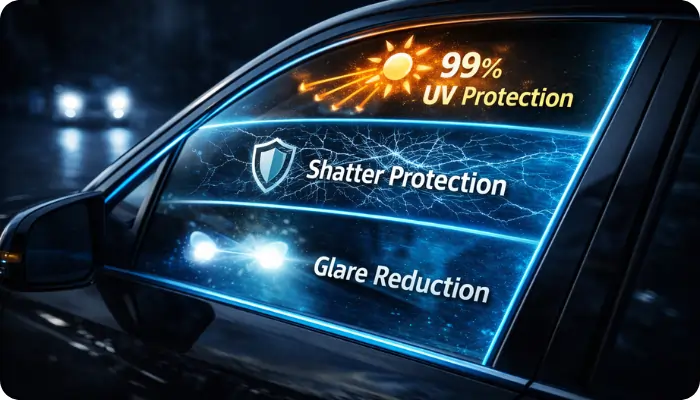
In addition to a high-quality, smooth appearance, professional window tinting provides three layers of protection that are important:
■ Higher UV Protection: Normal auto glass will only keep out UV rays to a 25 percent extent. There are specialized window tint film that prevents up to 99 percent of the UV rays and UVB rays contributing to the aging of your skin and your expensive leather seats cracking.
■ Better Safety and Shatter Protection: The adhesive area of the film provides a structural bond in case of a side impact collision, or if any part of the glass is broken off, keeping the glass together rather than allowing the sharp pieces to fly into the cabin.
■ Night-time Driving Glare Reduction: It is often believed that tints are exclusively used in the daytime. The films have high quality that minimizes the dazzle effect of the oncoming high-beams and, as a result, the eye fatigue that is very common in highway trips at night is drastically reduced.
Car Window Tint Laws in India
The black film is strictly forbidden as specified in the Central Motor Vehicle Rules (Rule 100) and later reiterated by the Supreme Court. It is centered upon Visual Light Transmission (VLT):
■ Front and Rear Windshield: Not less than 70% VLT
■ Side Windows: Minimum 50% VLT
The Fine Print: The law conventionally refers to the glass as it is manufactured. Nevertheless, the recent 2024-2026 enforcement patterns indicate that, in case an aftermarket film has these same VLT values (it is still transparent), then it usually fits the “Safety Glazing” category in the standards of IS 2553.
Learn more about: Car Window Tinting Laws in India
Data-Driven Analysis of Tinted Car Glass Technologies
To select the appropriate auto window tinting near me, I will have to understand the technology, durability, and the material which complience the RTO laws. Not every film is produced equally.
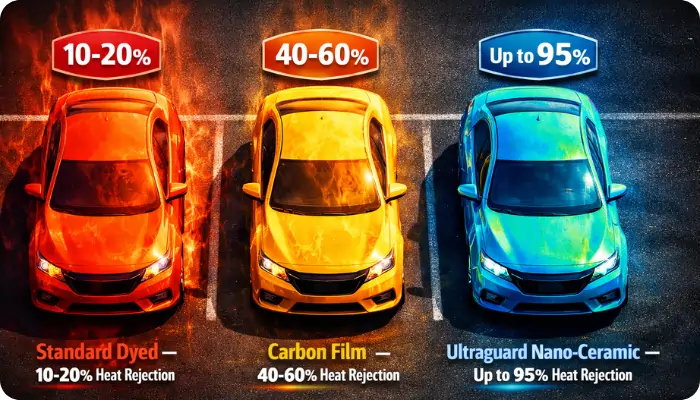
| Feature | Standard Dyed Film | Carbon Tint Film | Nano-Ceramic |
| Infrared Heat Rejection (IRR) | 10% – 20% | 40% – 60% | Up to 95% |
| UV Protection | Minimal | High | Maximum (99%+) |
| Visibility (Clarity) | Can be hazy/cloudy | Good (Matte finish) | Crystal Clear (HD) |
| Electronic Signal Blocking | None | None | Zero Interference |
| Durability | Fades/Turns Purple | Fade-resistant | Lifetime Durability |
Automotive Window Tint: Measured Performance & Real-World Case Study
Here are a few of the significant case studies that will help you better understand the window tinting.
1. Case Study: The AC Efficiency of the Urban Commuter
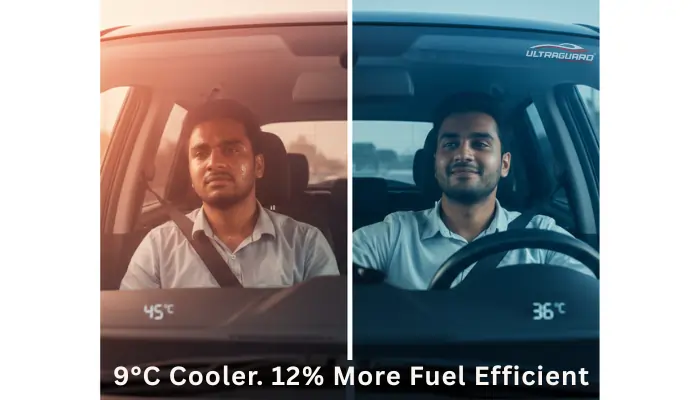
The Issue: Mr. Sahil is a commuter in Delhi, and yet he had to wait 20 minutes to drive in the city before he could get his AC to cool his sedan. The AC was always on Max, increasing his fuel bills.
The Solution: He decided to use the service of car window tinting, and he selected a 70% VLT ceramic film.
Conclusion: A digital thermometer was used to measure that the cabin temperature had reduced by 9°C. Since the AC took a shorter time to reach the desired temperature, his fuel consumption increased by about 12 percent in a period of three months.
2. Case Study: Guarding of a Car’s Luxury Interior
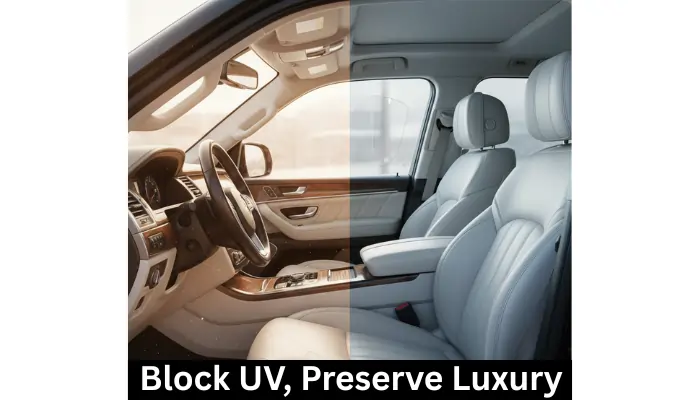
The Issue: A holder of a luxury SUV was concerned about the fact that the wood decor on the dashboard would begin to lose its shine, and the white leather seats began to turn yellow.
The Solution: Ultraguard tint film to the windows, which is used to block UV and IR rays, yet without darkening the windows.
The Outcome: The “UV-aging” of the interiors was discontinued. The owner ensured the car was in a 100% legal condition and had the resale value of the vehicle since he had taken care of the interior to ensure the car was in its original state.
Experience Nano-Ceramic Window Protection with Ultraguard
We do not only sell a film but a high-tech cover for your car. When you type in car window tinting near me, you should have a brand that is aware of the special Indian weather, extreme UV, great humidity, and dust.
Nano-Ceramic Excellence: Non-conductive ceramic particles are used in Ultraguard, in contrast to the cheap metallic tints that block your GPS or mobile data. Your calls and navigation remain 100 connected.
We are providing high VLT (Visual Light Transmission) films, which give you the rejection of heat and, at the same time, the film is transparent enough, and you will not lose the mobile network as well, therefore, making you stay within the safety standards.
Precision Installation: The labs are climate-controlled so that all dust particles do not attach themselves beneath the film, hence avoiding the bubbles and peeling that regularly occur with the roadside installers.
Stop settling for the heat. Investment and health are protected by the most trusted name in auto window tinting.
Conclusion
Selecting tinted car glass is not just a beauty addition, but it is also a health, safety, and comfort of driving. You can have a cooler cabin and avoid the danger of facing a court of law because it is a balance between highly technical heat rejection and transparency that is compliant with the legal requirements of RTO. You can either be in need of window tinting that is the best to beat the summer heat, or you can be in need of one that keeps your car interior luxurious; you would want the right kind of window tint film.
Ultraguard is a company that deals in high-performance, legal, and durable car window tinting systems that are suitable for the Indian road. Are you willing to change your car window film?
FAQ’s – Window Tint For Cars
Q1. Can one legally have any color car windows in 2026?
The legislation forbids black films that hinder visibility. Safety Glazing (transparent films), which preserve the 70 percent VLTs of front/back and 50 percent of the sides, are, however, commonly utilized to prevent heating. It is always good to make sure your film is certified to achieve such levels of transparency.
Q2. Does tinting windows influence my automobile insurance?
Generally, no. But when you make an accident with illegal 0% VLT (pitch black) films that cause the accident through lack of visibility, then theoretically an insurer can deny a claim. The high-clarity tinted car glass that is RTO compliant safeguards your insurance.
Q3. What is the time frame of the window tint film installation?
Ultraguard has an approximate time of 3 to 4 hours to do a professional installation. Our heat-curing method is used to permanently fix the film to the glass curves so that it does not peel off, as commonly seen in DIY kits, which do not have much life after several weeks.
Q4. Why does a certain tint on the window become purple?
That is the indicator of a cheap tinted window. The dyes are broken down by the sun, and the material discolors and completely loses its heat rejection. The inorganic particles used in Ceramic films do not change colour even after years of sun exposure.
Q5. Is it possible to use sunshades in place of window tinting?
The sunshades are used when the car is parked or when the rear passengers are present. When used in the process of driving, they may cause hazardous blind spots. Auto window tinting gives you 24-hour protection and does not hinder your road vision.
Q6. Why is the purpose of ceramic tint improved in the case of modern cars with GPS and 5G?
Metallic films manufactured many years ago include microscopic metal particles that form a Faraday cage, disrupting your GPS, cell phone data, and even tire pressure monitoring (TPMS). The Nano-Ceramic technology of Ultraguard does not enable any conductivity, and this translates to full heat rejection with no signal interference.


0 Comments