Car segments in India are a classification that helps buyers to bifurcate vehicles by size, space, features, practicality, and positioning in the market. Indian automotive market has a wide range of car types for different budgets and driving needs – from compact hatchbacks and sedans to SUVs and MUVs. The market dynamics of different types of cars in India change according to the buyer. MoneyControl reports that India recorded 47.07 lakh passenger-vehicle wholesales in FY2026. SUVs account for 56.72% of the market, compared with 20.99% for hatchbacks. The growing variety of car segments in India can make A-segment, B1, B2, C-segment and D-segment jargon confusing.
In this guide to car segments in India explained, we decode the types of cars (A/B/C/D classifications and body-style categories), vehicle segments in India, prices, characteristics and a guide to help you understand and choose which car category in India suits your needs.
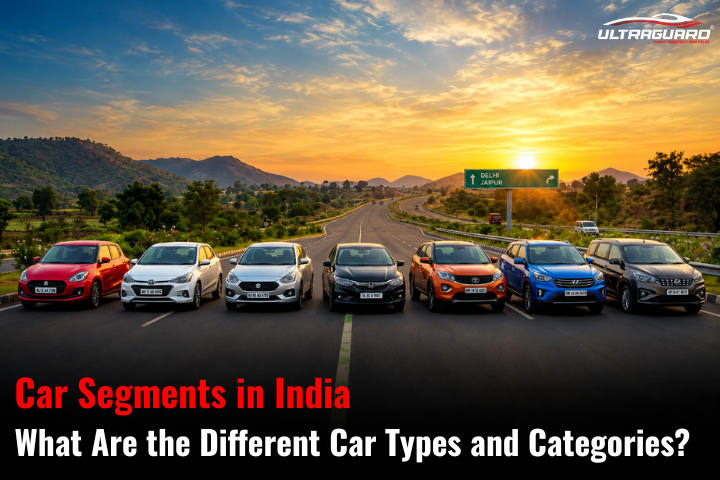
Car Segments in India Explained: What Are Car Segments in India?
A car segment is a broad way of grouping vehicles by overall length, body style, space, price, engine and intended use. The most modern classification of car categories in India is A, B1, B2, C1, C2, D1, and D2. It is based on vehicle’s length. However, there are no universal segments of car in India. Car segmentation is a multi-factor classification, not a single strict formula. Dimensions, interior space, performance, features, price, and intended use are some of the common factors that influence segments of car in India:
1. All Car Segments in India Based On Overall Size
Overall size describes the vehicle’s physical footprint:
-
Mini or city cars
-
Small cars
-
Compact cars
-
Mid-size cars
-
Large cars
-
Luxury or full-size cars
Size affects parking ease, road presence, cabin room, ride comfort, luggage capacity, and costs.
2. Car Types in India Based on Length and Dimensions
Length is one of the most common technical methods used in India. A simplified Indian length-based structure divides them into A, B, C and D segment cars in India.
Here From The Experts
In India, the 4-metre threshold is also commercially important because these cars have historically received lower tax treatment than longer cars. So manufacturers often design compact cars (Dzire, Swift, Venue) to stay just under 4,000 mm. This can make them cheaper to buy and own.
3. Different Segments of Cars in India Based on Cabin and Boot Space
Cars are also divided by interior volume rather than external dimensions.
|
Space category |
Vehicles |
|
City commuter |
Small hatchbacks |
|
Small family car |
Premium hatchbacks and compact sedans |
|
Family car |
C-segment sedans and compact SUVs |
|
Large family car |
Mid-size SUVs and MPVs |
|
Luxury family vehicle |
Large SUV, premium MPVs, luxury sedans |
4. Vehicle Segments in India By Engine and Powertrain
It helps distinguish performance and use categories.
Cars can be grouped by:
-
Engine displacement
-
Cylinders numbers
-
Turbocharged engine.
-
Petrol, diesel, CNG, LPG
-
Hybrid, plug-in hybrid, battery electric powertrain
-
Power and torque output
-
Front-wheel drive, rear-wheel drive, all-wheel drive
-
Manual, automated manual, torque-converter automatic, CVT, or dual-clutch transmission
Examples:
-
Small petrol hatchbacks: low running cost
-
CNG hatchbacks and sedans: fuel-economy-focused
-
Turbo-petrol compact SUV: stronger performance
-
Diesel SUV: long-distance use
-
Electric SUVs: technology focus
5. Car Categories in India Based on Features and Equipment
Separation point between basic, mid-range, premium, and luxury versions.
|
Feature category |
Examples |
|
Safety |
Airbags, electronic stability control (ESC), ADAS, advanced braking systems |
|
Comfort |
Automatic climate control, ventilated seats, powered seats |
|
Infotainment |
Touchscreen, connected-car functions, premium audio |
|
Convenience |
Keyless entry, powered tailgate, 360-degree camera |
|
Driving technology |
Adaptive cruise control, drive modes, all-wheel drive |
|
Interior quality |
Premium materials, sound insulation, seat construction, finishing |
6. Price and Market Positioning Based Vehicle Segment List in India
Price creates practical market categories:
|
Positioning |
Buyer priority |
|
Entry-level |
Lowest purchase and running cost |
|
Mass-market |
Value, reliability, service availability |
|
Upper mass-market |
More features and space |
|
Premium |
Brand image, technology, refinement |
|
Luxury |
Comfort, performance, exclusivity, prestige |
|
Performance/lifestyle |
Driving experience, design, capability |
Expert Take:
SUVs may rule the market, but compact sedans still win buyers. Fair pricing, a roomy cabin, a big boot and CNG. Hard to argue with that.
7. Car Segments in India Based on Intended Use
It considers what the vehicle is designed to do:
|
Intended use |
Common vehicle type |
|
City commuting |
Mini hatchback, small hatchback |
|
First family car |
Premium hatchback, compact sedan |
|
Urban family use |
Compact SUV, premium hatchback |
|
Long-distance travel |
Sedan, mid-size SUV |
|
Large-family transport |
MPV, three-row SUV |
|
Commercial and fleet use |
Sedan, MPV, compact utility vehicle |
|
Rough roads and rural use |
High-clearance SUV, utility vehicle |
|
Off-road recreation |
4×4 SUV |
|
Luxury chauffeur use |
Premium sedan or MPV |
|
Performance driving |
Sports sedan, coupe, performance SUV |
|
Low-emission mobility |
EV hatchback, EV sedan, EV SUV |
What Really Defines a Car Segment in India
Take the Hyundai Creta as a practical example. Size alone doesn’t decide its segment in India. Its dimensions, five-seat layout, features, powertrain options and market positioning all count. Together, they place it among compact SUVs. That’s why a vehicle segment list in India can file the same model differently from a price-based guide.
What Are the Different Types of Cars in India?
Here is a list of all car segments available in India:
Hatchback Cars in India
-
Passenger cabin and luggage area have one compact body.
-
Variety houses small city cars to premium hatchbacks.
-
Easy manoeuvrability, compact dimensions and efficient running.
Sedan Cars
-
A separate boot compartment; focus on passenger comfort and luggage space.
-
Compact, mid-size and executive models– all feature among the types of cars in India.
-
Best for buyers who prioritise highway comfort and traditional three-box styling.
SUV Cars in India (Sport Utility Vehicle)
-
A higher driving position, greater ground clearance and an upright design.
-
SUVs include compact, mid-size, full-size and luxury models.
-
One of the most diverse and fastest-growing vehicle categories.
MUVs/MPVs (Multi-Utility Vehicle)
-
You get passenger and luggage flexibility.
-
Three-row seating, accessible cabins and configurable interiors.
-
Particularly suited to larger families, and a big part of car types in India.
Vans
-
Passenger capacity over conventional passenger cars.
-
A smaller share of India’s passenger-vehicle market.
-
Vans still serve specific transport and commercial needs.
Crossover Cars in India
-
They combine characteristics of passenger cars and SUVs.
-
A car-like driving experience with SUV styling
-
Elevated seating or increased ground clearance.
-
They create some overlap between traditional hatchback and SUV categories.
Quick Q&A
Compare Hatchback, MUV and SUV Segments in India for Families.
Hatchback, MUV and SUV segments offer various and different benefits to Indian families depending on city traffic, family size, and budget.
|
Feature / Criteria |
Hatchback |
SUV |
MUV |
|
Best For |
Small families (3-4 members), tight city parking |
Road presence, safety, rough roads, monsoons |
Large/Joint families (6-8 members), road trips |
|
Seating Capacity |
5 Seater (Comfortable for 4) |
5 to 7 Seater |
6 to 8 Seater (Usable 3rd Row) |
|
Ground Clearance |
Low (160-180 mm) |
High (180-210 mm) |
Medium (180–185 mm) |
|
Average Fuel Efficiency |
High (19-24 km/l) |
Medium (14-19 km/l) |
Medium-High (15-20 km/l, higher for Hybrids) |
|
Boot Space |
Limited (250-350 Litres) |
Good (400-500 Litres) |
Flexible (Massive with 3rd row folded) |
|
Price Range |
₹3.5 Lakh– ₹11 Lakh |
₹5.5 Lakh – ₹50+ Lakh |
₹5.6 Lakh – ₹32+ Lakh |
|
Driving Dynamics |
Nimble, very easy to park |
Commanding view, handles potholes well |
Long wheelbase, comfortable plush ride |
What are Compact SUVs Known for in the Indian Market?
Compact SUVs are known for bridging the gap between a traditional hatchback and a large SUV. They offer a tall driving stance, high ground clearance, and premium features of a traditional SUV within a smaller, sub-4 meter footprint. Autopunditz points out that compact SUV segment has registered 19.1% YoY growth in 2026. Some of the famous compact SUVs in India are Tata Nexon, Maruti Suzuki Brezza, Hyundai Venue, Kia Sonet and Mahindra XUV 3XO.
Structured Breakdown: Sedan Vs Compact SUV in India
Well, as our experts in the automotive field put it, the debate between sedan and a compact SUV represents a classic conflict in car segments in India. Traditional driving pleasure and elegance stand against modern practicality and road dominance. No doubt compact SUVs are dominating the sales chart but Sedans are maintain a loyal following.
Core Structural Differences
|
Feature |
Sedan Segment |
Compact SUV Segment |
|
Ground Clearance |
Low to Medium (165 mm-180 mm) |
High (180 mm-210 mm) |
|
Seating Profile |
Low-slung, reclined, ergonomic |
Tall, upright, commanding “command view” |
|
Boot Style |
Dedicated 3-box notchback (Isolated luggage area) |
2-box hatch style (Integrated luggage area with parcel tray) |
|
Ride Dynamics |
Planted, high-speed stability, minimal body roll |
Taller center of gravity, noticeable body roll around sharp corners |
|
Cabin Space Focus |
Rear seat legroom and long under-thigh support |
Headroom, shoulder room, and overall cabin airiness |
A, B, C and D Car Segments in India Explained
The commonly used structure to identify all car segments in India is A, B, C and D, with sub-segments such as B1, B2, C1, C2, D1 and D2.
|
Segment |
Approx. length |
Body styles |
Examples |
Best for |
|
A |
Up to 3,699 mm |
Small hatchback |
Maruti Suzuki Alto K10, Renault Kwid, S-Presso |
City driving and easy parking |
|
B1 |
3,700–3,899 mm |
Hatchback, compact sedan |
Tata Tiago, Hyundai Grand i10 Nios, Suzuki Swift |
Everyday family and city use |
|
B2 |
3,900-3,999 mm |
Premium hatchback, sub-4-metre SUV/sedan |
Maruti Suzuki Baleno, Hyundai i20, Tata Punch, Brezza |
More space and features |
|
C1 |
4,000-4,399 mm |
Compact SUV, mid-size sedan |
Hyundai Creta, Kia Seltos, Honda City, Hyundai Verna |
Family use and highway travel |
|
C2 |
4,400–4,599 mm |
Large SUV, three-row SUV |
Hyundai Alcazar, MG ZS EV, some larger SUVs |
More cabin space and occasional third-row use |
|
D1 |
4,600-4,799 mm |
Large SUV, executive sedan |
Tata Harrier, Mahindra XUV700, MG Hector, Hyundai Tucson |
Premium family travel and long-distance driving |
|
D2 |
4,800 mm and above |
Full-size SUV, luxury sedan |
Toyota Fortuner, MG Gloster, Jeep Meridian |
Large families, premium use and highway touring |
Here is how each one works:
A-segment cars
Smallest car segment in India, up to 3,699 mm long. Mini hatchbacks in India is built for tight city streets, first-time buyers and low running costs.
B-segment cars in India
The biggest and most competitive slice of the market. It covers small hatchbacks, premium hatchbacks, compact sedans and sub-4-metre SUV.
B1 segment cars in India
Around 3.7 to 3.9 metres long. You get more cabin room, stronger engines and better features than A-segment.
B2-segment cars in India
Just under the four-metre mark. Premium hatchbacks and subcompact SUVs: balance size, space, features and price.
C-segment cars in India
Mid-size car segment in India, bigger than B-segment models. Focus on comfort, safety and highway ability.
C1 segment
Around 4.0 to 4.4 metres. Compact SUVs and mid-size sedans with a higher seating position and a bigger boot.
C2 segment
Approx. 4.4 to 4.6 metres. Extra width and cabin space, sometimes with a third row for occasional use.
D-segment cars in India
Larger, more powerful and more premium than C-segment cars. Long-distance comfort and advanced features.
D1 segment
Premium family SUVs with strong engines and loaded equipment. Roughly 4.6 to 4.8 metres.
D2 segment
Above 4.8 metres. Full-size SUVs and premium vehicles with commanding road presence and higher costs.
Note: A/B/C/D classifications differ based on the source and body style.
SUV Segments in India Explained
SUVs in India are classified by length, cabin space, seating capacity, price and intended use. Classification includes subcompact, compact, midsize, large and full-size.
Different Types of SUVs in India
|
SUV segment |
Approx. length |
Seating |
Common examples |
Best suited for |
|
Micro SUV |
Around 3.8-4.0 m |
5 |
Tata Punch, Hyundai Exter |
City driving with SUV styling |
|
Subcompact SUV |
Below 4.0 m |
5 |
Tata Nexon, Mahindra XUV 3XO, Hyundai Venue, Kia Sonet, Maruti Brezza |
Urban families and mixed use |
|
Compact SUV |
Around 4.2-4.4 m |
5 |
Hyundai Creta, Kia Seltos, Toyota Hyryder, Maruti Grand Vitara, Honda Elevate |
Family ownership |
|
Mid-size SUV |
4.5-4.7 m |
5 or 7 |
Tata Harrier, MG Hector, Mahindra XUV700, Hyundai Alcazar, Tata Safari |
Larger families and highway travel |
|
Large or full-size SUV |
Around 4.7 m and above |
5 or 7 |
Toyota Fortuner, MG Gloster, Jeep Meridian |
Premium use, long trips and road presence |
|
Luxury SUV |
Usually above 4.7 m, varies |
5 or 7 |
Mercedes-Benz GLE, BMW X5, Range Rover Sport, Volvo XC90 |
Premium ownership |
Why Are Cars in India Often Classified by the 4-Metre Rule?
Cars in India are often classified by the 4-metre rule because length of the vehicle has become an important basis for taxation. Navin, who has nearly 15 years of experience in automotive OEMs, explains that this rule encourages manufacturers to build cars that have enough space but still can remain under the government’s small car category.
What is the 4-metre rule?
It was introduced in 2006 Union Budget nad modified under GST 2.0 in 2025. A car meets the length rule if it is 4,000 mm or shorter. Longer cars can have higher taxes. But length alone can’t guarantee a lower tax bracket. Under the current GST framework, a small car segment in India has to pass an engine-capacity test too. To qualify for Goods and Services Tax (GST) and Compensation Cess brackets, a car must meet two criteria:
According to Outlook Business:
|
Fuel type |
Engine limit |
Length limit |
GST category |
|
Petrol, LPG or CNG |
Up to 1,200 cc |
Up to 4,000 mm |
18% GST |
|
Diesel |
Up to 1,500 cc |
Up to 4,000 mm |
18% GST |
|
Larger petrol/diesel cars |
Above the applicable limit or over 4,000 mm |
– |
Generally 40% GST |
|
Electric cars |
Not linked to the 4-metre rule |
Any length |
5% GST |
In Short:
Larger cars, SUVs and luxury vehicles sit in a flat 40% slab. The compensation cess is gone. Earlier, GST plus cess pushed the total as high as 50%. EVs are taxed at 5%. But here is a catch. Navin says length alone doesn’t decide it. A sub-4-metre SUV with a bigger engine, like the petrol Thar, still lands at 40%. The result was the rapid growth of subcompact sedans and subcompact SUVs and the classification of car segments based on length.
How to Choose the Right Car Segment in India
To choose the right car segment, you need to balance family needs, daily road conditions, parking constraints, and tax structures. Step-by-step guide to choosing a car segment in India:
Step 1: Define Your True Seating Requirement
-
1-4 people: Choose a hatchback, premium hatchback or compact SUV.
-
5 adults: Choose a spacious mid-size SUV or sedan.
-
6-8 people: MUV/MPV with a practical third row.
Step 2: Assess Your Daily Driving Environment & Parking
-
Tight city roads: Choose a hatchback or sub-4m SUV.
-
Highway Commutes: A sedan or mid-size SUV can be suitable
-
Mixed driving: A compact SUV offers a good balance.
Step 3: Evaluate Your Local Road Conditions
-
Poor roads: Choose an SUV with good ground clearance.
-
Smooth roads: A sedan or hatchback can work well.
-
Frequent potholes: Prioritise ground clearance and suspension.
Step 4: Map Your Budget to the “4-Metre Tax Rule”
-
Around ₹11 lakh: hatchbacks, sub-4m sedans or compact SUVs.
-
₹12-20 lakh: Compare mid-size sedans and SUVs.
-
Above ₹20 lakh: Premium MUVs and larger SUVs.
-
Remember final car segment prices in India vary by model, variant and location.
Step 5: Choose Your Fuel & Drivetrain Type
-
Low running: Petrol is a practical choice.
-
High running: Consider CNG, hybrid or diesel options.
-
City driving: EVs can be a good with easy charging access.
-
Highway driving: You can compare petrol, diesel and hybrid powertrains.
How India’s Car Segment Preferences Are Changing
With nearly 4 decades in the automotive industry, we keep a close eye on India’s passenger-vehicle market and shifting likes. What we notice is that it has shifted towards utility vehicles – strongly. Particularly SUVs. In FY2026, SUVs accounted for 56.72% of domestic PV wholesales. Hatchbacks declined to 20.99% from 23.50% and MPVs accounted for 10.41% and sedans 8.48%.
A Factual Analysis of Car Segment In India
Domestic PV wholesales in India (FY26 vs FY25):
|
Segment |
FY26 |
FY25 |
YoY change |
FY26 share |
|
SUV |
26.70 lakh |
23.70 lakh |
+12.66% |
56.72% |
|
Hatchback |
9.88 lakh |
10.20 lakh |
-3.14% |
20.99% |
|
MPV |
4.90 lakh |
4.60 lakh |
+6.52% |
10.41% |
|
Sedan |
3.99 lakh |
3.40 lakh |
+17.35% |
8.48% |
|
Van |
1.60 lakh |
1.50 lakh |
+6.67% |
3.40% |
Why Are SUVs Becoming More Popular in India?
Sports Utility Vehicle segments in India are growing manifold due to:
-
Higher seating position
-
Perceived road presence
-
Family practicality
-
Increasing model availability
-
Compact SUV options
-
Feature and technology packaging
-
Lifestyle positioning
Are Hatchbacks and Sedans Disappearing From India?
No. But the hatchback and sedan car segments in India are shrinking due to the growing popularity of the SUV car type. Hatchbacks fell from 47% of India’s passenger-vehicle market in FY2019 to 28% in FY2024, while SUVs rose from 23% to 51% says Hyundai. Hatchbacks are losing entry-level and premium buyers to subcompact SUVs.
Punch, Nexon, Venue and Sonet are leading but Dzire, Amaze, Verna, Virtus and City are no longer the leaders (yet they sell). In FY2025, hatchback and sedan sales together were 31% of the market, compared with 72% in FY2016 (Auto Car Pro).
Protect All Car Segments in India in 2026 with Ultraguard
Ultraguard offers a wide range of car paint protection films with around 39 years of expertise. You get excellent protection with more than 5000 installer network across India. The product portfolio includes Lubrizol, BASF and Wanhua TPU self-healing PPF with up to 10 years of warranty.
Choose Ultraguard for Globally Standardised Paint Protection.
Takeaways: Understanding Car Segments in India
Car segments in India are mostly defined by vehicle’s size. A/B/C/D types of cars are based on that. Meanwhile, hatchbacks, sedans, SUV and MUV describe major car categories in terms of style. If you are picking one among all car segments in India, focus on budget, space, driving conditions, usage and ownership costs.
Don’t choose one just by looking at the types of cars in India. Compare the specific model, variant, safety equipment and powertrain. Trends fade. Segments stay. Understand them now, and you’ll pick a car that still makes sense years from now.
FAQ’s – Car Segments in India
Q1. How many segments are there in a car?
There isn’t one universal segment in cars. Depending on the classification system, cars may be divided into A/B/C/D sub-segments, body styles and SUV categories.
Q2. What is the B-segment and C-segment SUV?
B-segment and C-segment SUVs are defined primarily by their overall vehicle length. This car segment helps evaluate cabin space, engine sizes, and how they are taxed under government policies. B-segment SUVs include cars that measure under 4,000 mm while C-segment SUVs are between 4,000 mm and 4,599 mm.
Q3. What is ABCD segment car?
A, B, C and D are broad size/market-position classifications in car types in India. They are not universal categories. They classify cars by length, cabin space, engine size, price and market positioning.
Q4. Best car type for a small family in India?
The Compact SUV (B-Segment) is the best car type for a small family in India. This car segment perfectly mixes affordable prices and easy city parking. Its high ground clearance (180–210mm) and commanding view are great for clear deep potholes, large speed breakers, and waterlogged roads.
Q5. Which car type is best for Indian highways and city traffic?
Mid-Size SUV (C-Segment) is the best overall car type to balance Indian highways and city traffic. They measure around 4.2 to 4.4 metres. Hyundai Creta, Kia Seltos, or Maruti Suzuki Grand Vitara hit that sweet spot in all car segments in India.
Q6. Is an SUV a car segment or a body style?
SUV is a body style, not a car segment. Body style defines the physical shape and design of vehicle. Car segments are mostly based on a vehicle’s physical size and length such as B-segment cars in India or C-segment cars.


0 Comments