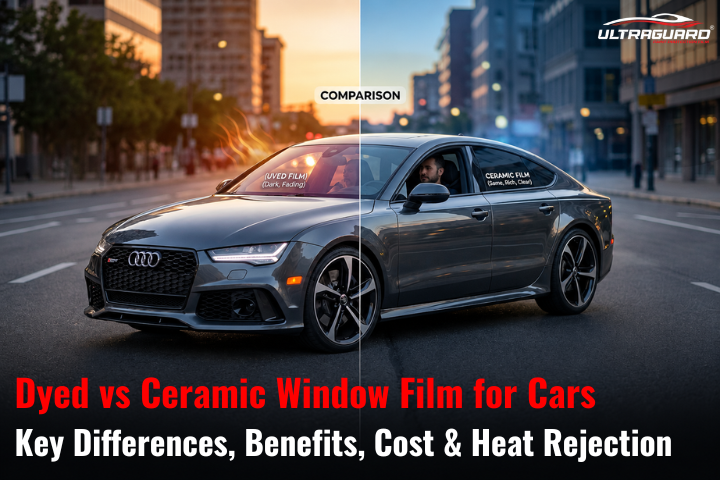
Dyed window tint vs ceramic window tint is a polarizing debate. Our clients, while ordering the window tinting, ask this question repeatedly. Car window films (also known as sun control tints) are ultra-thin laminates that are applied to your car’s windows. Window film also help in reducing the cabin heat by blocking solar energy. Dyed Window Film and Ceramic Window Film are two popular types of window tinting.
The legality of window tints hides in the fine print. Top window tint brands for cars are Ultraguard, 3M and Llumar. In this blog, we discuss what dyed and ceramic window films are, their benefits, and which one to choose.
What is Car Window Film?
Car window films are a thin laminate applied to the interior or exterior of the glass. These films modify light, heat, UV transmission, and privacy. These consist of multi-layer polyester laminates with adhesives and optional coatings. Additional layers are also added based on the type. Car window tints increase efficiency by reducing the cabin temperature. It also holds the glass from shattering in an accident.
Types of Window Films
Common variants of car window tinting:
● Dyed Films: for color and darkening
● Metallized/metal Films: reflect heat, may interfere with signals
● Carbon Films: non-metal, good heat rejection
● Ceramic or IR Films: high heat rejection without metal
What is Dyed Window Film?
Think of it as an entry-level window tint. It is made with a colored dye layer to darken glass, cut glare, and improve privacy. They absorb more solar energy than they reflect. That’s why they don’t have serious heat control but work well with glare. This is the most affordable option but over time, it can fade and turn purple.
Dyed Window Film – Pros and Cons
We have tabulated the advantages and limitations of dyed window tinting film:
| Pros | Cons |
| Budget-friendly | Lower heat rejection |
| Reduces glare for more comfortable driving | Can fade or turn purple over time in strong sunlight |
| Provides a darker, more private cabin | Less effective at keeping the cabin cool |
| Won’t interfere with GPS, mobile, or radio signals | Best for basic styling and comfort rather than premium performance |
Some Quick questions answered by our window tint experts:
Is Dyed Window Film Good?
Yes, it is if you are looking for an affordable option and can compromise on heat control. But they cannot survive in the long term.
How long does Dyed Film last?
Dyed window tints can last 2 to 5 years. But they can change color in the extreme sun.
What is Ceramic Window Film?
Ceramic window tints utilize ceramic nanoparticle technology. They are non-reflective. Ceramic window films stay clear with no haze. Ceramic particles absorb and reflect infrared energy. It also blocks UV rays. It reduces the heat that enters the cabin. Instead of relying on dyed films, this utilizes dense, non-conductive nanoparticles. The non-metalized structure does not interfere with the phone’s signal.
Ceramic Window Film – Pros and Cons
| Pros | Cons |
| Excellent heat rejection | Higher cost than dyed films |
| Blocks harmful UV rays | Performance varies on brands |
| No interference with mobile signals | Check IR and TSER ratings |
| Superior clarity with long-lasting color stability | Poor installation can lead to lifting |
Some Quick questions answered by our window tint experts:
What are the Benefits of Ceramic Window Tint for Cars?
Ceramic window tints’ benefits include higher infrared heat rejection and better optical clarity. They don’t darken the windows as much as dyed ones.
Can you see better at night with a 5% ceramic tint than with a 5% standard tint?
No, no matter the technology, the VLT (Visual Light Transmission) is the same for both films. They let in the same amount of light. But nano ceramic window tint gives better optical clarity. Even so, 5% VLT is very dark. Night visibility will be reduced significantly.
Does the ceramic tint last longer than a standard one?
Yes, Ceramic window films last longer than standard tints. Ceramic window tints can last for more than 10 years if protected properly.
Difference B/w Dyed Window Tint vs Ceramic Window Film?
The difference between ceramic window tints and dyed window tints is the output. Dyed window films darken the glass. Meanwhile, ceramic window films reduce heat entering the cabin. Moneywise, ceramic window films are costlier.
Here we have curated a comparison table:
| Feature | Dyed Tint | Ceramic Tint |
| Heat Rejection | Basic | Excellent |
| UV Protection | Good | Up to 99% |
| Signal Interference | None | None |
| Clarity | Good | Superior |
| Color Stability | May fade over time | Long-lasting |
| Durability | Standard | High |
| Price | Budget-friendly | Premium |
| Best For | Privacy and styling | Maximum comfort and heat reduction |
Is Ceramic or Dyed Tint Better?
Ceramic window films are better than dyed window films if you compare the comfort, heat reduction, and UV rejection. If you just want dark car window films, go for dyed because it serves the goal and is cheap.
Choose ceramic window tinting if you want:
● Cooler cabin temperatures
● Better UV protection
● Durability
In India’s unpredictable weather, ceramic car window films are more popular.
Dyed Window Tint vs Ceramic vs Carbon
Carbon window tints sit between dyed window tints and ceramic films.
Let’s look at the comparison:
| Feature | Dyed Tint | Carbon Tint | Ceramic Tint |
| Heat Rejection | Basic | Good | Excellent |
| UV Protection | Good | Very Good | Up to 99%+ |
| Fade Resistance | May fade over time | Long-lasting | Excellent |
| Signal Interference | None | None | None |
| Appearance | Dark finish | Rich matte finish | Premium clear finish |
| Durability | Standard | High | Highest |
| Price | Budget | Mid-range | Premium |
| Best For | Privacy and styling | Balanced performance | Maximum heat rejection |
Dyed Window Film vs Ceramic Window Film Cost?
Dyed window films are cheaper and start from ₹3,000 to ₹8,000. Ceramic window films are expensive. The cost is around ₹12,000 – ₹35,000.
| Application | Dyed Window Film Cost | Ceramic Window Film Cost |
| Small Hatchback / Sedan | ₹3,000 – ₹6,000 | ₹12,000 – ₹25,000 |
| Mid-size Sedan / SUV | ₹4,000 – ₹8,000 | ₹18,000 – ₹35,000 |
| Front Windshield Strip | ₹1,000 – ₹2,500 | ₹3,000 – ₹7,000 |
We receive clients unsure about the extra price of ceramic tints. Here is a clear answer:
Ceramic Window Tint vs Standard Window Film: Is the price difference worth it?
Yes, Definitely Ceramic window tints are worth every penny. Their heat rejection is excellent. The cabin stays significantly cooler. UV protection and longevity are add-ons. It performs much better than the standard window films and is less likely to fade.
How to Clean Windows with Tinted Film?
Clean tinted windows with an ammonia-free cleaner and a microfibre cloth. You can also use diluted mild dish soap. Do not wash aggressively because it can discolor the tints. Also, wait for 30 days before cleaning after applying the window film. Clean it only in one direction so that the adhesion won’t come off.
Why does heat rejection matter in Car Window Films?
India’s summers are harsh. Add the open parking. Your car traps the heat inside, meaning a hotter cabin. That heat can damage the interiors, including the upholstery. So, many Indian car owners opt for window films and tints to reduce the amount of heat that enters the cabin. But a common misconception that we have seen is that customers think that darker films mean greater heat reduction. The truth? Heat rejection has nothing to do with dark tints. But sometimes it does.
● Visible light contributes about 44% of solar heat.
● Infrared (IR) radiation contributes about 53% of solar heat.
● UV rays contribute about 3% of solar heat.
What is VLT in Ceramic Films?
Here comes the VLT. Visual Light Transmission measures visible light that passes through your car’s glass. For example:
● A window film with 20% VLT lets only 20% of light pass.
● 70% VLT means that 70% of the light can pass.
What is TSER and How does it impact the Heat Rejection in Window Films?
The right way to measure a film’s heat rejection capacity is to measure Total Solar Energy Rejected (TSER). This checks the full solar spectrum of window films. In dyed window films, the light might be reflected but a significant amount of light also passes into the cabin. In ceramic films, IR rejections are excellent. Here is a quick version to understand the technicalities:
| Film Type | TSER | IR Rejection | UV Block | Signal Safe | Lifespan |
| Dyed | 15-25% | 20-30% | 70-80% | Yes | 3-5 years |
| Ceramic | 50-55% | 90-99% | 99% | Yes | Up to 10 years |
A Quick Tip:
You often hear 99% IR rejection when you wanna choose the best window films for car. But remember that IR makes up only 53% of the heat. So instead of falling for the 99 gimmick, look for TSER figure. Because it tells you how much solar energy your film can reject, UV, IR, and VLT combined.
How Much Cooler Can Window Tint Make Your Car?
A high-quality ceramic window tint can noticeably reduce cabin heat. Let’s look at the numbers:
| Area | Temperature Reduction |
| Cabin Air | 5-10°C cooler |
| Dashboard | Up to 20-25°C cooler |
| Steering Wheel | 10-15°C cooler |
| Seats | 8-12°C cooler |
| AC Cool-Down Time | 30-40% faster |
From Scorching to Comfortable
On a 45°C summer day in Delhi or Jaipur, an untinted car parked in direct sunlight can become extremely hot…around 60 to 65°C. A quality ceramic window film can reduce heat build-up even before you switch on the AC.
What to Look for in Window Tint Films?
● TSER: 40%+ (Carbon), 50%+ (Ceramic)
● IRR: High IRR + high TSER means best performance
● UVR: 99% UV protection
● VLT: 70% (Windshield & Rear), 50% (Sides)
● Warranty: 5 years
Is Window Tint Legal in India? The CMVR and RTO Compliance
First, let’s understand the legal and regulatory frameworks of automotive window tints:
● CMVR Rule 100(2): Regulates window film use.
● IS: 2553 (Part 2) – 1992: Safety standard for automotive glass.
● 2012 Supreme Court ruling: Banned black window films.
● 2024 Kerala High Court ruling: Clarified safety glazing film rules.
What are the Legal VLT Limits of Window Tints in India?
On the front windshield, 70% VLT is legal. The rear windshield can also get tinted up to 70%. Only 50% of window tinting is legal on the side windows of the car.
● Front Windshield: 70%
● Rear Windshield: 70%
● Side Windows: 50%
RTO-Approved Car Window Tints
Car window film RTO-approved means that the window tint has been certified and it meets the VLT standard. The film has received BIS certification under IS: 2553. If found not to be complying, you will have to pay a fine of ₹1,000 to ₹5,000. The authorities can also ask to remove the film on the spot.
What are the Best Car Window Films in India?
You will find multiple window tint options in the market. Here we have shortlisted some of the best ones. Ceramic window films are the best for Indian car owners.
The best brands for window tinting are:
● Ultraguard IR Series Window Films
● UltrashieldX Window Tints
● 3M Crystalline series
● Cosmo Sunshield nano-ceramic
● Garware-type sun control films
Why Choose Ultraguard Window Tints?
Ultraguard window films for cars are designed for Indian climates…to fight high temperatures and UV radiation. Backed by the 39-year legacy of the Manmachine Group, Ultraguard offers higher TSER.
Here are the advantages of Ultraguard window tinting:
Our window tint lineup offers 96% IR rejection.
| Specification | Ultraguard Body Ice Window Films |
| Infrared Rejection (IRR) | Up to 95% |
| UV Rejection (UVR) | 99% |
| Warranty | 10 Years |
| Film Thickness | 2 mil |
| Scratch Resistance | >2H Hardness |
| Visible Light Transmission (VLT) Options | 5%, 35%, 55%, 75% |
Ultraguard Window Films’ TSER (Total Solar Energy Rejection)
| VLT (%) | TSER (%) |
| 5% | 75% |
| 35% | 61% |
| 55% | 52% |
| 75% | 42% |
Conclusion
With all the details explained, the difference between dyed window films and ceramic window films shouldn’t have to be complex. Ceramic window tints are the most advanced versions and offer maximum benefit. Whereas dyed tints are mainly for looks, not heat rejection. The budget is a criterion too. But remember that a lower upfront cost can mean lower performance. Investing in a good quality ceramic window film gives you safety, comfort, and protection.
Car Window Film – FAQ’s
Q1. Does tinted window film work at night?
Yes, Tinted window film works at night for heat control but not for privacy. Most tinted window films lose the one-way effect at night because the inside is light and the outside is dark. But it reduces glare even at night.
Q2. How long does window film take to cure?
The window films usually take 2 weeks to cure fully once the installation is complete. But you can roll down the window after 3-5 days.
Q3. Will window film fade over time?
Yes, A low-quality dyed window film can fade after a few months of heat exposure. While ceramic window tints can last up to 10 years. The color starts to turn yellow or purple. You can also notice bubbling and peeling.
Q4. Are tinted windows illegal in India?
In India, tinted windows are illegal. But in enforcement, dark privacy films are the main problem. CMVR rules notify VLT rules for car window tints. Factory-fitted tints are allowed. For aftermarket, heat rejection through legal alternatives is legal.
Q5. Can we use black film on car windows?
Black car window tinting films are illegal in India because they have a lower VLT. The Supreme Court order cited by the Ministry of Home Affairs says no black films can be pasted.


0 Comments